


Metal-poor star formation at z > 6 with JWST: new insight into hard radiation fields and nitrogen enrichment on 20 pc scales
Monthly Notices of the Royal Astronomical Society Oxford University Press (OUP) 529:4 (2024) 3301-3322
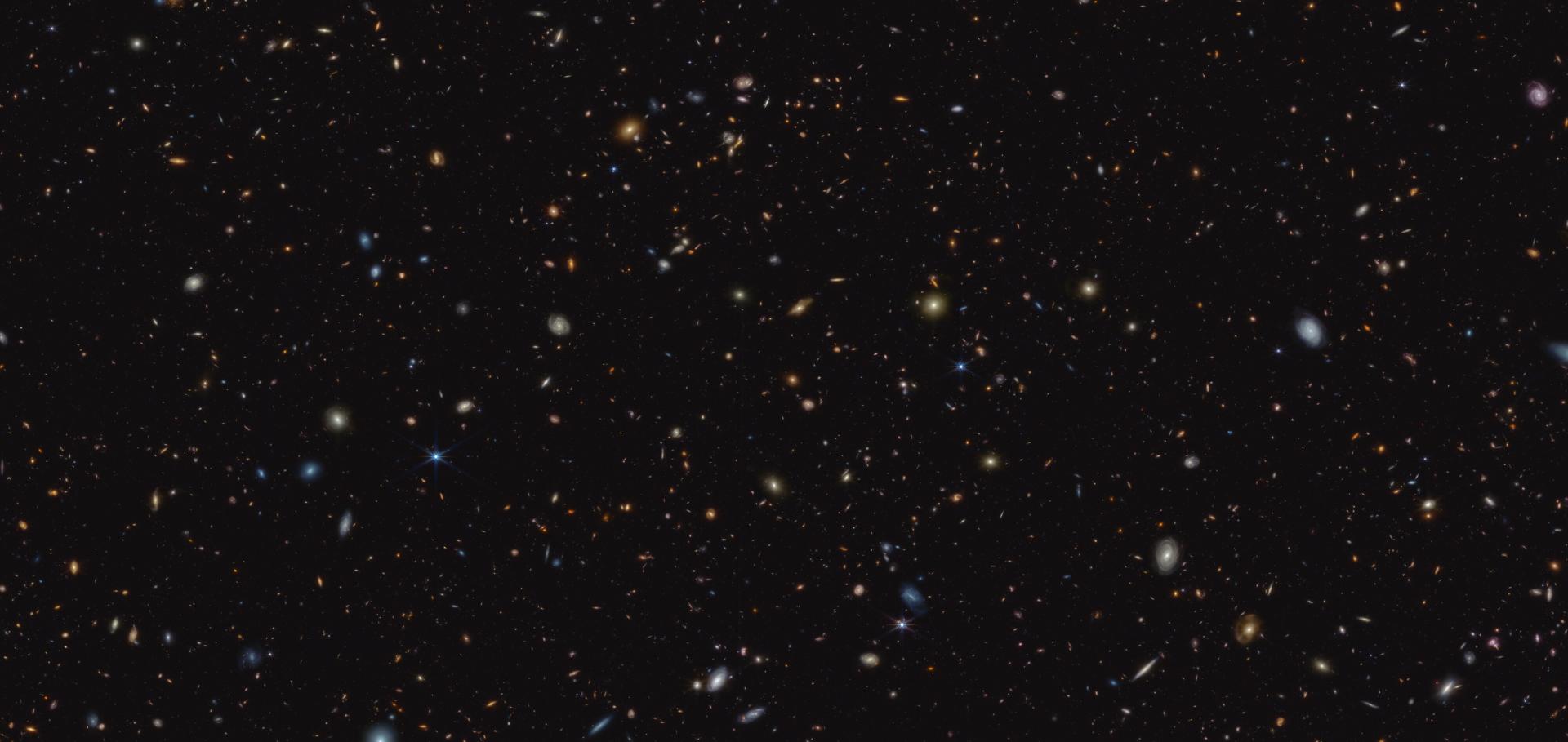
The Cosmos in Its Infancy: JADES Galaxy Candidates at z > 8 in GOODS-S and GOODS-N
The Astrophysical Journal American Astronomical Society 964:1 (2024) 71-71
Abstract:
© 2024. The Author(s). Published by the American Astronomical Society. This is an open access article distributed under the Creative Commons Attribution License, to view a copy of the license, see: https://creativecommons.org/licenses/by/4.0/We present a catalog of 717 candidate galaxies at z > 8 selected from 125 square arcmin of NIRCam imaging as part of the JWST Advanced Deep Extragalactic Survey (JADES). We combine the full JADES imaging data set with data from the JWST Extragalactic Medium Survey and First Reionization Epoch Spectroscopic COmplete Survey (FRESCO) along with extremely deep existing observations from Hubble Space Telescope (HST)/Advanced Camera for Surveys (ACS) for a final filter set that includes 15 JWST/NIRCam filters and five HST/ACS filters. The high-redshift galaxy candidates were selected from their estimated photometric redshifts calculated using a template-fitting approach, followed by visual inspection from seven independent reviewers. We explore these candidates in detail, highlighting interesting resolved or extended sources, sources with very red long-wavelength slopes, and our highest-redshift candidates, which extend to z phot ∼ 18. Over 93% of the sources are newly identified from our deep JADES imaging, including 31 new galaxy candidates at z phot > 12. We also investigate potential contamination by stellar objects, and do not find strong evidence from spectral energy distribution fitting that these faint high-redshift galaxy candidates are low-mass stars. Using 42 sources in our sample with measured spectroscopic redshifts from NIRSpec and FRESCO, we find excellent agreement to our photometric redshift estimates, with no catastrophic outliers and an average difference of 〈Δz = z phot − z spec〉 = 0.26. These sources comprise one of the most robust samples for probing the early buildup of galaxies within the first few hundred million years of the Universe’s history.Peer revieweJADES: The incidence rate and properties of galactic outflows in low-mass galaxies across 3 < z < 9
Astronomy & Astrophysics EDP Sciences 685 (2024) A99-A99
Abstract:
We investigate the incidence and properties of ionised gas outflows in a sample of 52 galaxies with stellar masses between 107 M and 109 M observed with ultra-deep JWST/NIRSpec MSA spectroscopy as part of the JWST Advanced Deep Extragalactic Survey (JADES). The high-spectral resolution (R2700) NIRSpec observations allowed us to identify for the first time the potential signature of outflows in the rest-frame optical nebular lines in low-mass galaxies at z > 4. The incidence fraction of ionised outflows, traced by broad components, is about 25–40%, depending on the intensity of the emission lines. The low incidence fraction might be due to both the sensitivity limit and the fact that outflows are not isotropic, but have a limited opening angle, which only results in detection when this is directed toward our line of sight. Evidence for outflows increases slightly with stellar mass and star formation rate. The median velocity and mass-loading factor (i.e. the ratio of the mass outflow rate and star formation rate) of the outflowing ionised gas are 350 km s−1 and η = 2.0+−1165, respectively. These are 1.5 and 100 times higher than the typical values observed in local dwarf galaxies. Some of these high-redshift outflows can escape the gravitational potential of the galaxy and dark matter halo and enrich the circumgalactic medium and possibly even the intergalactic medium. Our results indicate that outflows can significantly impact the star formation activity in low-mass galaxies within the first 2 Gyr of the UniverseA SPectroscopic survey of biased halos In the Reionization Era (ASPIRE): Impact of Galaxies on the Circumgalactic Medium Metal Enrichment at z > 6 Using the JWST and VLT
The Astrophysical Journal Letters American Astronomical Society 963:1 (2024) L28-L28
Abstract:
Large scale structure and cosmologyGalaxieGA-NIFS: JWST/NIRSpec integral field unit observations of HFLS3 reveal a dense galaxy group at z ∼6.3
Astronomy & Astrophysics EDP Sciences 682 (2024) A122