

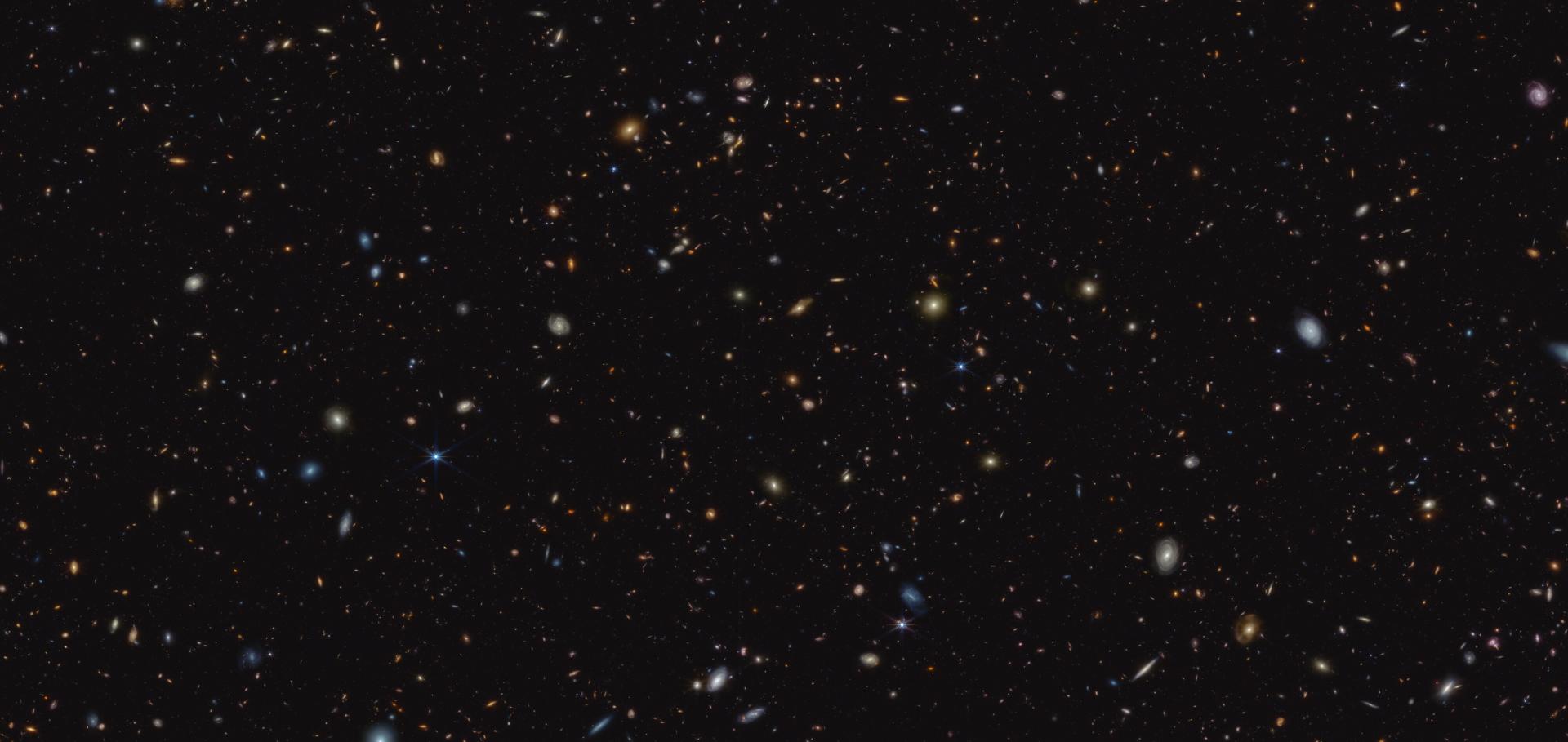

JADES Data Release 3: NIRSpec/Microshutter Assembly Spectroscopy for 4000 Galaxies in the GOODS Fields
The Astrophysical Journal: Supplement Series American Astronomical Society 277:1 (2025) 4
Abstract:
We present the third data release of the JWST Advanced Deep Extragalactic Survey (JADES), providing both imaging and spectroscopy in the two GOODS fields. Spectroscopy consists of medium-depth and deep NIRSpec/microshutter assembly spectra of 4000 targets, covering the spectral range 0.6–5.3 μm and observed with both the low-dispersion prism (R = 30–300) and all three medium-resolution gratings (R = 500–1500). We describe the observations, data reduction, sample selection, and target allocation. We measured 2375 redshifts (2053 from multiple emission lines); our targets span the range from z = 0.5 up to z = 13, including 404 at z > 5. The data release includes 2D and 1D fully reduced spectra, with slit-loss corrections and background subtraction optimized for point sources. We also provide redshifts and signal-to-noise ratio > 5 emission-line flux catalogs for the prism and grating spectra, and concise guidelines on how to use these data products. Alongside spectroscopy, we are also publishing fully calibrated NIRCam imaging, which enables studying the JADES sample with the combined power of imaging and spectroscopy. Together, these data provide the largest statistical sample to date to characterize the properties of galaxy populations in the first billion years after the Big Bang.Improved SED-fitting Assumptions Result in Inside-out Quenching at z ~ 0.5 and Quenching at All Radii Simultaneously at z ~ 1
The Astrophysical Journal American Astronomical Society 980:2 (2025) 168
Abstract:
Many studies conclude that galaxies quench from the inside-out by examining profiles of specific star formation rate (sSFR). These are usually measured by fitting spectral energy distributions (SEDs) assuming a fixed dust law and uniform priors on all parameters. Here, we examine the effects of more physically motivated priors: a flexible dust law, an exponential prior on the dust attenuation AV, and Gaussian priors that favor extended star formation histories. This results in model colors that better trace observations. We then perform radial SED fits to multiband flux profiles measured from Hubble Space Telescope images for 1440 galaxies at 0.4 < z < 1.5 of stellar masses 1010–1011.5M⊙ using both the traditional and the more physically motivated assumptions. The latter results in star formation rate and AV profiles that agree with measurements from spectroscopy and AV profiles that behave correctly as a function of inclination. Since green valley galaxies at z ∼ 1.3 are expected to evolve into quiescent galaxies at z ∼ 0.9, we compare their sSFR profiles using the more physically motivated assumptions. Their slopes are similar at all masses (0.06–0.08 dex kpc−1), and the normalizations for the quiescent galaxies are lower. Therefore, the sSFR profiles decline with time as quenching occurs at all radii simultaneously. We compare profiles of green valley galaxies at z ∼ 0.9 and quiescent galaxies at z ∼ 0.5. The former are shallower at all masses by ~0.1 dex kpc−1. The sSFR profiles steepen with time as galaxies quench from the inside-out. In summary, galaxies at z ∼ 1 quench at all radii simultaneously while galaxies at z ∼ 0.7 quench from the inside-out.The Relation between AGN and Host-galaxy Properties in the JWST Era. I. Seyferts at Cosmic Noon are Obscured and Disturbed
The Astrophysical Journal American Astronomical Society 978:1 (2024) 74
Abstract:
The morphology of a galaxy reflects the mix of physical processes occurring within and around it, offering indirect clues to its formation and evolution. We apply both visual classification and computer vision to test the suspected connection between galaxy mergers and active galactic nucleus (AGN) activity, as evidenced by a close/merging galaxy pair, or tidal features surrounding an apparently singular system. We use JADES JWST/NIRCam imagery of a complete, multiwavelength AGN sample recently expanded with JWST/Mid-Infrared Instrument (MIRI) photometry. This 0.9–25 μm data set enables constraints on the host-galaxy morphologies of a broad range of AGN beyond z ∼ 1, including heavily obscured examples missing from previous studies. Our primary AGN sample consists of 243 lightly to highly obscured X-ray-selected AGN and 138 presumed Compton-thick, mid-infrared-bright/X-ray-faint AGN revealed by MIRI. Utilizing the shape asymmetry morphology indicator, AS, as the metric for disturbance, we find that 88% of the Seyferts sampled are strongly spatially disturbed (AS > 0.2). The experimental design we employ reveals a ≳3σ obscuration–merger (NH–AS) correlation at 0.6 < z < 2.4, and also recovers a physical distinction between the X-ray- and mid-IR-detected AGN suggestive of their link to a common evolutionary scenario. Placing the observed pattern of disturbances in the context of the other average host-galaxy properties, we conclude that mergers are common among obscured AGN. This finding presents tension with the leading model on AGN fueling that requires Seyfert AGN with subquasar luminosities (Lbol < 1045 erg s−1) to evolve only through nonmerger mechanisms.Searching for Emission Lines at z > 11: The Role of Damped Lyα and Hints About the Escape of Ionizing Photons
The Astrophysical Journal American Astronomical Society 976:2 (2024) 160
JADES: Primaeval Lyman-α emitting galaxies reveal early sites of reionisation out to redshift z ∼ 9
Monthly Notices of the Royal Astronomical Society Oxford University Press (OUP) (2024) stae2535