Home
Department Of Physics text logo
  • Research
    • Our research
    • Our research groups
    • Our research in action
    • Research funding support
    • Summer internships for undergraduates
  • Study
    • Undergraduates
    • Postgraduates
  • Engage
    • For alumni
    • For business
    • For schools
    • For the public
  • Support
Menu
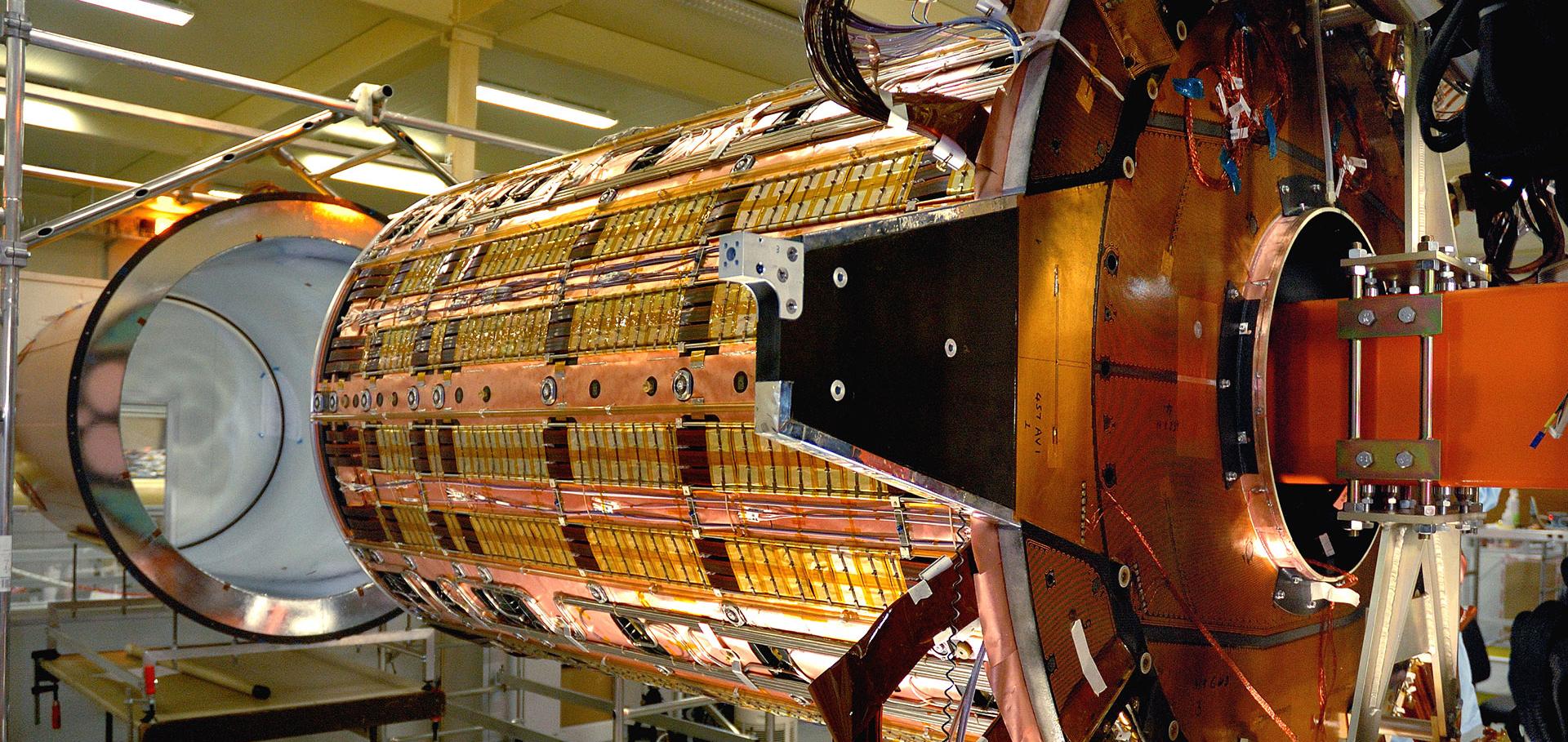
Insertion of STC into TRT at the Department of Physics, Oxford
Credit: CERN

Professor Amanda Cooper-Sarkar

Emeritus Professor

Research theme

  • Fundamental particles and interactions

Sub department

  • Particle Physics

Research groups

  • ATLAS
Amanda.Cooper-Sarkar@physics.ox.ac.uk
Telephone: 01865 (2)73406
Denys Wilkinson Building, room 659
  • About
  • Publications

HERAPDF fits including F2(charm) data

Proceedings of Science (2010)

Abstract:

PDF fits in the HERAPDF1.0 formalism have been made to the combined HERA-I inclusive data and the combined F2(charm) data from the H1 and ZEUS experiments. The charm data are found to be sensitive to the value of the charm mass and the choice of the heavy quark scheme. This has consequences for the predictions of W and Z cross-sections at the LHC. © Copyright owned by the author(s) under the terms of the Creative Commons Attribution-NonCommercial- ShareAlike Licence.

Inclusive dijet cross sections in neutral current deep inelastic scattering at HERA

European Physical Journal C 70:4 (2010) 965-982

Authors:

H Abramowicz, I Abt, L Adamczyk, M Adamus, R Aggarwal, S Antonelli, P Antonioli, A Antonov, M Arneodo, V Aushev, Y Aushev, O Bachynska, A Bamberger, AN Barakbaev, G Barbagli, G Bari, F Barreiro, D Bartsch, M Basile, O Behnke, J Behr, U Behrens, L Bellagamba, A Bertolin, S Bhadra, M Bindi, C Blohm, V Bokhonov, T Bołd, EG Boos, K Borras, D Boscherini, D Bot, SK Boutle, I Brock, E Brownson, R Brugnera, N Brümmer, A Bruni, G Bruni, B Brzozowska, PJ Bussey, JM Butterworth, B Bylsma, A Caldwell, M Capua, R Carlin, CD Catterall, S Chekanov, J Chwastowski, J Ciborowski, R Ciesielski, L Cifarelli, F Cindolo, A Contin, AM Cooper-Sarkar, N Coppola, M Corradi, F Corriveau, M Costa, G D'Agostini, F Dal Corso, J del Peso, RK Dementiev, S De Pasquale, M Derrick, RCE Devenish, D Dobur, BA Dolgoshein, G Dolinska, AT Doyle, V Drugakov, LS Durkin, S Dusini, Y Eisenberg, PF Ermolov, A Eskreys, S Fang, S Fazio, J Ferrando, MI Ferrero, J Figiel, M Forrest, B Foster, S Fourletov, G Gach, A Galas, E Gallo, A Garfagnini, A Geiser, I Gialas, LK Gladilin, D Gladkov, C Glasman, O Gogota, YA Golubkov, P Göttlicher, I Grabowska-Bołd, J Grebenyuk, I Gregor

Abstract:

Single- and double-differential inclusive dijet cross sections in neutral current deep inelastic ep scattering have been measured with the ZEUS detector using an integrated luminosity of 374 pb-1. The measurement was performed at large values of the photon virtuality, Q2, between 125 and 20 000 GeV2. The jets were reconstructed with the kT cluster algorithm in the Breit reference frame and selected by requiring their transverse energies in the Breit frame, ET,Bjet, to be larger than 8 GeV. In addition, the invariant mass of the dijet system, Mjj, was required to be greater than 20 GeV. The cross sections are described by the predictions of next-to-leading-order QCD. © 2010 The Author(s).
More details from the publisher

Measurement of high-Q2 charged current deep inelastic scattering cross sections with a longitudinally polarised positron beam at HERA

European Physical Journal C 70:4 (2010) 945-963

Authors:

H Abramowicz, I Abt, L Adamczyk, M Adamus, R Aggarwal, S Antonelli, P Antonioli, A Antonov, M Arneodo, V Aushev, Y Aushev, O Bachynska, A Bamberger, AN Barakbaev, G Barbagli, G Bari, F Barreiro, D Bartsch, M Basile, O Behnke, J Behr, U Behrens, L Bellagamba, A Bertolin, S Bhadra, M Bindi, C Blohm, V Bokhonov, T Bołd, EG Boos, K Borras, D Boscherini, D Bot, SK Boutle, I Brock, E Brownson, R Brugnera, N Brümmer, A Bruni, G Bruni, B Brzozowska, PJ Bussey, JM Butterworth, B Bylsma, A Caldwell, M Capua, R Carlin, CD Catterall, S Chekanov, J Chwastowski, J Ciborowski, R Ciesielski, L Cifarelli, F Cindolo, A Contin, AM Cooper-Sarkar, N Coppola, M Corradi, F Corriveau, M Costa, G D'Agostini, F Dal Corso, J del Peso, RK Dementiev, S De Pasquale, M Derrick, RCE Devenish, D Dobur, BA Dolgoshein, G Dolinska, AT Doyle, V Drugakov, LS Durkin, S Dusini, Y Eisenberg, PF Ermolov, A Eskreys, S Fang, S Fazio, J Ferrando, MI Ferrero, J Figiel, M Forrest, B Foster, S Fourletov, G Gach, A Galas, E Gallo, A Garfagnini, A Geiser, I Gialas, LK Gladilin, D Gladkov, C Glasman, O Gogota, YA Golubkov, P Göttlicher, I Grabowska-Bołd, J Grebenyuk, I Gregor

Abstract:

Measurements of the cross sections for charged current deep inelastic scattering in e+p collisions with a longitudinally polarised positron beam are presented. The measurements are based on a data sample with an integrated luminosity of 132 pb-1 collected with the ZEUS detector at HERA at a centre-of-mass energy of 318 GeV. The total cross section is presented at positive and negative values of the longitudinal polarisation of the positron beams. The single-differential cross-sections dσ/dQ2, dσ/dx and dσ/dy are presented for Q2>200 GeV2. The reduced cross-section σ̃ is presented in the kinematic range 200
More details from the publisher
Details from ORA

Readiness of the ATLAS Tile Calorimeter for LHC collisions

European Physical Journal C 70:4 (2010) 1193-1236

Authors:

G Aad, B Abbott, J Abdallah, AA Abdelalim, A Abdesselam, O Abdinov, B Abi, M Abolins, H Abramowicz, H Abreu, BS Acharya, DL Adams, TN Addy, J Adelman, C Adorisio, P Adragn, T Adye, S Aefsky, JA Aguilar-Saavedra, M Aharrouche, SP Ahlen, F Ahles, A Ahmad, M Ahsan, G Aielli, T Akdogan, TPA Åkesson, G Akimoto, AV Akimov, A Aktas, MS Alam, MA Alam, S Albrand, M Aleksa, IN Aleksandrov, C Alexa, G Alexander, G Alexandre, T Alexopoulos, M Alhroob, M Aliev, G Alimontia, J Alison, M Aliyev, PP Allport, SE Allwood-Spiers, J Almond, A Aloisio, R Alon, A Alonso, MG Alviggi, K Amako, C Amelung, A Amorima, G Amorós, N Amram, C Anastopoulos, T Andeen, CF Anders, KJ Anderson, A Andreazzaa, V Andreia, XS Anduaga, A Angerami, F Anghinolfi, N Anjosa, A Annovi, A Antonaki, M Antonelli, S Antonellia, J Antos, B Antunovic, F Anullia, S Aoun, G Arabidze, I Aracena, Y Arai, ATH Arce, JP Archambault, S Arfaoui, JF Arguin, T Argyropoulos, M Arika, AJ Armbruster, O Arnaez, C Arnault, A Artamonov, D Arutinov, M Asai, S Asai, R Asfandiyarov, S Ask, B Åsmana, D Asner, L Asquith, K Assamagan, A Astvatsatourov, G Atoian, B Auerbach, K Augsten

Abstract:

The Tile hadronic calorimeter of the ATLAS detector has undergone extensive testing in the experimental hall since its installation in late 2005. The readout, control and calibration systems have been fully operational since 2007 and the detector has successfully collected data from the LHC single beams in 2008 and first collisions in 2009. This paper gives an overview of the Tile Calorimeter performance as measured using random triggers, calibration data, data from cosmic ray muons and single beam data. The detector operation status, noise characteristics and performance of the calibration systems are presented, as well as the validation of the timing and energy calibration carried out with minimum ionising cosmic ray muons data. The calibration systems' precision is well below the design value of 1%. The determination of the global energy scale was performed with an uncertainty of 4%. © 2010 CERN for the benefit of the ATLAS collaboration.
More details from the publisher
More details

Readiness of the ATLAS liquid argon calorimeter for LHC collisions

European Physical Journal C 70:3 (2010) 723-753

Authors:

The ATLAS Collaboration, G Aad, B Abbott, J Abdallah, AA Abdelalim, A Abdesselam, O Abdinov, B Abi, M Abolins, H Abramowicz, H Abreu, BS Acharya, DL Adams, TN Addy, J Adelman, C Adorisio, P Adragna, T Adye, S Aefsky, JA Aguilar-Saavedra, M Aharrouche, SP Ahlen, F Ahles, A Ahmad, H Ahmed, M Ahsan, G Aielli, T Akdogan, TPA Åkesson, G Akimoto, AV Akimov, A Aktas, MS Alam, MA Alam, J Albert, S Albrand, M Aleksa, IN Aleksandrov, F Alessandria, C Alexa, G Alexander, G Alexandre, T Alexopoulos, M Alhroob, M Aliev, G Alimonti, J Alison, M Aliyev, PP Allport, SE Allwood-Spiers, J Almond, A Aloisio, R Alon, A Alonso, MG Alviggi, K Amako, C Amelung, VV Ammosov, A Amorim, G Amorós, N Amram, C Anastopoulos, T Andeen, CF Anders, KJ Anderson, A Andreazza, V Andrei, XS Anduaga, A Angerami, F Anghinolfi, N Anjos, A Antonaki, M Antonelli, S Antonelli, B Antunovic, F Anulli, S Aoun, G Arabidze, I Aracena, Y Arai, ATH Arce, JP Archambault, S Arfaoui, JF Arguin, T Argyropoulos, E Arik, M Arik, AJ Armbruster, O Arnaez, C Arnault, A Artamonov, D Arutinov, M Asai, S Asai, R Asfandiyarov, S Ask, B Åsman, D Asner, L Asquith, K Assamagan

Abstract:

The ATLAS liquid argon calorimeter has been operating continuously since August 2006. At this time, only part of the calorimeter was readout, but since the beginning of 2008, all calorimeter cells have been connected to the ATLAS readout system in preparation for LHC collisions. This paper gives an overview of the liquid argon calorimeter performance measured in situ with random triggers, calibration data, cosmic muons, and LHC beam splash events. Results on the detector operation, timing performance, electronics noise, and gain stability are presented. High energy deposits from radiative cosmic muons and beam splash events allow to check the intrinsic constant term of the energy resolution. The uniformity of the electromagnetic barrel calorimeter response along η (averaged over Φ) is measured at the percent level using minimum ionizing cosmic muons. Finally, studies of electromagnetic showers from radiative muons have been used to cross-check the Monte Carlo simulation. The performance results obtained using the ATLAS readout, data acquisition, and reconstruction software indicate that the liquid argon calorimeter is well-prepared for collisions at the dawn of the LHC era. © 2010 CERN for the benefit of the ATLAS collaboration.
More details from the publisher
More details

Pagination

  • First page First
  • Previous page Prev
  • …
  • Page 501
  • Page 502
  • Page 503
  • Page 504
  • Current page 505
  • Page 506
  • Page 507
  • Page 508
  • Page 509
  • …
  • Next page Next
  • Last page Last

Footer Menu

  • Contact us
  • Giving to the Dept of Physics
  • Work with us
  • Media

User account menu

  • Log in

Follow us

FIND US

Clarendon Laboratory,

Parks Road,

Oxford,

OX1 3PU

CONTACT US

Tel: +44(0)1865272200

University of Oxfrod logo Department Of Physics text logo
IOP Juno Champion logo Athena Swan Silver Award logo

© University of Oxford - Department of Physics

Cookies | Privacy policy | Accessibility statement

Built by: Versantus

  • Home
  • Research
  • Study
  • Engage
  • Our people
  • News & Comment
  • Events
  • Our facilities & services
  • About us
  • Giving to Physics
  • Current students
  • Staff intranet