Home
Department Of Physics text logo
  • Research
    • Our research
    • Our research groups
    • Our research in action
    • Research funding support
    • Summer internships for undergraduates
  • Study
    • Undergraduates
    • Postgraduates
  • Engage
    • For alumni
    • For business
    • For schools
    • For the public
  • Support
Menu
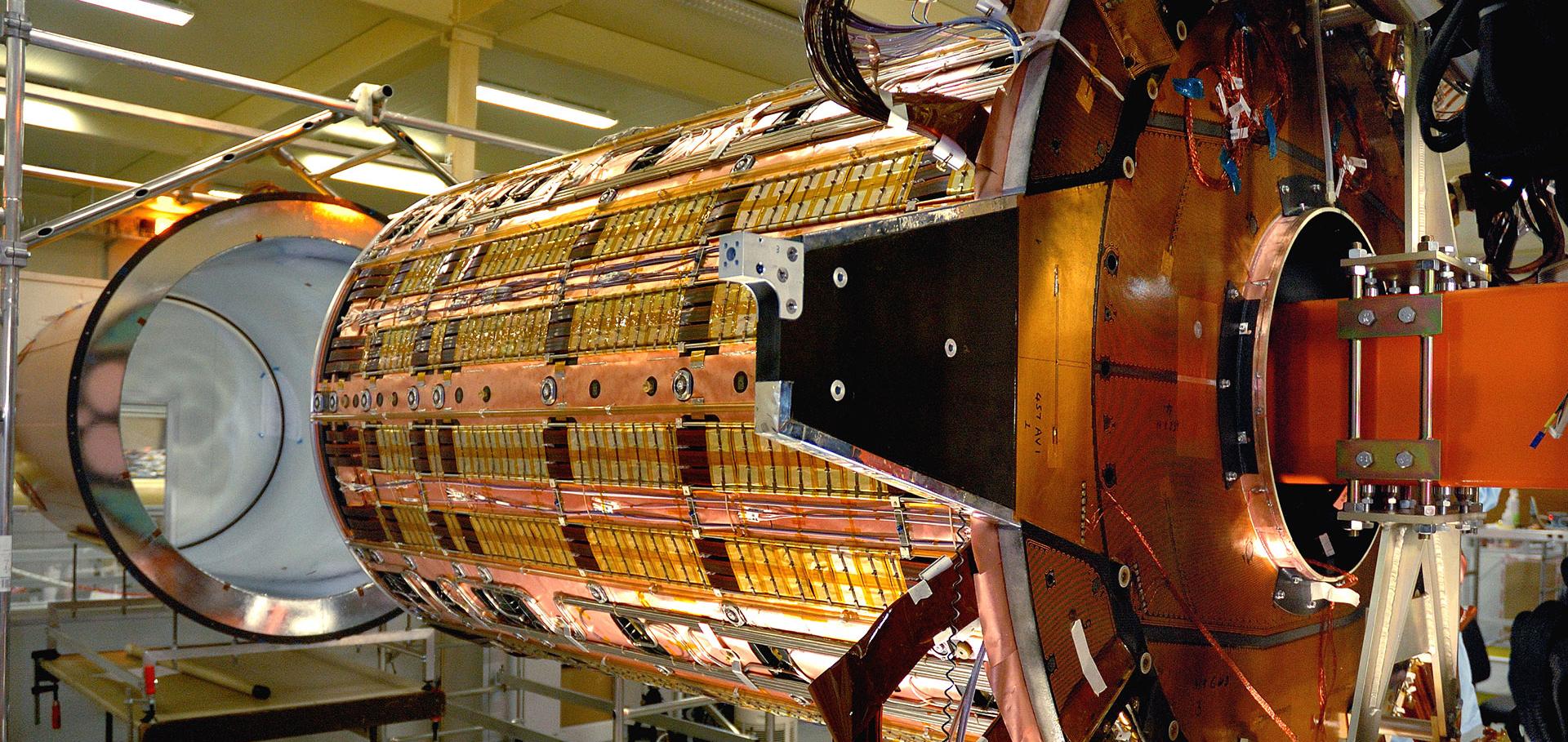
Insertion of STC into TRT at the Department of Physics, Oxford
Credit: CERN

Professor Amanda Cooper-Sarkar

Emeritus Professor

Research theme

  • Fundamental particles and interactions

Sub department

  • Particle Physics

Research groups

  • ATLAS
Amanda.Cooper-Sarkar@physics.ox.ac.uk
Telephone: 01865 (2)73406
Denys Wilkinson Building, room 659
  • About
  • Publications

Deep inelastic scattering with leading protons or large rapidity gaps at HERA

Nuclear Physics B 816:1-2 (2009) 1-61

Authors:

S Chekanov, M Derrick, S Magill, B Musgrave, D Nicholass, J Repond, R Yoshida, MCK Mattingly, P Antonioli, G Bari, L Bellagamba, D Boscherini, A Bruni, G Bruni, G Cara Romeo, F Cindolo, M Corradi, G Iacobucci, A Margotti, T Massam, R Nania, A Polini, S Antonelli, M Basile, M Bindi, L Cifarelli, A Contin, F Palmonari, S De Pasquale, G Sartorelli, A Zichichi, D Bartsch, I Brock, H Hartmann, E Hilger, HP Jakob, M Jüngst, AE Nuncio-Quiroz, E Paul, U Samson, V Schönberg, R Shehzadi, M Wlasenko, NH Brook, GP Heath, JD Morris, M Kaur, P Kaur, I Singh, M Capua, S Fazio, A Mastroberardino, M Schioppa, G Susinno, E Tassi, JY Kim, ZA Ibrahim, FM Idris, B Kamaluddin, WATW Abdullah, Y Ning, Z Ren, F Sciulli, J Chwastowski, A Eskreys, J Figiel, A Galas, K Olkiewicz, B Pawlik, P Stopa, L Zawiejski, L Adamczyk, T Bołd, I Grabowska-Bołd, D Kisielewska, J Łukasik, M Przybycień, L Suszycki, A Kotański, W Słomiński, O Behnke, U Behrens, C Blohm, A Bonato, K Borras, D Bot, R Ciesielski, N Coppola, S Fang, J Fourletova, A Geiser, P Göttlicher, J Grebenyuk, I Gregor, T Haas, W Hain, A Hüttmann, F Januschek, B Kahle, II Katkov

Abstract:

The dissociation of virtual photons, γ{star operator} p → X p, in events with a large rapidity gap between X and the outgoing proton, as well as in events in which the leading proton was directly measured, has been studied with the ZEUS detector at HERA. The data cover photon virtualities Q2 > 2   GeV2 and γ{star operator} p centre-of-mass energies 40 < W < 240   GeV, with MX > 2   GeV, where MX is the mass of the hadronic final state, X. Leading protons were detected in the ZEUS leading proton spectrometer. The cross section is presented as a function of t, the squared four-momentum transfer at the proton vertex and Φ, the azimuthal angle between the positron scattering plane and the proton scattering plane. It is also shown as a function of Q2 and xP, the fraction of the proton's momentum carried by the diffractive exchange, as well as β, the Bjorken variable defined with respect to the diffractive exchange. © 2009 Elsevier B.V.
More details from the publisher

Multi-Leptons with High Transverse Momentum at HERA

ArXiv 0907.3627 (2009)

Authors:

The H1 Collaboration, the ZEUS Collaboration
Details from ArXiV

A QCD analysis of ZEUS data including DIS inclusive cross sections with longitudinally polarised leptons and data run at lower proton beam energies

(2009)
More details from the publisher
Details from ArXiV

Measurement of beauty production from dimuon events at HERA

Journal of High Energy Physics 2009:2 (2009)

Authors:

S Chekanov, M Derrick, S Magill, B Musgrave, D Nicholass, J Repond, R Yoshida, MCK Mattingly, P Antonioli, G Bari, L Bellagamba, D Boscherini, A Bruni, G Bruni, F Cindolo, M Corradi, G Iacobucci, A Margotti, R Nania, A Polini, S Antonelli, M Basile, M Bindi, L Cifarelli, A Contin, S De Pasquale, G Sartorelli, A Zichichi, D Bartsch, I Brock, H Hartmann, E Hilger, HP Jakob, M Jungst, AE Nuncio-Quiroz, E Paul, U Samson, V Schonberg, R Shehzadi, M Wlasenko, NH Brook, GP Heath, JD Morris, M Kaur, P Kaur, I Singh, M Capua, S Fazio, A Mastroberardino, M Schioppa, G Susinno, E Tassi, JY Kim, ZA Ibrahim, B Kamaluddin, WAT Wan Abdullah, Y Ning, Z Ren, F Sciulli, J Chwastowski, A Eskreys, J Figiel, A Galas, K Olkiewicz, P Stopa, L Zawiejski, L Adamczyk, T Bold, I Grabowska-Bold, D Kisielewska, J Lukasik, M Przybycien, L Suszycki, A Kotanski, WS Lominski, O Behnke, U Behrens, I Bloch, C Blohm, A Bonato, K Borras, D Bot, R Ciesielski, N Coppola, S Fang, J Fourletova, A Geiser, P Gottlicher, J Grebenyuk, I Gregor, O Gutsche, T Haas, W Hain, A Huttmann, F Januschek, B Kahle, II Katkov, U Klein, U Kotz, H Kowalski

Abstract:

Beauty production in events containing two muons in the final state has been measured with the ZEUS detector at HERA using an integrated luminosity of 114 pb-1. A low transverse-momentum threshold for muon identification, in combination with the large rapidity coverage of the ZEUS muon system, gives access to almost the full phase space for beauty production. The total cross section for beauty production in ep collisions at (s)1/2 = 318 GeV has been measured to be σtot(ep bX) = 13.9 1.5(stat.)+4.0-4.3(syst.)nb. Differential cross sections and a measurement of b correlations are also obtained, and compared to other beauty cross-section measurements, Monte Carlo models and next-to-leading-order QCD predictions. © 2009 SISSA.
More details from the publisher

Measurement of $J/ψ$ helicity distributions in inelastic photoproduction at HERA

ArXiv 0906.1424 (2009)
Details from ArXiV

Pagination

  • First page First
  • Previous page Prev
  • …
  • Page 518
  • Page 519
  • Page 520
  • Page 521
  • Current page 522
  • Page 523
  • Page 524
  • Page 525
  • Page 526
  • …
  • Next page Next
  • Last page Last

Footer Menu

  • Contact us
  • Giving to the Dept of Physics
  • Work with us
  • Media

User account menu

  • Log in

Follow us

FIND US

Clarendon Laboratory,

Parks Road,

Oxford,

OX1 3PU

CONTACT US

Tel: +44(0)1865272200

University of Oxfrod logo Department Of Physics text logo
IOP Juno Champion logo Athena Swan Silver Award logo

© University of Oxford - Department of Physics

Cookies | Privacy policy | Accessibility statement

Built by: Versantus

  • Home
  • Research
  • Study
  • Engage
  • Our people
  • News & Comment
  • Events
  • Our facilities & services
  • About us
  • Giving to Physics
  • Current students
  • Staff intranet