Home
Department Of Physics text logo
  • Research
    • Our research
    • Our research groups
    • Our research in action
    • Research funding support
    • Summer internships for undergraduates
  • Study
    • Undergraduates
    • Postgraduates
  • Engage
    • For young people
    • For teachers
    • For the public
    • For alumni
    • For business
  • Support
Menu
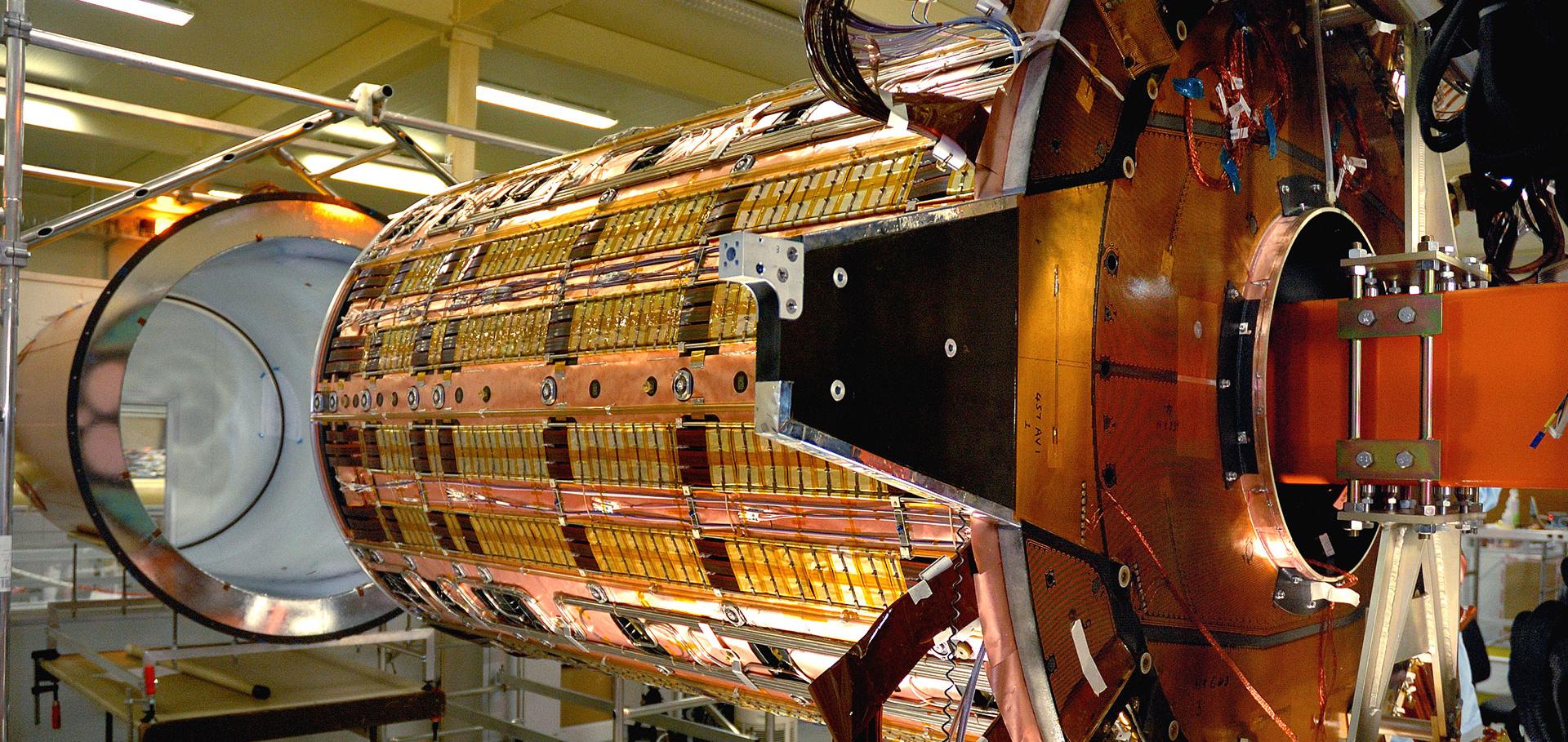
Insertion of STC into TRT at the Department of Physics, Oxford
Credit: CERN

Professor Amanda Cooper-Sarkar

Emeritus Professor

Research theme

  • Fundamental particles and interactions

Sub department

  • Particle Physics

Research groups

  • ATLAS
Amanda.Cooper-Sarkar@physics.ox.ac.uk
Telephone: 01865 (2)73406
Denys Wilkinson Building, room 659
  • About
  • Publications

Measurement of isolated photon production in deep inelastic ep scattering

Physics Letters, Section B: Nuclear, Elementary Particle and High-Energy Physics 687:1 (2010) 16-25

Authors:

S Chekanov, M Derrick, S Magill, B Musgrave, D Nicholass, J Repond, R Yoshida, MCK Mattingly, P Antonioli, G Bari, L Bellagamba, D Boscherini, A Bruni, G Bruni, F Cindolo, M Corradi, G Iacobucci, A Margotti, R Nania, A Polini, S Antonelli, M Basile, M Bindi, L Cifarelli, A Contin, S De Pasquale, G Sartorelli, A Zichichi, D Bartsch, I Brock, H Hartmann, E Hilger, HP Jakob, M Jüngst, AE Nuncio-Quiroz, E Paul, U Samson, V Schönberg, R Shehzadi, M Wlasenko, JD Morris, M Kaur, P Kaur, I Singh, M Capua, S Fazio, A Mastroberardino, M Schioppa, G Susinno, E Tassi, JY Kim, ZA Ibrahim, FM Idris, B Kamaluddin, WATW Abdullah, Y Ning, Z Ren, F Sciulli, J Chwastowski, A Eskreys, J Figiel, A Galas, K Olkiewicz, B Pawlik, P Stopa, L Zawiejski, L Adamczyk, T Bołd, I Grabowska-Bołd, D Kisielewska, J Łukasik, M Przybycień, L Suszycki, A Kotański, W Słomiński, O Bachynska, O Behnke, J Behr, U Behrens, C Blohm, K Borras, D Bot, R Ciesielski, N Coppola, S Fang, A Geiser, P Göttlicher, J Grebenyuk, I Gregor, T Haas, W Hain, A Hüttmann, F Januschek, B Kahle, II Katkov, U Klein, U Kötz, H Kowalski, V Libov, M Lisovyi

Abstract:

Isolated photon production in deep inelastic ep scattering has been measured with the ZEUS detector at HERA using an integrated luminosity of 320 pb - 1. Measurements were made in the isolated-photon transverse-energy and pseudorapidity ranges 4 < E Tγ < 15 GeV and - 0.7 < η γ < 0.9 for exchanged photon virtualities, Q 2, in the range 10 < Q 2 < 350 GeV 2 and for invariant masses of the hadronic system W X > 5 GeV. Differential cross sections are presented for inclusive isolated photon production as functions of Q 2, x, E Tγ and η γ. Leading-logarithm parton-shower Monte Carlo simulations and perturbative QCD predictions give a reasonable description of the data over most of the kinematic range. © 2010 Elsevier B.V.
More details from the publisher

A posteriori inclusion of parton density functions in NLO QCD final-state calculations at hadron colliders: The APPLGRID project

European Physical Journal C 66:3 (2010) 503-524

Authors:

T Carli, D Clements, A Cooper-Sarkar, C Gwenlan, GP Salam, F Siegert, P Starovoitov, M Sutton

Abstract:

A method to facilitate the consistent inclusion of cross-section measurements based on complex final-states from HERA, TEVATRON and the LHC in proton parton density function (PDF) fits has been developed. This can be used to increase the sensitivity of LHC data to deviations from Standard Model predictions. The method stores perturbative coefficients of NLO QCD calculations of final-state observables measured in hadron colliders in look-up tables. This allows the a posteriori inclusion of parton density functions (PDFs), and of the strong coupling, as well as the a posteriori variation of the renormalisation and factorisation scales in cross-section calculations. The main novelties in comparison to original work on the subject are the use of higher-order interpolation of Lagrangian form, which substantially improves the trade-off between accuracy and memory use, and a CPU and computer memory optimised way to construct and store the look-up table using modern software tools. It is demonstrated that a sufficient accuracy on the cross-section calculation can be achieved with reasonably small look-up table size by using the examples of jet production and electro-weak boson (Z, W) production in proton-proton collisions at a center-of-mass energy of 14 TeV at the LHC. The use of this technique in PDF fitting is demonstrated in a PDF-fit to HERA data and simulated LHC jet cross-sections as well as in a study of the jet cross-section uncertainties at various centre-of-mass energies. © Springer-Verlag / Società Italiana di Fisica 2010.
More details from the publisher
Details from ORA
More details
Details from ArXiV

Charged-particle multiplicities in pp interactions at sqrt(s) = 900 GeV measured with the ATLAS detector at the LHC

ArXiv 1003.3124 (2010)
Details from ArXiV

Inclusive-jet cross sections in NC DIS at HERA and a comparison of the kT, anti-kT and SIScone jet algorithms

ArXiv 1003.2923 (2010)

Authors:

The ZEUS Collaboration, H Abramowicz
Details from ArXiV

Measurement of dijet photoproduction for events with a leading neutron at HERA

Nuclear Physics B 827:1-2 (2010) 1-33

Authors:

S Chekanov, M Derrick, S Magill, B Musgrave, D Nicholass, J Repond, R Yoshida, MCK Mattingly, P Antonioli, G Bari, L Bellagamba, D Boscherini, A Bruni, G Bruni, F Cindolo, M Corradi, G Iacobucci, A Margotti, R Nania, A Polini, S Antonelli, M Basile, M Bindi, L Cifarelli, A Contin, S De Pasquale, G Sartorelli, A Zichichi, D Bartsch, I Brock, H Hartmann, E Hilger, HP Jakob, M Jüngst, AE Nuncio-Quiroz, E Paul, U Samson, V Schönberg, R Shehzadi, M Wlasenko, JD Morris, M Kaur, P Kaur, I Singh, M Capua, S Fazio, A Mastroberardino, M Schioppa, G Susinno, E Tassi, JY Kim, ZA Ibrahim, FM Idris, B Kamaluddin, WATW Abdullah, Y Ning, Z Ren, F Sciulli, J Chwastowski, A Eskreys, J Figiel, A Galas, K Olkiewicz, B Pawlik, P Stopa, L Zawiejski, L Adamczyk, T Bołd, I Grabowska-Bołd, D Kisielewska, J Łukasik, M Przybycień, L Suszycki, A Kotański, W Słomiński, O Bachynska, O Behnke, J Behr, U Behrens, C Blohm, K Borras, D Bot, R Ciesielski, N Coppola, S Fang, A Geiser, P Göttlicher, J Grebenyuk, I Gregor, T Haas, W Hain, A Hüttmann, F Januschek, B Kahle, II Katkov, U Klein, U Kötz, H Kowalski, V Libov, M Lisovyi

Abstract:

Differential cross sections for dijet photoproduction and this process in association with a leading neutron, e ++p→e ++jet+jet+X(+n), have been measured with the ZEUS detector at HERA using an integrated luminosity of 40 pb -1. The fraction of dijet events with a leading neutron was studied as a function of different jet and event variables. Single- and double-differential cross sections are presented as a function of the longitudinal fraction of the proton momentum carried by the leading neutron, x L, and of its transverse momentum squared, pT2. The dijet data are compared to inclusive DIS and photoproduction results; they are all consistent with a simple pion-exchange model. The neutron yield as a function of x L was found to depend only on the fraction of the proton beam energy going into the forward region, independent of the hard process. No firm conclusion can be drawn on the presence of rescattering effects. © 2009 Elsevier B.V.
More details from the publisher
More details

Pagination

  • First page First
  • Previous page Prev
  • …
  • Page 543
  • Page 544
  • Page 545
  • Page 546
  • Current page 547
  • Page 548
  • Page 549
  • Page 550
  • Page 551
  • …
  • Next page Next
  • Last page Last

Footer Menu

  • Contact us
  • Giving to the Dept of Physics
  • Work with us
  • Media

User account menu

  • Log in

Follow us

FIND US

Clarendon Laboratory,

Parks Road,

Oxford,

OX1 3PU

CONTACT US

Tel: +44(0)1865272200

University of Oxfrod logo Department Of Physics text logo
IOP Juno Champion logo Athena Swan Silver Award logo

© University of Oxford - Department of Physics

Cookies | Privacy policy | Accessibility statement

Built by: Versantus

  • Home
  • Research
  • Study
  • Engage
  • Our people
  • News & Comment
  • Events
  • Our facilities & services
  • About us
  • Giving to Physics
  • Current students
  • Staff intranet