Home
Department Of Physics text logo
  • Research
    • Our research
    • Our research groups
    • Our research in action
    • Research funding support
    • Summer internships for undergraduates
  • Study
    • Undergraduates
    • Postgraduates
  • Engage
    • For young people
    • For teachers
    • For the public
    • For alumni
    • For business
  • Support
Menu
Atomic and Laser Physics
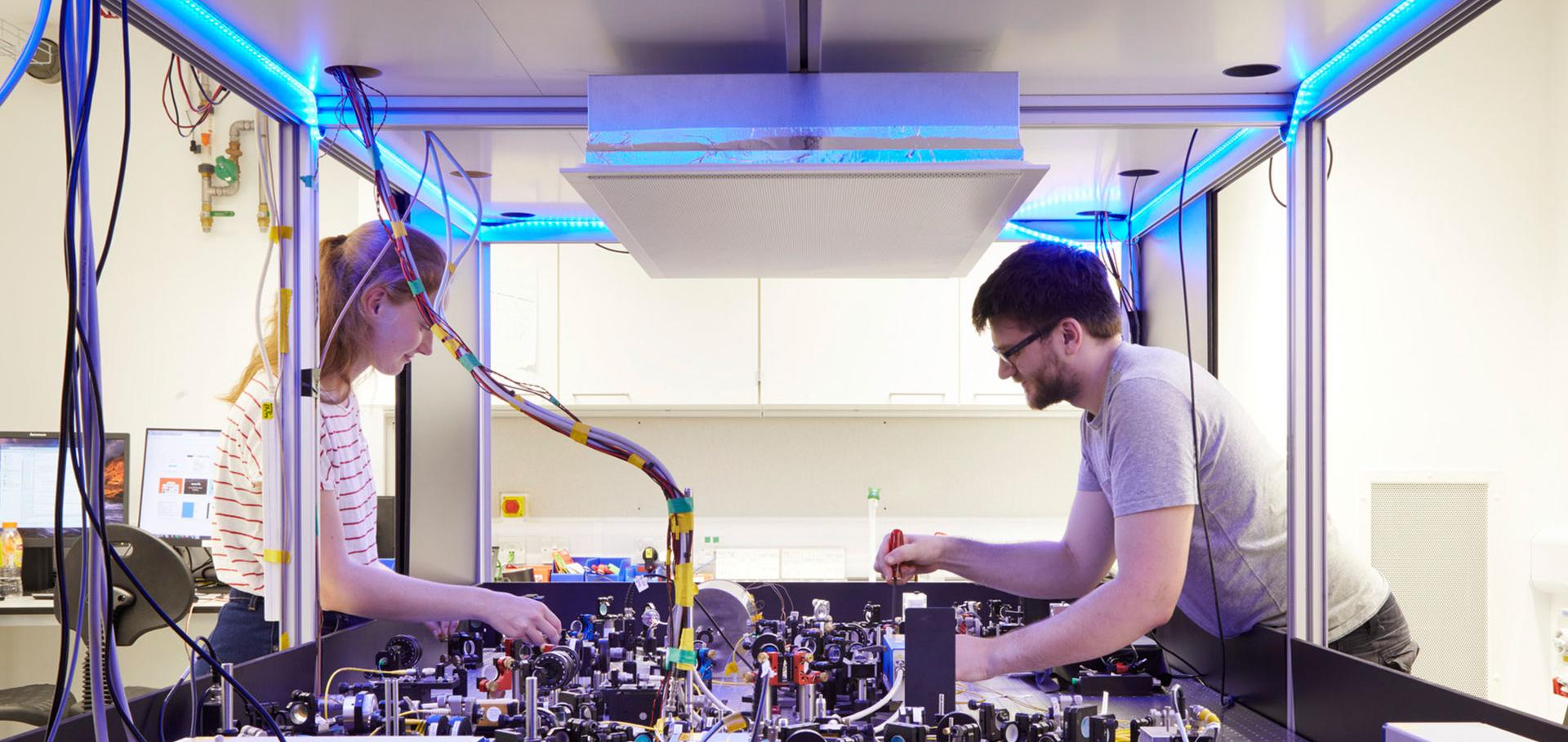
Credit: Jack Hobhouse

Professor Andrew Daley

Professor of Quantum Physics

Research theme

  • Quantum information and computation
  • Quantum optics & ultra-cold matter

Sub department

  • Atomic and Laser Physics

Research groups

  • Theory of quantum systems
andrew.daley@physics.ox.ac.uk
Clarendon Laboratory, room 1st floor Townsend
  • About
  • Publications

Interference of interacting matter waves

New Journal of Physics IOP Publishing 12:6 (2010) 065029

Authors:

Mattias Gustavsson, Elmar Haller, Manfred J Mark, Johann G Danzl, Russell Hart, Andrew J Daley, Hanns-Christoph Nägerl
More details from the publisher

Dynamical crystal creation with polar molecules or Rydberg atoms in optical lattices

ArXiv 1003.5858 (2010)

Authors:

J Schachenmayer, I Lesanovsky, A Micheli, AJ Daley

Abstract:

We investigate the dynamical formation of crystalline states with systems of polar molecules or Rydberg atoms loaded into a deep optical lattice. External fields in these systems can be used to couple the atoms or molecules between two internal states: one that is weakly interacting and one that exhibits a strong dipole-dipole interaction. By appropriate time variation of the external fields, we show that it is possible to produce crystalline states of the strongly interacting states with high filling fractions chosen via the parameters of the coupling. We study the coherent dynamics of this process in one dimension (1D) using a modified form of the time-evolving block decimation (TEBD) algorithm, and obtain crystalline states for system sizes and parameters corresponding to realistic experimental configurations. For polar molecules these crystalline states will be long-lived, assisting in a characterization of the state via the measurement of correlation functions. We also show that as the coupling strength increases in the model, the crystalline order is broken. This is characterized in 1D by a change in density-density correlation functions, which decay to a constant in the crystalline regime, but show different regions of exponential and algebraic decay for larger coupling strengths.
More details from the publisher
Details from ArXiV

Dynamical crystal creation with polar molecules or Rydberg atoms in optical lattices

(2010)

Authors:

J Schachenmayer, I Lesanovsky, A Micheli, AJ Daley
More details from the publisher

A single trapped atom in front of an oscillating mirror

Optics Communications Elsevier 283:5 (2010) 758-765

Authors:

AW Glaetzle, K Hammerer, AJ Daley, R Blatt, P Zoller
More details from the publisher

Time-dependent currents of one-dimensional bosons in an optical lattice

New Journal of Physics IOP Publishing 12:2 (2010) 025014

Authors:

J Schachenmayer, G Pupillo, AJ Daley
More details from the publisher

Pagination

  • First page First
  • Previous page Prev
  • …
  • Page 41
  • Page 42
  • Page 43
  • Page 44
  • Current page 45
  • Page 46
  • Page 47
  • Page 48
  • Page 49
  • …
  • Next page Next
  • Last page Last

Footer Menu

  • Contact us
  • Giving to the Dept of Physics
  • Work with us
  • Media

User account menu

  • Log in

Follow us

FIND US

Clarendon Laboratory,

Parks Road,

Oxford,

OX1 3PU

CONTACT US

Tel: +44(0)1865272200

University of Oxfrod logo Department Of Physics text logo
IOP Juno Champion logo Athena Swan Silver Award logo

© University of Oxford - Department of Physics

Cookies | Privacy policy | Accessibility statement

Built by: Versantus

  • Home
  • Research
  • Study
  • Engage
  • Our people
  • News & Comment
  • Events
  • Our facilities & services
  • About us
  • Giving to Physics
  • Current students
  • Staff intranet