Home
Department Of Physics text logo
  • Research
    • Our research
    • Our research groups
    • Our research in action
    • Research funding support
    • Summer internships for undergraduates
  • Study
    • Undergraduates
    • Postgraduates
  • Engage
    • For young people
    • For teachers
    • For the public
    • For alumni
    • For business
  • Support
Menu
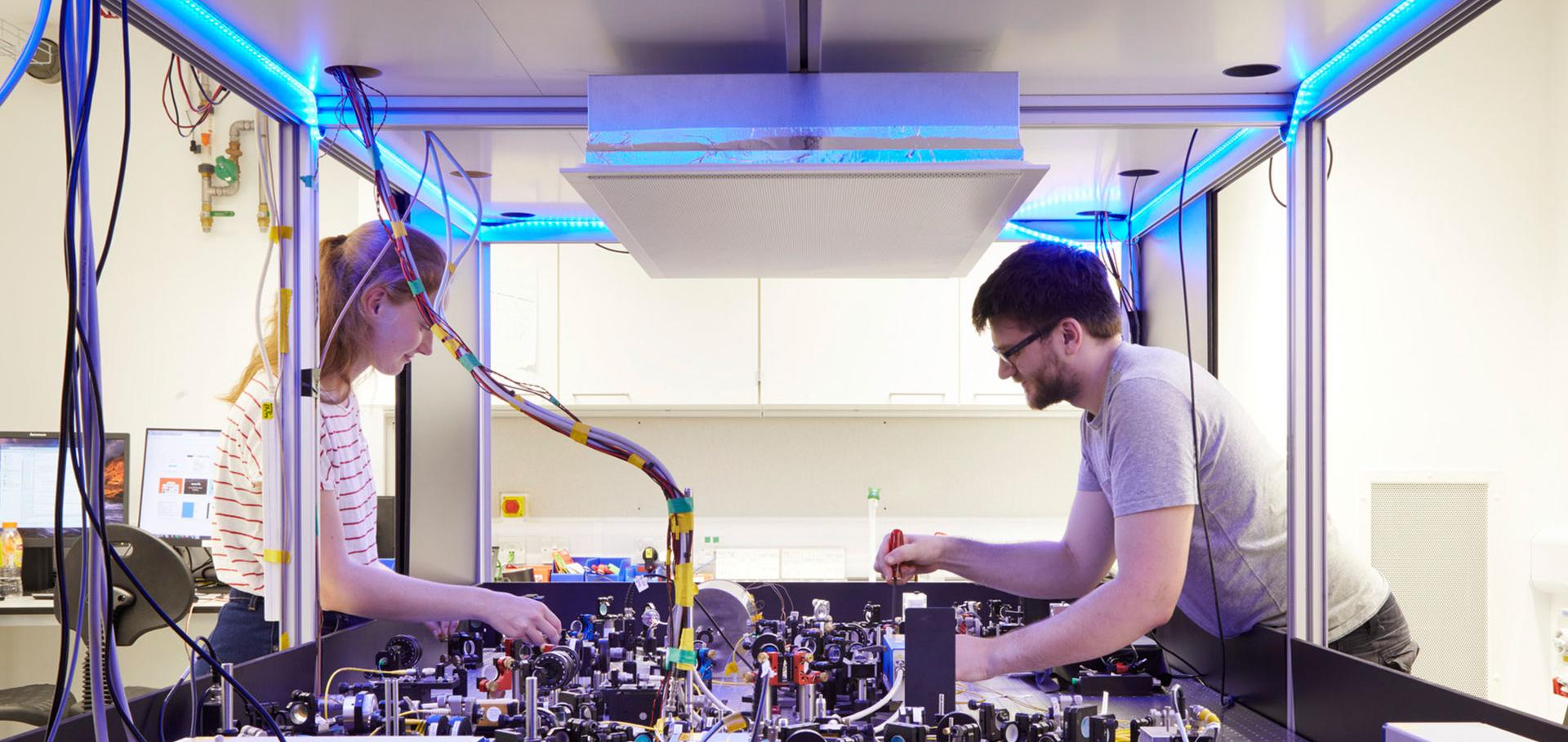
Atomic and Laser Physics
Credit: Jack Hobhouse

Colin Danson

Visiting Professor

Sub department

  • Atomic and Laser Physics

Research groups

  • Oxford Centre for High Energy Density Science (OxCHEDS)
colin.danson@physics.ox.ac.uk
  • About
  • Publications

High pressures generated by laser driven shocks: Applications to planetary physics

Nuclear Fusion 44:12 (2004) S208-S214

Authors:

M Koenig, E Henry, G Huser, A Benuzzi-Mounaix, B Faral, E Martinolli, S Lepape, T Vinci, D Batani, M Tomasini, B Telaro, P Loubeyre, T Hall, P Celliers, G Collins, L Dasilva, R Cauble, D Hicks, D Bradley, A MacKinnon, P Patel, J Eggert, J Pasley, O Willi, D Neely, M Notley, C Danson, M Borghesi, L Romagnani, T Boehly, K Lee

Abstract:

High power lasers are a tool that can be used to determine important parameters in the context of Warm Dense Matter, i.e. at the convergence of low-temperature plasma physics and finite-temperature condensed matter physics. Recent results concerning planet inner core materials such as water and iron are presented. We determined the equation of state, temperature and index of refraction of water for pressures up to 7 Mbar. The release state of iron in a LiF window allowed us to investigate the melting temperature near the inner core boundary conditions. Finally, the first application of proton radiography to the study of shocked material is also discussed.
More details from the publisher
More details

Radiological characterisation of Petawatt laser interactions

Inertial Fusion Sciences and Applications 2003 (2004) 373-377

Authors:

D Neely, R Clarke, P Brummitt, J Collier, CN Danson, CB Edwards, RD Edwards, A Frackiewicz, J Govans, S Hancock, P Hatton, S Hawkes, R Heathcote, C Hernandez-Gomez, P Holligan, C Hooker, MHR Hutchinson, A Kidd, W Lester, D McAllister, J McLaughlan, D Neville, P Norreys, D Pepler, M Pitts, C Reason, IN Ross, R Wellstood, BE Wyborn, T Winstone, PNM Wright, R Wyatt, C Ziener

Abstract:

Vulcan is established as a world leading user facility for studies of ultra-high intensity laser interactions with matter. The Petawatt(PW) Upgrade project will deliver an order of magnitude increase in laser power to target, delivering interaction intensities of 10 21 Wcm -2. Before commencing operation to users a commissioning study was carried out. The objectives of this investigation were: To perform radiological surveys of the facility in anticipated target configurations and to install additional shielding for high-Z interactions as required To measure the target irradiance and the X-ray spot size To investigate the effects of electromagnetic noise on the chamber and target area equipment To determine the level of debris produced from the target and to devise a suitable operating scheme to protect chamber optics from damage Installation of an optical probe Contrast measurement of the laser pulses This report will review the experimental and radiological data obtained from the thirteen solid target interaction shots fired during the commissioning run in the newly constructed PW interaction facility 1) where doses of 45 mSv @ 1m were obtained. Commissioning of the PW laser and compressor chain is reported in separate articles, as is the commissioning of the large aperture gratings at high laser fluences 2).

Recent developments in high pressure physics using laser driven shocks

Inertial Fusion Sciences and Applications 2003 (2004) 897-901

Authors:

M Koenig, E Henry, A Benuzzi-Mounaix, G Huser, B Faral, E Martinolli, S Lepape, P Audebert, T Vinci, D Batani, M Tomasini, B Telaro, B Marchet, I Masclet, M Rabec, C Reverdin, P Loubeyre, T Hall, P Celliers, G Collins, L Dasilva, R Cauble, D Hicks, D Bradley, A MacKinnon, P Patel, J Eggert, J Pasley, O Willi, D Neely, M Motley, C Danson, M Borghesi, L Romagnani, T Boehly, K Lee

Abstract:

High power lasers are nowadays a tool that can be used to determine important parameters in the context of Warm Dense Matter. In this paper, the general issues that have been addressed in the last few years are presented. Recent results concerning water experiments are exposed as a paradigm of laser driven shocks experiments. Finally the first application of proton radiography to the study of shocked material is presented.

The Vulcan Petawatt interaction facility

Inertial Fusion Sciences and Applications 2003 (2004) 512-516

Authors:

CN Danson, PA Brummitt, J Collier, RJ Clark, M Dominey, CB Edwards, R Edwards, AJ Frackiewicz, JAC Govans, S Hancock, PE Hatton, S Hawkes, CR Heathcote, C Hernandez-Gomez, P Holligan, C Hooker, MHR Hutchinson, A Jackson, A Kidd, WJ Lester, J Monk, D Neely, DR Neville, P Norreys, M Notley, DA Pepler, MR Pitts, CJ Reason, D Robinson, KJ Rodgers, D Rose, IN Ross, AJ Ryder, MR Selley, D Shepherd, T Strange, M Tolley, R Wellstood, GN Wiggins, TB Winstone, PNM Wright, RWW Wyatt, BE Wyborn, C Ziener

Abstract:

The Vulcan Nd:glass laser at the Central Laser Facility (CLF) has recently been upgraded to the Petawatt level (10 15 Watts). The facility is now operational to the UK and international user community. During the first user experiments, the power and focussed intensity were increased gradually up to the Petawatt regime. Considerable experience has been gained operating the Vulcan facility in this mode. The Petawatt facility is designed to deliver irradiance on target of 10 21 W.cm -2 for a wide-ranging experimental programme in fundamental physics and advanced applications. This includes the interaction of super-high intensity light with matter, fast ignition fusion research, photon induced nuclear reactions, electron and ion acceleration by light waves and the exploration of the exotic world of plasma physics dominated by relativity.

Vulcan petawatt - An ultra-high-intensity interaction facility

Nuclear Fusion 44:12 (2004) S239-S246

Authors:

CN Danson, PA Brummitt, RJ Clarke, JL Collier, B Fell, AJ Frackiewicz, S Hancock, S Hawkes, C Hernandez-Gomez, P Holligan, MHR Hutchinson, A Kidd, WJ Lester, IO Musgrave, D Neely, DR Neville, PA Norreys, DA Pepler, CJ Reason, W Shaikh, TB Winstone, RWW Wyatt, BE Wyborn

Abstract:

The Vulcan Nd: glass laser at the Central Laser Facility is a Petawatt (1015 W) interaction facility available to the UK and international user community. The facility came online to users in 2002 and considerable experience has been gained operating the Vulcan facility in this mode. The facility is designed to deliver irradiance on target of 1021 W cm-2 for a wide-ranging experimental programme in fundamental physics and advanced applications. This includes the interaction of super-high-intensity light with matter, fast ignition fusion research, photon induced nuclear reactions, electron and ion acceleration by light waves and the exploration of the exotic world of plasma physics dominated by relativity.
More details from the publisher

Pagination

  • First page First
  • Previous page Prev
  • Page 1
  • Page 2
  • Current page 3
  • Page 4
  • Page 5
  • Page 6
  • Page 7
  • Page 8
  • Page 9
  • …
  • Next page Next
  • Last page Last

Footer Menu

  • Contact us
  • Giving to the Dept of Physics
  • Work with us
  • Media

User account menu

  • Log in

Follow us

FIND US

Clarendon Laboratory,

Parks Road,

Oxford,

OX1 3PU

CONTACT US

Tel: +44(0)1865272200

University of Oxfrod logo Department Of Physics text logo
IOP Juno Champion logo Athena Swan Silver Award logo

© University of Oxford - Department of Physics

Cookies | Privacy policy | Accessibility statement

Built by: Versantus

  • Home
  • Research
  • Study
  • Engage
  • Our people
  • News & Comment
  • Events
  • Our facilities & services
  • About us
  • Giving to Physics
  • Current students
  • Staff intranet