Home
Department Of Physics text logo
  • Research
    • Our research
    • Our research groups
    • Our research in action
    • Research funding support
    • Summer internships for undergraduates
  • Study
    • Undergraduates
    • Postgraduates
  • Engage
    • For alumni
    • For business
    • For schools
    • For the public
Menu
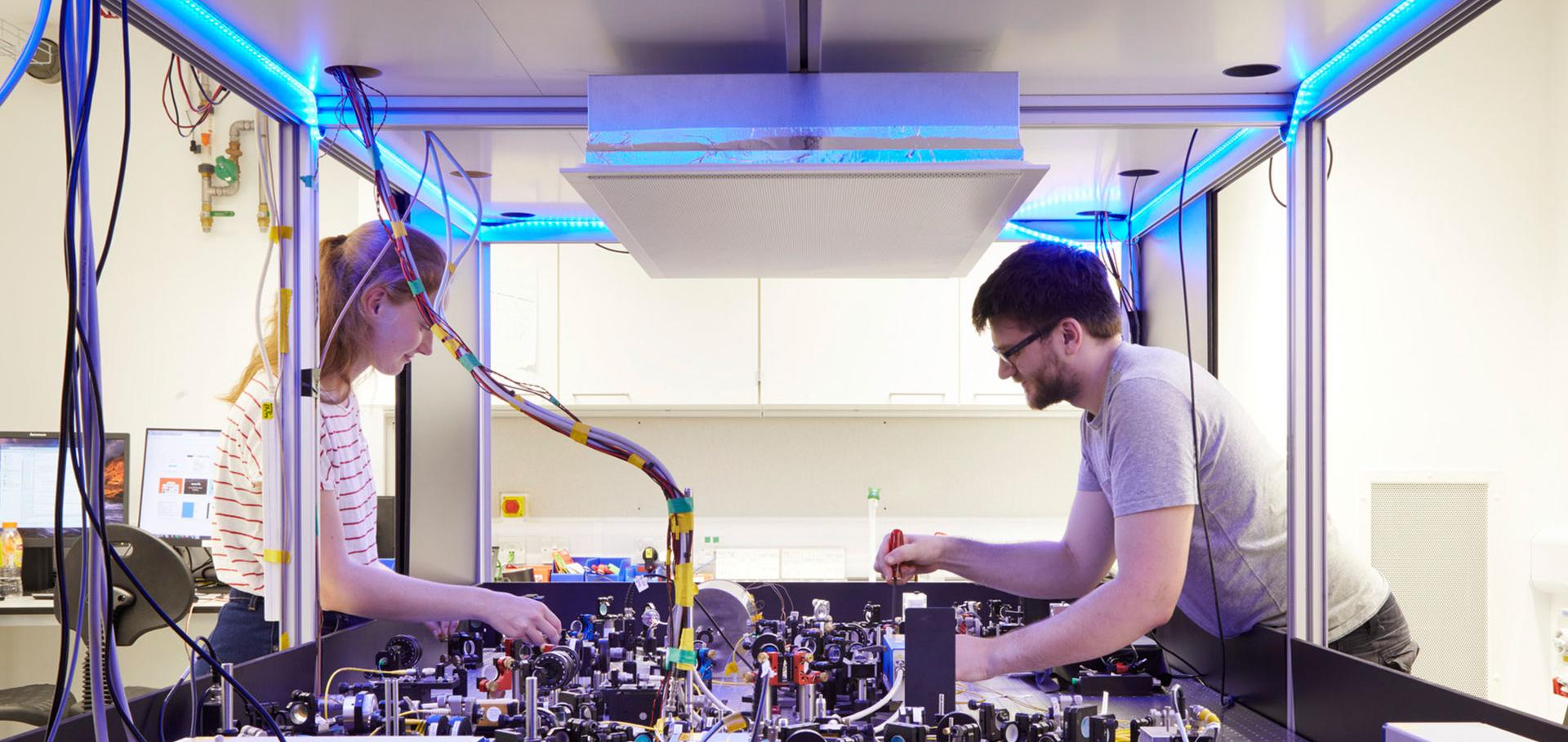
Atomic and Laser Physics
Credit: Jack Hobhouse

Aleksandr Duplinskii

Postdoctoral Research Assistant

Sub department

  • Atomic and Laser Physics
aleksandr.duplinskii@physics.ox.ac.uk
Clarendon Laboratory
  • About
  • Publications

Tsang’s resolution enhancement method for imaging with focused illumination

Light: Science & Applications Springer Nature 14:1 (2025) 159

Authors:

Aleksandr Duplinskii, Jernej Frank, Kaden Bearne, Alex Lvovsky

Abstract:

A widely tested approach to overcoming the diffraction limit in microscopy without disturbing the sample relies on substituting widefield sample illumination with a structured light beam. This gives rise to confocal, image scanning, and structured illumination microscopy methods. On the other hand, as shown recently by Tsang and others, subdiffractional resolution at the detection end of the microscope can be achieved by replacing the intensity measurement in the image plane with spatial mode demultiplexing. In this work, we study the combined action of Tsang’s method with image scanning. We experimentally demonstrate superior lateral resolution and enhanced image quality compared to either method alone. This result paves the way for integrating spatial demultiplexing into existing microscopes, contributing to further pushing the boundaries of optical resolution.

More details from the publisher
Details from ORA
More details
More details

Passive superresolution imaging of incoherent objects

Optica Optica Publishing Group 10:9 (2023) 1147-1152

Authors:

Jernej Frank, Aleksandr Duplinskii, Kaden Bearne, Alexander Lvovsky

Abstract:

The need to observe objects that are smaller than the diffraction limit has led to the development of various superresolution techniques. However, most such techniques require active interaction with the sample, which may not be possible in multiple practical scenarios. The recently developed technique of Hermite–Gaussian imaging (HGI) achieves superresolution by passively observing the light coming from an object. This approach involves decomposing the incoming field into the Hermite–Gaussian basis of spatial modes and measuring the amplitude or intensity of each component. From these measurements, the original object can be reconstructed. However, implementing HGI experimentally has proven to be challenging, and previous achievements have focused on coherent imaging or parameter estimation of simple objects. In this paper, we implement interferometric HGI in the incoherent regime and demonstrate a three-fold improvement in the resolution compared to direct imaging. We evaluate the performance of our method under different noise levels. Our results constitute a step towards powerful passive superresolution imaging techniques in fluorescent microscopy and astronomy.
More details from the publisher
Details from ORA
More details

Footer Menu

  • Contact us
  • Giving to the Dept of Physics
  • Work with us
  • Media

User account menu

  • Log in

Follow us

FIND US

Clarendon Laboratory,

Parks Road,

Oxford,

OX1 3PU

CONTACT US

Tel: +44(0)1865272200

University of Oxfrod logo Department Of Physics text logo
IOP Juno Champion logo Athena Swan Silver Award logo

© University of Oxford - Department of Physics

Cookies | Privacy policy | Accessibility statement

Built by: Versantus

  • Home
  • Research
  • Study
  • Engage
  • Our people
  • News & Comment
  • Events
  • Our facilities & services
  • About us
  • Giving to Physics
  • Current students
  • Staff intranet