Home
Department Of Physics text logo
  • Research
    • Our research
    • Our research groups
    • Our research in action
    • Research funding support
    • Summer internships for undergraduates
  • Study
    • Undergraduates
    • Postgraduates
  • Engage
    • For alumni
    • For business
    • For schools
    • For the public
  • Support
Menu
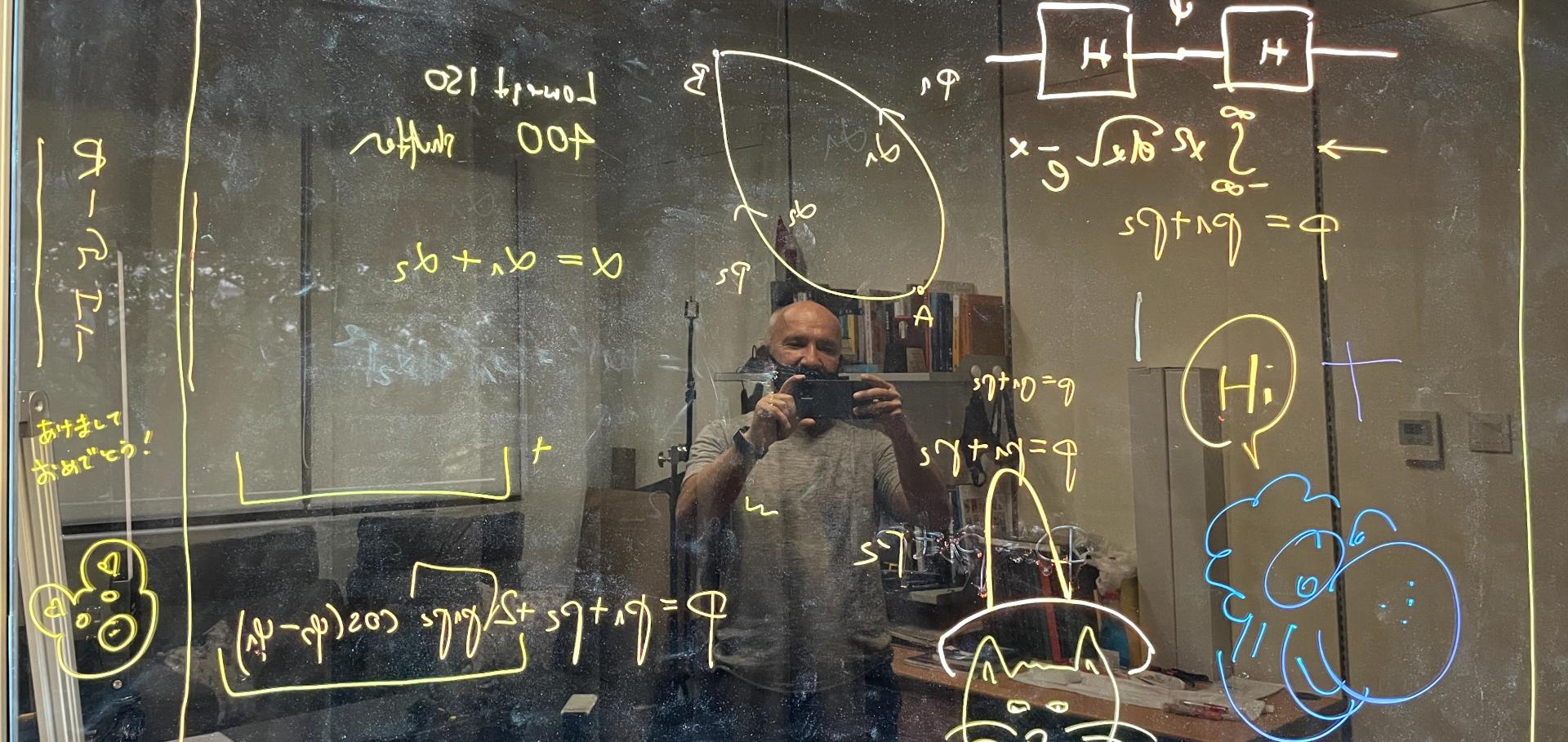
lightboard

Professor Artur Ekert FRS

Professor

Research theme

  • Quantum information and computation

Sub department

  • Atomic and Laser Physics
artur.ekert@physics.ox.ac.uk
Clarendon Laboratory
Wikipedia
Lecture: Introduction to Quantum Information Science
  • About
  • Publications

Optimal universal and state-dependent quantum cloning

Physical Review A - Atomic, Molecular, and Optical Physics 57:4 (1998) 2368-2378

Authors:

D Bruß, DP DiVincenzo, A Ekert, CA Fuchs, C Macchiavello, JA Smolin

Abstract:

We establish the best possible approximation to a perfect quantum cloning machine that produces two clones out of a single input. We analyze both universal and state-dependent cloners. The maximal fidelity of cloning is shown to be 5/6 for universal cloners. It can be achieved either by a special unitary evolution or by a teleportation scheme. We construct the optimal state-dependent cloners operating on any prescribed two nonorthogonal states and discuss their fidelities and the use of auxiliary physical resources in the process of cloning. The optimal universal cloners permit us to derive an upper bound on the quantum capacity of the depolarizing quantum channel. © 1998 The American Physical Society.
More details from the publisher

Quantum algorithms revisited

Proceedings of the Royal Society A Mathematical Physical and Engineering Sciences 454:1969 (1998) 339-354

Authors:

R Cleve, A Ekert, C Macchiavello, M Mosca

Abstract:

Quantum computers use the quantum interference of different computational paths to enhance correct outcomes and suppress erroneous outcomes of computations. A common pattern underpinning quantum algorithms can be identified when quantum computation is viewed as multiparticle interference. We use this approach to review (and improve) some of the existing quantum algorithms and to show how they are related to different instances of quantum phase estimation. We provide an explicit algorithm for generating any prescribed interference pattern with an arbitrary precision. © 1998 The Royal Society.
More details from the publisher
More details

Quantum computation

Physics World 11:3 (1998) 47-52

Authors:

D Deutsch, A Ekert
More details from the publisher
More details

Quantum computation: From the sequential approach to simulated annealing

International Journal of Theoretical Physics 37:1 (1998) 463-469

Authors:

G Castagnoli, A Ekert, C Macchiavello

Abstract:

This is a brief outline of some essential features of quantum computation. We describe sequential quantum data processing and speculate on new modes of quantum computation such as quantum annealing.
More details from the publisher
More details

An overview of quantum computing

UNCONVENTIONAL MODELS OF COMPUTATION (1998) 19-44

Authors:

A Ekert, C Macchiavello
More details

Pagination

  • First page First
  • Previous page Prev
  • …
  • Page 34
  • Page 35
  • Page 36
  • Page 37
  • Current page 38
  • Page 39
  • Page 40
  • Page 41
  • Page 42
  • …
  • Next page Next
  • Last page Last

Footer Menu

  • Contact us
  • Giving to the Dept of Physics
  • Work with us
  • Media

User account menu

  • Log in

Follow us

FIND US

Clarendon Laboratory,

Parks Road,

Oxford,

OX1 3PU

CONTACT US

Tel: +44(0)1865272200

University of Oxfrod logo Department Of Physics text logo
IOP Juno Champion logo Athena Swan Silver Award logo

© University of Oxford - Department of Physics

Cookies | Privacy policy | Accessibility statement

Built by: Versantus

  • Home
  • Research
  • Study
  • Engage
  • Our people
  • News & Comment
  • Events
  • Our facilities & services
  • About us
  • Giving to Physics
  • Current students
  • Staff intranet