

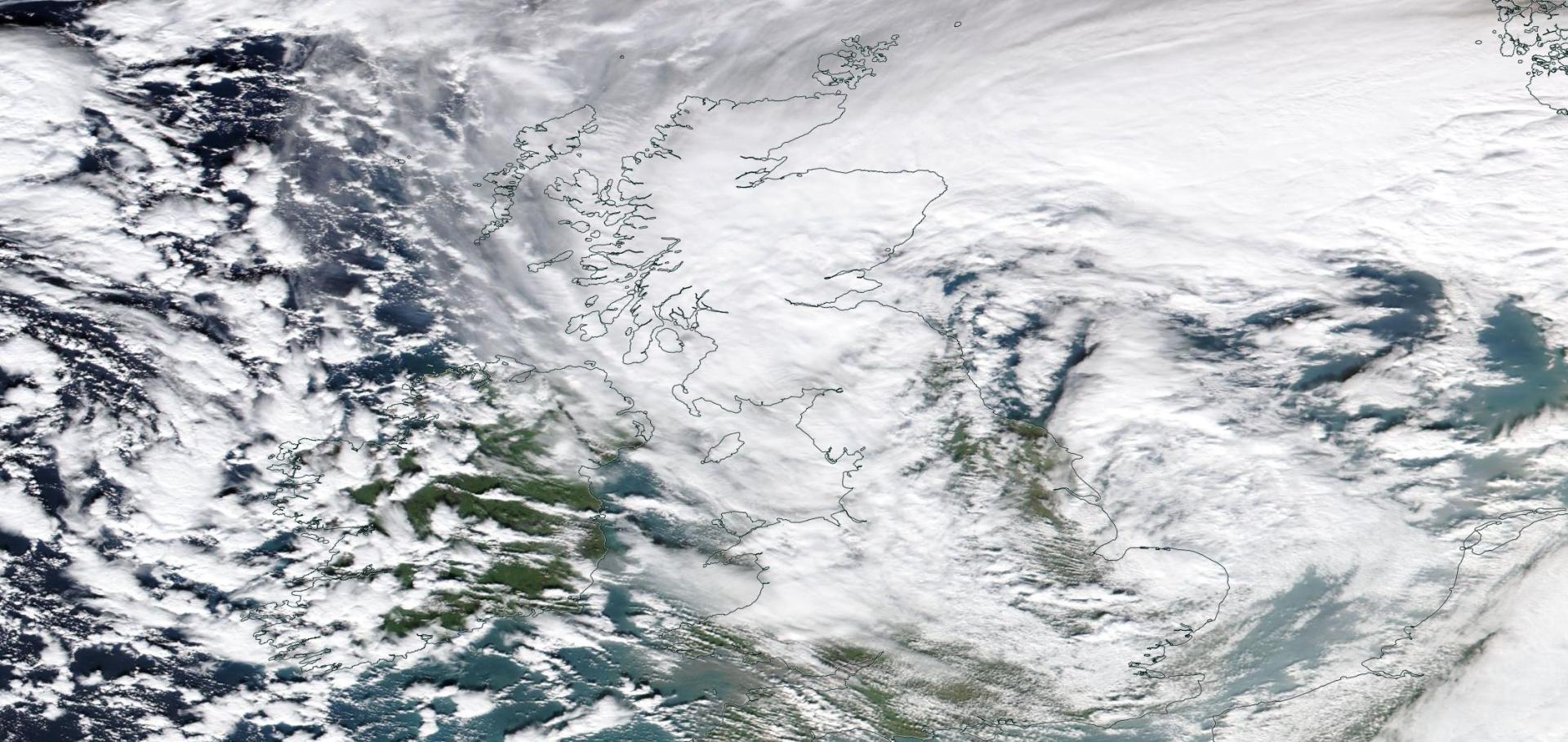

The perfect storm: human influence on the loss potential of Eunice-like cyclones
Environmental Research Letters IOP Publishing (2026)
Abstract:
Abstract Storm Eunice was a severe windstorm that impacted Central Europe in February 2022. The meteorology and synoptic dynamics of Eunice have been studied in depth in several studies examining features of the storm such as its sting jet. The contribution of climate change to the storm dynamics and severity was examined in previous work, which found that in counterfactual weather forecasts - given an identical initial synoptic setup - climate change had measurably increased the severity of the storm. Here we move beyond meteorological attribution and quantify the role of climate change in the insured losses incurred during Eunice in, to the best of our knowledge, the first impact attribution of its kind for a European windstorm event. We combine the same counterfactual weather forecasts with three loss models, including two state-of-the-art commercial models, finding that the increases in meteorological severity do translate through to significant increases in estimated loss. We estimate a conditional increase in insured loss of nearly €2 bn between pre-industrial and present-day climates. Of particular note is the existence of several members within the forecast ensembles whose losses are far greater than what unfolded in reality. This includes one realisation, simulated in a warmer “future” climate, in which the estimated loss could reach over 10x the realised loss during Eunice. The plausible existence of such a catastrophic loss is of considerable relevance to a wide variety of stakeholders across adaptation planning and the financial sector. We suggest that our results practically demonstrate not only the utility of counterfactual weather forecasts in quantifying impacts attributable to climate change, but also the value of academic - private partnerships in which the two sectors are able to bring different areas of expertise.Economic damages attributable to climate change in the Northeastern United States from 2011 Storm Irene
Copernicus Publications (2026)
Abstract:
As global temperatures rise, extreme weather events are increasingly causing damages across human health, infrastructure, agriculture, and the broader economy. The science of event attribution is evolving to include estimates of economic damages attributable to climate change in addition to physical impacts. A key challenge in this field is to create physically consistent and high-resolution counterfactuals which can be used to estimate to attributable losses.Here, we analyse the precipitation-driven impacts of Storm Irene in August 2011 when it was undergoing extratropical transition in the Northeastern United States. Across the Northeast United States, this storm caused rainfall of up to 180 mm within a few hours, leading to fluvial and pluvial flooding with catastrophic consequences that caused more than $1.3 billion in property damages in the state of Vermont alone.Our method enables linking economic damages attributable to climate change to meteorological drivers through a direct modelling chain by combining an operational weather forecasting model, hydrodynamic model, and economic damage model.This research underscores the potential of interdisciplinary attribution methodologies to inform climate risk assessments in insurance and provide an evidentiary basis for climate-related liability.Multi-method extreme event attribution: Motivation, case study, and implications
Copernicus Publications (2026)
Abstract:
Since 2004, many methods for event attribution have been developed. Early studies showed that attribution statements are sensitive to the framing of research questions but few large comparisons have been undertaken.Here, we firstly motivate the need for multi-method extreme event attribution, highlighting conceptual differences between methods. In a second part, we present a case study of midlatitude storm Babet (2023) to compare three common storyline attribution methods, alongside a severity-based probabilistic method. We discuss three widely relevant questions which highlight the complementarity and the differences between methods: (1) How has climate change impacted the frequency of the event? (2) How has climate change impacted the event severity? (3) Were the dynamics of the event influenced by climate change and if yes, how?We show that methods differ in the extent to which they reproduce observed weather patterns. This influences attribution statements, and can even change the sign of results for events with uncertain climate signals. We argue that limitations and strengths of methods need to be clearly communicated when presenting event attribution reports to ensure findings can be used reliably by a wide range of stakeholders.Contrasting Extreme Event Attribution Frameworks in the Case of Midlatitude Storm Babet 2023
(2026)
The need for multi-method extreme event attribution
Weather Wiley (2025)