Home
Department Of Physics text logo
  • Research
    • Our research
    • Our research groups
    • Our research in action
    • Research funding support
    • Summer internships for undergraduates
  • Study
    • Undergraduates
    • Postgraduates
  • Engage
    • For young people
    • For teachers
    • For the public
    • For alumni
    • For business
  • Support
Menu
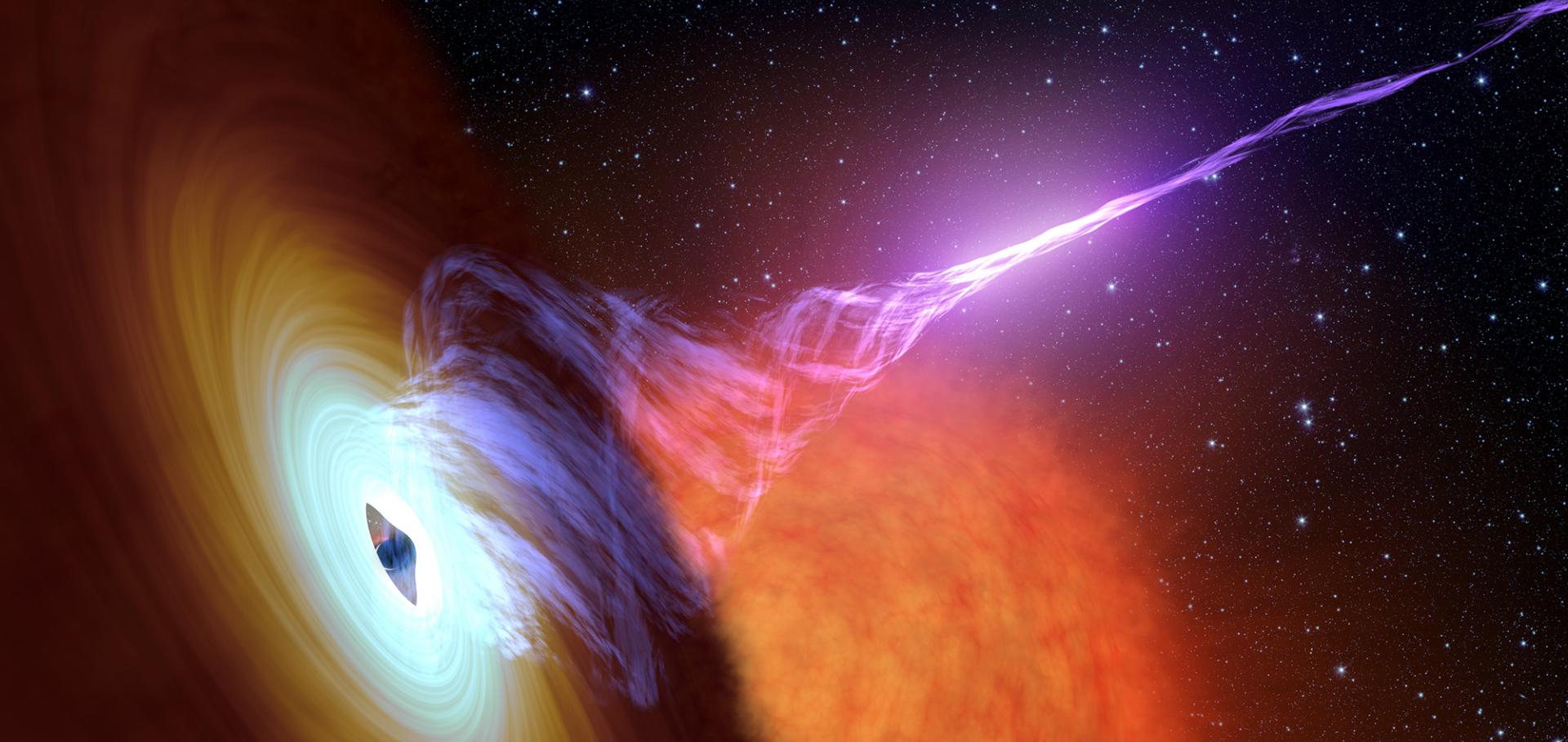
Relativistic Jet from Black Hole

An artist's impression of a relativistic jet propagating away from a black hole at close to the speed of light. Such jets are formed by the inner regions of the accretion flow: matter flowing inwards towards the black hole, via processes which are not yet fully understood. The accretion flow emits primarily in X-rays, the relativistic jet in the radio band: by combing observations in each band we can try and understand how such jets form and how much energy they carry away from the black hole.

Professor Rob Fender

Professor of Astrophysics

Research theme

  • Astronomy and astrophysics

Sub department

  • Astrophysics

Research groups

  • Hintze Centre for Astrophysical Surveys
  • MeerKAT
  • Pulsars, transients and relativistic astrophysics
  • Rubin-LSST
  • The Square Kilometre Array (SKA)
  • Gamma-ray astronomy
Rob.Fender@physics.ox.ac.uk
Telephone: 01865 (2)73435
Denys Wilkinson Building, room 712
  • About
  • Publications

Black hole X-ray binary jets

(2005)

Authors:

Elena Gallo, Rob Fender, Christian Kaiser
More details from the publisher

Rapid variability of the arcsec-scale X-ray jets of SS 433

(2005)

Authors:

S Migliari, RP Fender, KM Blundell, M Mendez, M van der Klis
More details from the publisher

Black hole X-ray binary jets

Nature 436 (2005) 819-821

Authors:

E Gallo, R Fender, C Kaiser

Abstract:

Relativistic jets powered by stellar mass black holes in X-ray binaries appear to come in two types: steady outflows associated with hard X-ray states and large scale discrete ejections associated with transient outbursts. We show that the broadband radio spectrum of a `quiescent' stellar mass black hole closely resembles that of canonical hard state sources emitting at four orders of magnitude higher X-ray levels, suggesting that a relativistic outflow is being formed down to at least a few 10^(-6) times the Eddington X-ray luminosity. We further report on the discovery of a low surface brightness radio nebula around the stellar black hole in Cyg X-1, and discuss how it can be used as an effective calorimeter for the jet kinetic power.
More details from the publisher
Details from ArXiV

Upper limits on central black hole masses of globular clusters from radio emission and a possible black hole detection in the Ursa Minor dwarf galaxy

Monthly Notices of the Royal Astronomical Society: Letters Oxford University Press (OUP) 356:1 (2005) l17-l22

Authors:

Thomas J Maccarone, Robert P Fender, Anastasios K Tzioumis
More details from the publisher
Details from ArXiV

The 2003 radio outburst of a new X-ray transient: XTE J1720-318

\mnras 356 (2005) 125-130-125-130

Authors:

C Brocksopp, S Corbel, RP Fender, M Rupen, R Sault, SJ Tingay, D Hannikainen, K O Brien
More details from the publisher
More details

Pagination

  • First page First
  • Previous page Prev
  • …
  • Page 185
  • Page 186
  • Page 187
  • Page 188
  • Current page 189
  • Page 190
  • Page 191
  • Page 192
  • Page 193
  • …
  • Next page Next
  • Last page Last

Footer Menu

  • Contact us
  • Giving to the Dept of Physics
  • Work with us
  • Media

User account menu

  • Log in

Follow us

FIND US

Clarendon Laboratory,

Parks Road,

Oxford,

OX1 3PU

CONTACT US

Tel: +44(0)1865272200

University of Oxfrod logo Department Of Physics text logo
IOP Juno Champion logo Athena Swan Silver Award logo

© University of Oxford - Department of Physics

Cookies | Privacy policy | Accessibility statement

Built by: Versantus

  • Home
  • Research
  • Study
  • Engage
  • Our people
  • News & Comment
  • Events
  • Our facilities & services
  • About us
  • Giving to Physics
  • Current students
  • Staff intranet