Home
Department Of Physics text logo
  • Research
    • Our research
    • Our research groups
    • Our research in action
    • Research funding support
    • Summer internships for undergraduates
  • Study
    • Undergraduates
    • Postgraduates
  • Engage
    • For alumni
    • For business
    • For schools
    • For the public
  • Support
Menu
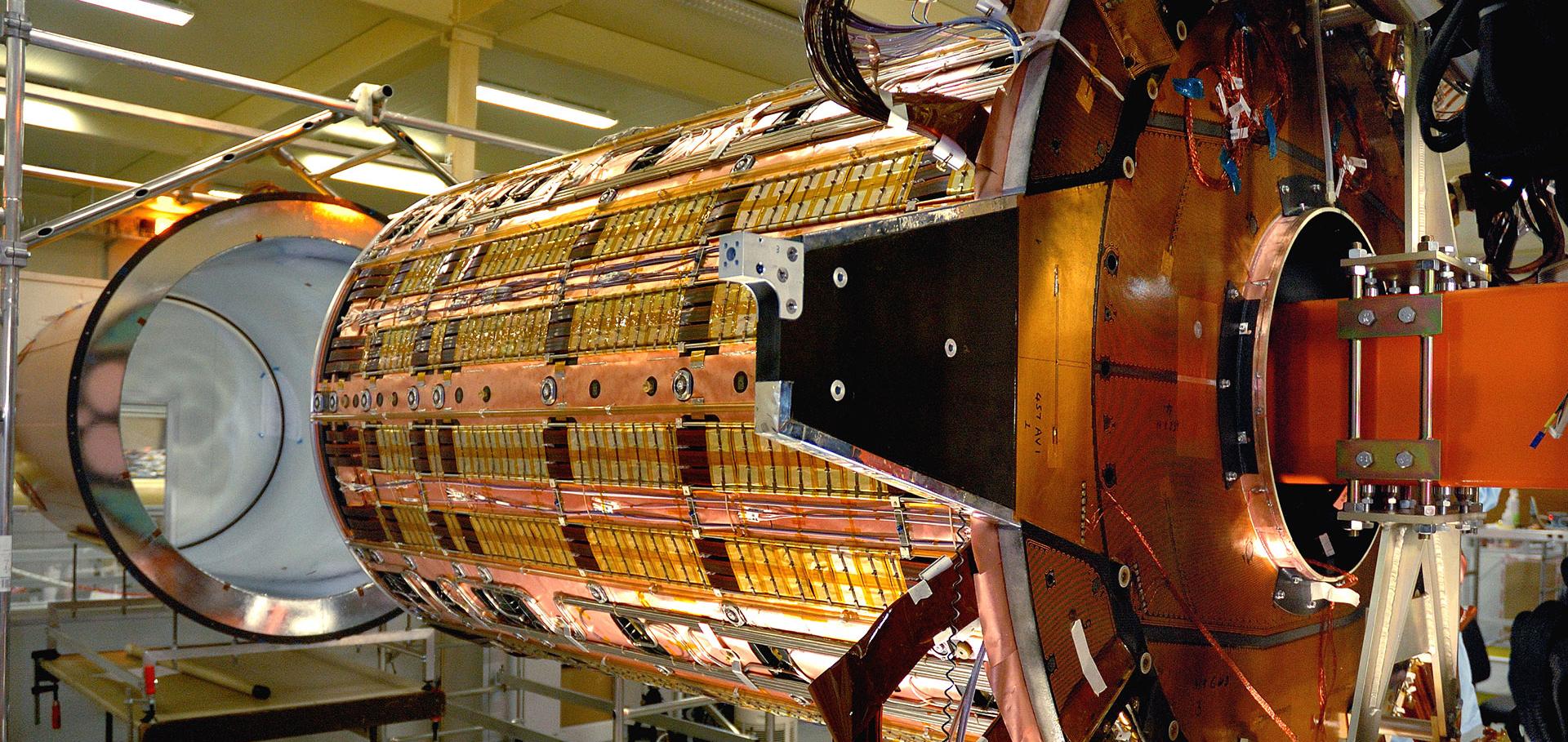
Insertion of STC into TRT at the Department of Physics, Oxford
Credit: CERN

Professor Brian Foster OBE, FRS

Donald H. Perkins Professor of Experimental Physics

Research theme

  • Accelerator physics
  • Fundamental particles and interactions

Sub department

  • Particle Physics

Research groups

  • Future Colliders
  • Plasma-Wakefield Accelerator Group
Brian.Foster@physics.ox.ac.uk
Telephone: 01865 (2)73323
Denys Wilkinson Building, room 611
Oxford May Music - An annual festival of science and music
  • About
  • Publications

Ω- produced in K-p reactions at 4.2 GeV/c

Nuclear Physics Section B 142:3 (1978) 205-219

Authors:

RJ Hemingway, R Armenteros, C Dionisi, P Gavillet, A Gurtu, SO Holmgren, MJ Losty, JC Marin, M Mazzucato, L Montanet, M Banting, R Blokzijl, AJ De Groot, B Jongejans, JC Kluyver, WM Van Leeuwen, GGG Massaro, AG Tenner, GF Wolters, PM Heinen, EW Kittel, WJ Metzger, HGJM Tiecke, JJM Timmermans, RT Van De Walle, B Foster, P Grossmann, PR Lamb, JL Lloyd, J Wells

Abstract:

Forty Ω- events have been observed in a large (133 events/βb) experiment at 4.2 GeV/c incident K- momentum. Thirty nine of the events come from the three-body reaction K-p→Ω-K+K0. The Ω- is mainly produced in the forward hemisphere (direction of the incident K-). The lifetime is measured to be τ = (0.75 +0.14-0.11 × 10⁻¹⁰ sec substantially less than the Particle Data Group value of (1.3 -0.3+0.2) × 10-10 sec. The mass is determined to be 1671.7 ± 0.6 MeV, in good agreement with other determinations. The decay asymmetry parameter α (for the decay mode Ω- → ΛK-) is found to be -0.2 ± 0.4. © 1978.
More details from the publisher

An I = 1 enhancement at a mass of 1550 MeV in the (Λπ) and (Σπ)-systems

Physics Letters B 78:1 (1978) 154-157

Authors:

C Dionisi, R Armenteros, J Diaz, P Gavillet, JB Gay, A Gurtu, RJ Hemingway, M Mazzucato, P Trepagnier, R Blokzijl, GGG Massaro, B Jongejans, J Engelen, JJ Timmermans, RT Van De Walle, B Foster, PR Lamb, WL McDowell

Abstract:

Evidence is presented for an I = 1 enhancement observed in the reactions K-p→Λ(Σ)K01K ±π∓ at 4.2 GeV c inciden momentum. The mass and width of the proposed new Y* are, respectively, (1553 ± 7) MeV) and (80 ± 30) MeV. A decay branching ratio Σπ (Σπ + Λπ) = (35 ± 12)% is also obtained. © 1978.
More details from the publisher

Backward production of the B meson in K-p interactions at 4.2 GeV c

Physics Letters B 78:1 (1978) 158-161

Authors:

P Gavillet, C Dionisi, A Gurtu, RJ Hemingway, MJ Losty, JC Marin, M Mazzucato, L Montanet, E Pagiola, R Blokzijl, B Jongejans, JC Kluyver, GGG Massaro, JJ Engelen, JSM Vergeest, M Zralek, B Foster, P Grossmann, J Wells

Abstract:

The backward production of the B(1235) meson is studied in the reaction K-p→Σ-π+ω. This reaction is observed in the final state Σ-π+π+π-π 0. A π+ω mass enhancement is visible in the region of the B meson for events with small |u|K- →Σ-) squared four-momentum transfer. The properties of the enhancement agree with those of the B meson. The cross section for K-p→Σ-B+ at 4.15 GeV c incident K- momentum is (3.2 ± 0.5) μb. The backward production of the B meson is compared with similar baryon exchange productions of the A1 and C(Q1) axial vector mesons observed in the same experiment. © 1978.
More details from the publisher
More details

A spin determination of the Ξ* (1820) resonance

Physics Letters B 77:4-5 (1978) 451-453

Authors:

D Teodoro, J Diaz, C Dionisi, JB Gay, RJ Hemingway, MJ Losty, M Mazzucato, R Blokzijl, GGG Massaro, H Voorthuis, WJ Metzger, JJM Timmermans, RT van de Walle, B Foster, P Grossmann, WL McDowell

Abstract:

Using a spin test proposed recently by Minnaert, we determine the spin of the Ξ* (1820) resonance to be 3 2. © 1978.
More details from the publisher
More details

Rare decay modes of K*(1420) and K*(892)

Nuclear Physics Section B 139:4 (1978) 383-393

Authors:

B Jongejans, R Blokzijl, JC Kluyver, GGG Massaro, H Voorthuis, M Cerrada, P Gavillet, RJ Hemingway, MJ Losty, JJ Engelen, WJ Metzger, CLA Pols, B Foster, L McDowell, J Wells

Abstract:

A 2.5 standard deviation signal is observed for the decay K*-(1420) → K*-(892)π+π-. From this signal a partial width of 13.0 ± 5.0 MeV for the decay mode K*(1420)→K*(892)ππ is deduced under the assumption that the ππ system is in an I = 1 state. For the rare decay mode K*(892)→Kππ no signal is observed. The following upper limits can be given for the decay widths: ΓK*-(892) → K-π+π- < 40 keV, ΓK*-(892) → K0π-π0 < 35 keV, ΓK*0(892) → K0π+π- < 35 keV. © 1978.
More details from the publisher

Pagination

  • First page First
  • Previous page Prev
  • …
  • Page 124
  • Page 125
  • Page 126
  • Page 127
  • Page 128
  • Current page 129
  • Page 130
  • Page 131
  • Page 132
  • Next page Next
  • Last page Last

Footer Menu

  • Contact us
  • Giving to the Dept of Physics
  • Work with us
  • Media

User account menu

  • Log in

Follow us

FIND US

Clarendon Laboratory,

Parks Road,

Oxford,

OX1 3PU

CONTACT US

Tel: +44(0)1865272200

University of Oxfrod logo Department Of Physics text logo
IOP Juno Champion logo Athena Swan Silver Award logo

© University of Oxford - Department of Physics

Cookies | Privacy policy | Accessibility statement

Built by: Versantus

  • Home
  • Research
  • Study
  • Engage
  • Our people
  • News & Comment
  • Events
  • Our facilities & services
  • About us
  • Giving to Physics
  • Current students
  • Staff intranet