Home
Department Of Physics text logo
  • Research
    • Our research
    • Our research groups
    • Our research in action
    • Research funding support
    • Summer internships for undergraduates
  • Study
    • Undergraduates
    • Postgraduates
  • Engage
    • For alumni
    • For business
    • For schools
    • For the public
Menu
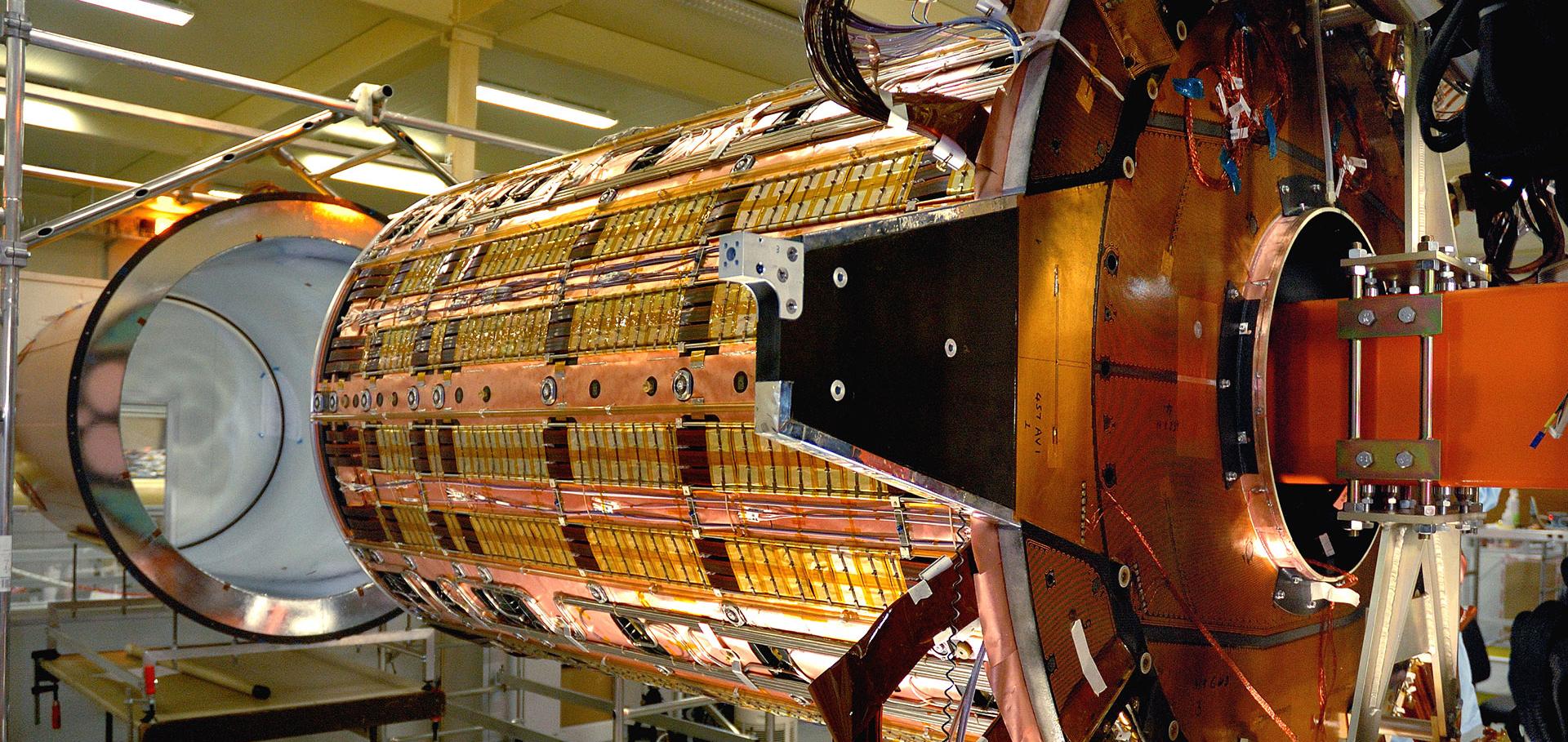
Insertion of STC into TRT at the Department of Physics, Oxford
Credit: CERN

Professor Brian Foster OBE, FRS

Donald H. Perkins Professor of Experimental Physics

Research theme

  • Accelerator physics
  • Fundamental particles and interactions

Sub department

  • Particle Physics

Research groups

  • Future Colliders
  • Plasma-Wakefield Accelerator Group
Brian.Foster@physics.ox.ac.uk
Telephone: 01865 (2)73323
Denys Wilkinson Building, room 611
Oxford May Music - An annual festival of science and music
  • About
  • Publications

THE STATUS OF THE INTERNATIONAL LINEAR COLLIDER

PARTICLE PHYSICS ON THE EVE OF LHC (2009) 65-66
More details from the publisher

Beauty photoproduction using decays into electrons at HERA

Physical Review D - Particles, Fields, Gravitation and Cosmology 78:7 (2008)

Authors:

S Chekanov, M Derrick, S Magill, B Musgrave, D Nicholass, J Repond, R Yoshida, MCK Mattingly, P Antonioli, G Bari, L Bellagamba, D Boscherini, A Bruni, G Bruni, F Cindolo, M Corradi, G Iacobucci, A Margotti, R Nania, A Polini, S Antonelli, M Basile, M Bindi, L Cifarelli, A Contin, S De Pasquale, G Sartorelli, A Zichichi, D Bartsch, I Brock, H Hartmann, E Hilger, HP Jakob, M Jüngst, OM Kind, AE Nuncio-Quiroz, E Paul, U Samson, V Schönberg, R Shehzadi, M Wlasenko, NH Brook, GP Heath, JD Morris, M Capua, S Fazio, A Mastroberardino, M Schioppa, G Susinno, E Tassi, JY Kim, ZA Ibrahim, B Kamaluddin, WAT Wan Abdullah, Y Ning, Z Ren, F Sciulli, J Chwastowski, A Eskreys, J Figiel, A Galas, M Gil, K Olkiewicz, P Stopa, L Zawiejski, L Adamczyk, T Bołd, I Grabowska-Bołd, D Kisielewska, J Łukasik, M Przybycień, L Suszycki, A Kotański, W Słomiński, U Behrens, C Blohm, A Bonato, K Borras, R Ciesielski, N Coppola, S Fang, J Fourletova, A Geiser, P Göttlicher, J Grebenyuk, I Gregor, T Haas, W Hain, A Hüttmann, F Januschek, B Kahle, II Katkov, U Klein, U Kötz, H Kowalski, E Lobodzinska, B Löhr, R Mankel, IA Melzer-Pellmann, S Miglioranzi

Abstract:

Photoproduction of beauty quarks in events with two jets and an electron associated with one of the jets has been studied with the ZEUS detector at HERA using an integrated luminosity of 120pb-1. The fractions of events containing b quarks, and also of events containing c quarks, were extracted from a likelihood fit using variables sensitive to electron identification as well as to semileptonic decays. Total and differential cross sections for beauty and charm production were measured and compared with next-to-leading-order QCD calculations and MonteCarlo models. © 2008 The American Physical Society.
More details from the publisher

Review of particle physics

667:1-5 (2008) 1-+

Authors:

C Amsler, M Doser, M Antonelli, DA Asner, KS Babu, H Baer, HR Band, RM Barnett, E Bergren, J Beringer, G Bernardi, V Bertl, H Bichsel, O Biebel, P Bloch, E Blucher, S Blusk, RN Cahn, M Carena, C Caso, A Cecccci, D Chakraborty, MC Chen, RS Chivukula, G Cowan, O Dahl, G D'Ambrosio, T Damour, A de Gouvea, T DeGrand, B Dobrescu, A Drees, DA Edwards, S Eidelman, VD Elvira, J Erler, VV Ezhela, JL Feng, W Fetscher, BD Fields, B Foster, TK Gaisser, L Garren, HJ Gerber, G Gerbier, T Gherghetta, GF Giudice, A Goodman, C Grab, AV Gritsan, JF Grivaz, DE Groom, M Grunewald, A Gurtu, T Gutsche, HE Haber, K Hagiwara, C Hagmann, KG Hayes, JJ Hernandez-Rey, K Hikasa, I Hincliliffe, A Hocker, J Huston, P Igo-Kemenes, JD Jackson, KF Johnson, T Junk, D Karlen, B Kayser, D Kirkby, SR Klein, IG Knowles, C Kolda, RV Kowalewski, P Kreitz, B Krusche, YV Kuyanov, Y Kwon, O Lahav, P Langacker, A Liddle, Z Ligeti, CJ Lin, TM Liss, L Littenberg, JC Liu, KS Lugovsky, SB Lugovsky, H Mahlke, ML Mangano, T Mannel, AV Manohar, WJ Marciano, AD Martin, A Masoni, M Milstead, R Miquel, K Moenig, H Murayama, K Nakamura, M Narain, P Nason, S Navas, P Nevski, Y Nir, KA Olive, L Pape, C Patrignani, JA Peacock, A Piepke, G Punzi, A Quadt, S Raby, G Raffelt, BN Rateliff, B Renk, P Richardson, S Roesler, S Rolli, A Romaniouk, LJ Rosenberg, JL Rosner, CT Sachrajda, Y Sakai, S Sarkar, F Sauli, O Schneider, D Scott, WG Seligman, MH Shaevitz, T Sjostrand, JG Smith, GF Smoot, S Spanier, H Spieler, A Stahl, T Stanev, SL Stone, T Surniyoshi, M Tanabashi, J Terning, M Titov, NP Tkachenko, NA Tornqvist, D Tovey, GH Trilling, TG Trippe, G Valencia, K van Bibber, MG Vincter, P Vogel, DR Ward, T Watari, BR Vebber, G Weiglein, JD Wells, M Whalley, A Wheeler, CG Wohl, L Wolfenstein, J Womersley, CL Woody, RL Workmnan, A Yamamoto, WM Yao, OV Zenin, J Zhang, RY Zhu, PA Zyla, Particle Data Grp

Abstract:

This biennial Review summarizes much of particle physics. Using data from previous editions., plus 2778 new measurements from 645 papers, we list, evaluate, and average measured properties of gauge bosons, leptons, quarks, mesons, and baryons. We also summarize searches for hypothetical particles such as Higgs bosons, heavy neutrinos, and supersymmetric particles. All the particle properties and search limits are listed in Summary Tables. We also give numerous tables, figures, formulae, and reviews of topics such as the Standard Model, particle detectors., probability, and statistics. Among the 108 reviews are many that are new or heavily revised including those on CKM quark-mixing matrix, V-ud & V-us, V-cb & V-ub, top quark, muon anomalous magnetic moment, extra dimensions, particle detectors, cosmic background radiation, dark matter, cosmological parameters, and big bang cosmology.
More details from the publisher
More details

Inclusive KS0KS0 resonance production in ep collisions at HERA

Physical Review Letters 101:11 (2008)

Authors:

S Chekanov, M Derrick, S Magill, B Musgrave, D Nicholass, J Repond, R Yoshida, MCK Mattingly, P Antonioli, G Bari, L Bellagamba, D Boscherini, A Bruni, G Bruni, F Cindolo, M Corradi, G Iacobucci, A Margotti, R Nania, A Polini, S Antonelli, M Basile, M Bindi, L Cifarelli, A Contin, S De Pasquale, G Sartorelli, A Zichichi, D Bartsch, I Brock, H Hartmann, E Hilger, HP Jakob, M Jüngst, AE Nuncio-Quiroz, E Paul, U Samson, V Schönberg, R Shehzadi, M Wlasenko, NH Brook, GP Heath, JD Morris, M Capua, S Fazio, A Mastroberardino, M Schioppa, G Susinno, E Tassi, JY Kim, ZA Ibrahim, B Kamaluddin, WAT Wan Abdullah, Y Ning, Z Ren, F Sciulli, J Chwastowski, A Eskreys, J Figiel, A Galas, M Gil, K Olkiewicz, P Stopa, L Zawiejski, L Adamczyk, T Bołd, I Grabowska-Bołd, D Kisielewska, J Åukasik, M Przybycień, L Suszycki, A Kotański, W Słomiński, U Behrens, C Blohm, A Bonato, K Borras, R Ciesielski, N Coppola, S Fang, J Fourletova, A Geiser, P Göttlicher, J Grebenyuk, I Gregor, T Haas, W Hain, A Hüttmann, F Januschek, B Kahle, II Katkov, U Klein, U Kötz, H Kowalski, E Lobodzinska, B Löhr, R Mankel, IA Melzer-Pellmann, S Miglioranzi, A Montanari

Abstract:

Inclusive KS0KS0 production in ep collisions at the DESY ep collider HERA was studied with the ZEUS detector using an integrated luminosity of 0.5fb-1. Enhancements in the mass spectrum were observed and are attributed to the production of f2(1270)/a20(1320), f2′(1525) and f0(1710). Masses and widths were obtained using a fit which takes into account theoretical predictions based on SU(3) symmetry arguments, and are consistent with the Particle Data Group values. The f0(1710) state, which has a mass consistent with a glueball candidate, was observed with a statistical significance of 5 standard deviations. However, if this state is the same as that seen in γγ→KS0KS0, it is unlikely to be a pure glueball state. © 2008 The American Physical Society.
More details from the publisher

Deep inelastic inclusive and diffractive scattering at Q2 values from 25 to 320 GeV2 with the ZEUS forward plug calorimeter

Nuclear Physics B 800:1-2 (2008) 1-76

Authors:

S Chekanov, M Derrick, S Magill, B Musgrave, D Nicholass, J Repond, R Yoshida, MCK Mattingly, M Jechow, N Pavel, P Antonioli, G Bari, L Bellagamba, D Boscherini, A Bruni, G Bruni, F Cindolo, M Corradi, G Iacobucci, A Margotti, R Nania, A Polini, S Antonelli, M Basile, M Bindi, L Cifarelli, A Contin, S De Pasquale, G Sartorelli, A Zichichi, D Bartsch, I Brock, H Hartmann, E Hilger, HP Jakob, M Jüngst, AE Nuncio-Quiroz, E Paul, R Renner, U Samson, V Schönberg, R Shehzadi, M Wlasenko, NH Brook, GP Heath, JD Morris, M Capua, S Fazio, A Mastroberardino, M Schioppa, G Susinno, E Tassi, JY Kim, ZA Ibrahim, B Kamaluddin, WAT Wan Abdullah, Y Ning, Z Ren, F Sciulli, J Chwastowski, A Eskreys, J Figiel, A Galas, M Gil, K Olkiewicz, P Stopa, L Zawiejski, L Adamczyk, T Bołd, I Grabowska-Bołd, D Kisielewska, J Łukasik, M Przybycień, L Suszycki, A Kotański, W Słomiński, U Behrens, C Blohm, A Bonato, K Borras, R Ciesielski, N Coppola, V Drugakov, S Fang, J Fourletova, A Geiser, P Göttlicher, J Grebenyuk, I Gregor, T Haas, W Hain, A Hüttmann, B Kahle, M Kasemann, II Katkov, U Klein, U Kötz, H Kowalski, H Lim, E Lobodzinska

Abstract:

Deep inelastic scattering and its diffractive component, e p → e′ γ* p → e′ X N, have been studied at HERA with the ZEUS detector using an integrated luminosity of 52.4 pb-1. The MX method has been used to extract the diffractive contribution. A wide range in the centre-of-mass energy W (37-245 GeV), photon virtuality Q2 (20-450 GeV2) and mass MX (0.28-35 GeV) is covered. The diffractive cross section for 2 < MX < 15 GeV rises strongly with W, the rise becoming steeper as Q2 increases. The data are also presented in terms of the diffractive structure function, F2D (3), of the proton. For fixed Q2 and fixed MX, xP F2D (3) shows a strong rise as xP → 0, where xP is the fraction of the proton momentum carried by the pomeron. For Bjorken-x < 1 × 10⁻³, xP F2D (3) shows positive log Q2 scaling violations, while for x ≥ 5 × 10⁻³ negative scaling violations are observed. The diffractive structure function is compatible with being leading twist. The data show that Regge factorisation is broken. © 2008 Elsevier B.V. All rights reserved.
More details from the publisher

Pagination

  • First page First
  • Previous page Prev
  • …
  • Page 29
  • Page 30
  • Page 31
  • Page 32
  • Current page 33
  • Page 34
  • Page 35
  • Page 36
  • Page 37
  • …
  • Next page Next
  • Last page Last

Footer Menu

  • Contact us
  • Giving to the Dept of Physics
  • Work with us
  • Media

User account menu

  • Log in

Follow us

FIND US

Clarendon Laboratory,

Parks Road,

Oxford,

OX1 3PU

CONTACT US

Tel: +44(0)1865272200

University of Oxfrod logo Department Of Physics text logo
IOP Juno Champion logo Athena Swan Silver Award logo

© University of Oxford - Department of Physics

Cookies | Privacy policy | Accessibility statement

Built by: Versantus

  • Home
  • Research
  • Study
  • Engage
  • Our people
  • News & Comment
  • Events
  • Our facilities & services
  • About us
  • Giving to Physics
  • Current students
  • Staff intranet