


3D Cloud reconstruction through geospatially-aware Masked Autoencoders
Workshop paper at “Machine Learning and the Physical Sciences”, NeurIPS (2024)
Abstract:
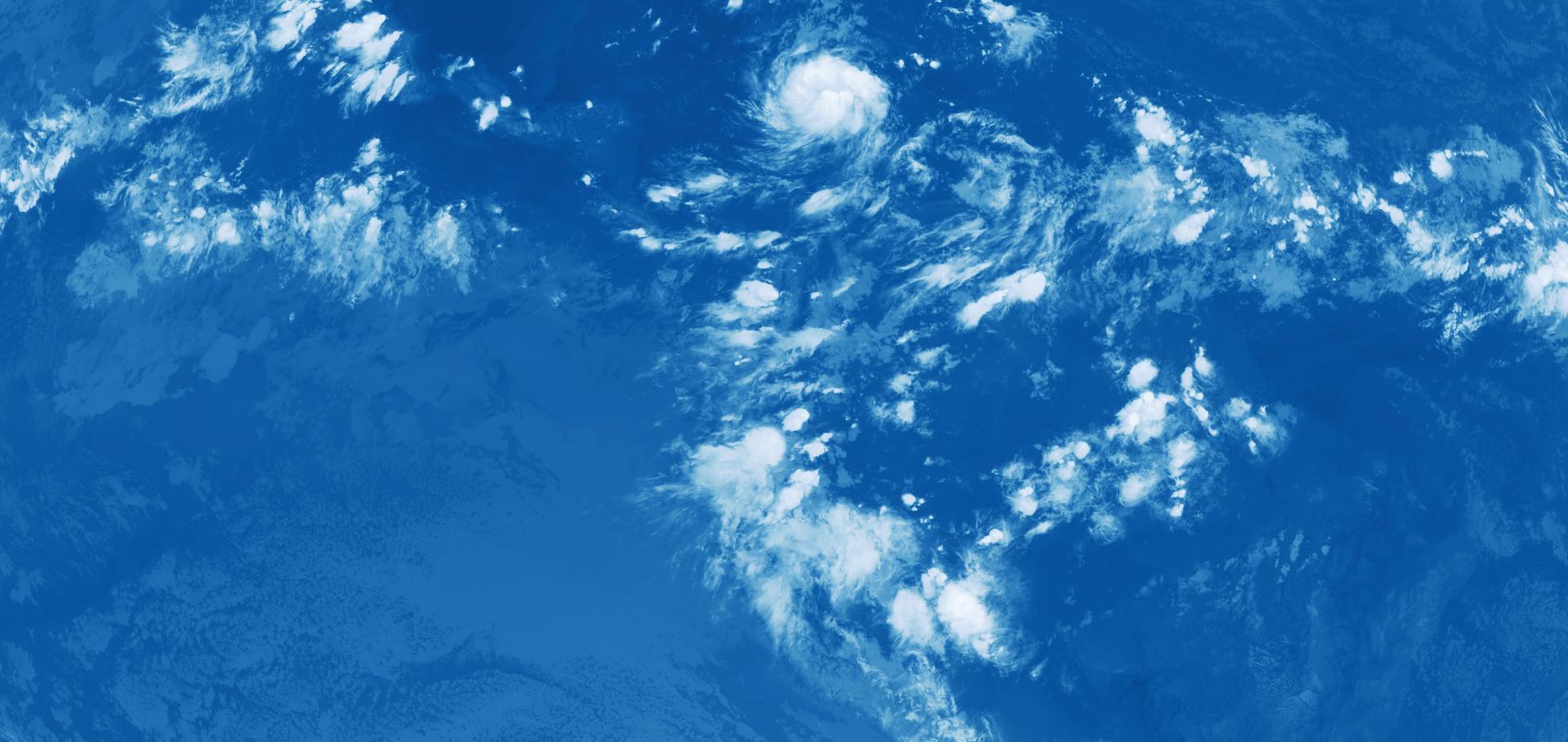
Clouds play a key role in Earth's radiation balance with complex effects that introduce large uncertainties into climate models. Real-time 3D cloud data is essential for improving climate predictions. This study leverages geostationary imagery from MSG/SEVIRI and radar reflectivity measurements of cloud profiles from CloudSat/CPR to reconstruct 3D cloud structures. We first apply self-supervised learning (SSL) methods-Masked Autoencoders (MAE) and geospatially-aware SatMAE on unlabelled MSG images, and then fine-tune our models on matched image-profile pairs. Our approach outperforms state-of-the-art methods like U-Nets, and our geospatial encoding further improves prediction results, demonstrating the potential of SSL for cloud reconstruction.
Multifractal Analysis for Evaluating the Representation of Clouds in Global Kilometre-Scale Models
Geophysical Research Letters American Geophysical Union (2024)
Multifractal Analysis for Evaluating the Representation of Clouds in Global Kilometer-Scale Models
Geophysical Research Letters, 51 (2024)
Abstract:
Clouds are one of the largest sources of uncertainty in climate predictions. Global km-scale models need to simulate clouds and precipitation accurately to predict future climates. To isolate issues in their representation of clouds, models need to be thoroughly evaluated with observations. Here, we introduce multifractal analysis as a method for evaluating km-scale simulations. We apply it to outgoing longwave radiation fields to investigate structural differences between observed and simulated anvil clouds. We compute fractal parameters which compactly characterize the scaling behavior of clouds and can be compared across simulations and observations. We use this method to evaluate the nextGEMS ICON simulations via comparison with observations from the geostationary satellite GOES-16. We find that multifractal scaling exponents in the ICON model are significantly lower than in observations. We conclude that too much variability is contained in the small scales (<100 km) leading to less organized convection and smaller, isolated anvils.
Multifractal Analysis for Evaluating the Representation of Clouds in Global Kilometre-Scale Models
(2024)
Multifractal analysis for evaluating the representation of clouds in global km-scale models
Copernicus Publications (2024)