Home
Department Of Physics text logo
  • Research
    • Our research
    • Our research groups
    • Our research in action
    • Research funding support
    • Summer internships for undergraduates
  • Study
    • Undergraduates
    • Postgraduates
  • Engage
    • For alumni
    • For business
    • For schools
    • For the public
Menu
CMP
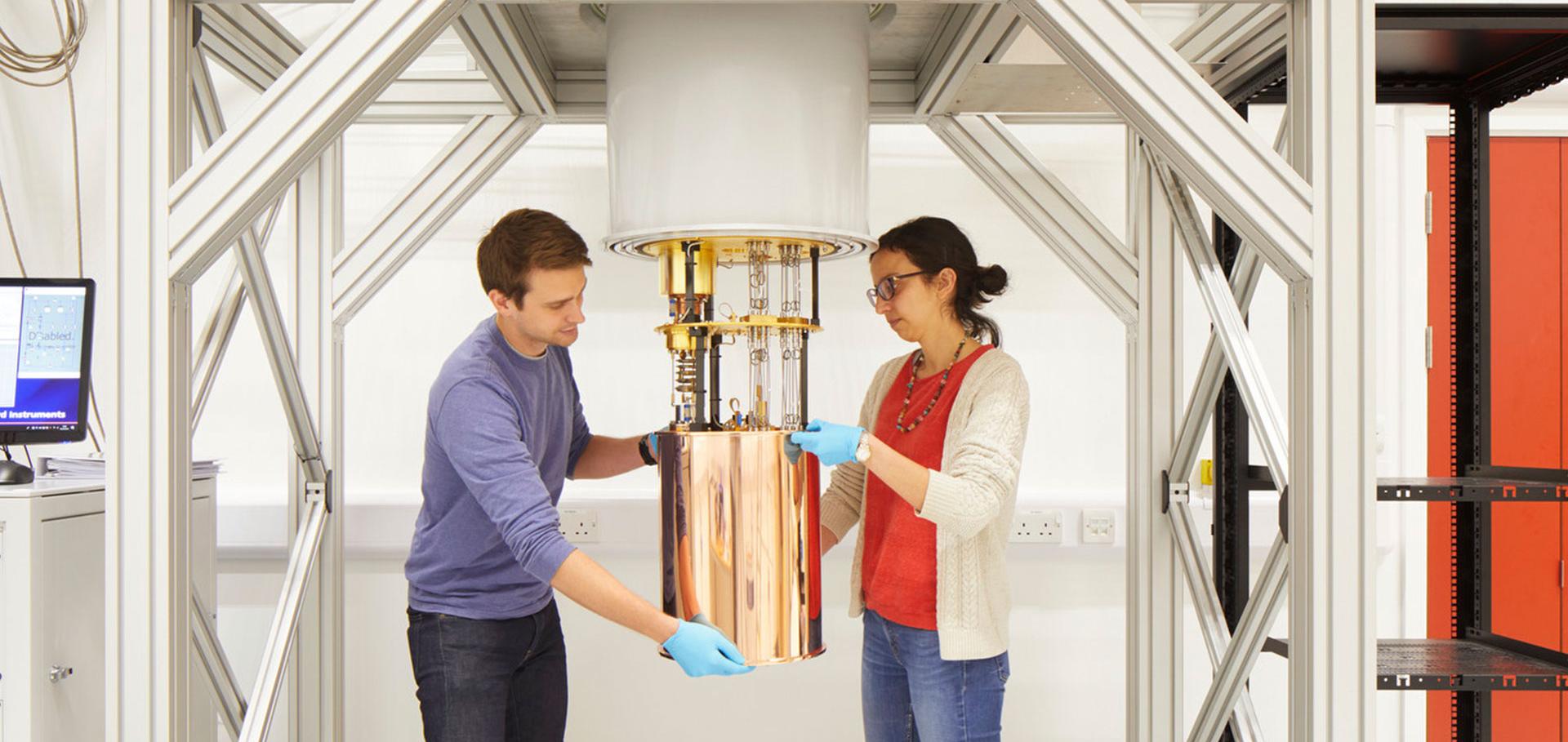
Credit: Jack Hobhouse

Dr Benjamin Huddart

PDRA

Research theme

  • Quantum materials

Sub department

  • Condensed Matter Physics

Research groups

  • Muons and magnets
benjamin.huddart@physics.ox.ac.uk
Clarendon Laboratory, room 106
  • About
  • Publications

Magnetism in M1/3NbS2 (M=Fe, V, Mn): Insight into intercalated transition metal dichalcogenides using μSR

Physical Review B American Physical Society (APS) 112:13 (2025) 134453

Authors:

NP Bentley, TL Breeze, A Hernández-Melián, TJ Hicken, BM Huddart, FL Pratt, AE Hall, DA Mayoh, G Balakrishnan, SJ Clark, T Lancaster

Abstract:

We present the results of muon-spin relaxation ( μ SR ) measurements of the static and dynamic magnetism of M 1 / 3 NbS 2 ( M = Fe ,   V ,   Mn ) , three intercalated transition-metal dichalcogenides. Transitions to long-range magnetic order are observed in all three materials, and local magnetic fields at muon sites are compared to dipole field calculations. Measurements on Fe 1 / 3 NbS 2 capture the evolution of two coexisting magnetic phases. In V 1 / 3 NbS 2 , we observe a peak in the dynamic response at 9 K, coincident with previous reports of a possible low-temperature phase transition. The observation of high-frequency muon precession in Mn 1 / 3 NbS 2 suggests the existence of an additional muon site that implies a difference in the electronic energy landscape compared to the other materials in the series. Taken together, this demonstrates that the change in intercalant species drives significant variations in magnetism, highlighting the M 1 / 3 NbS 2 series as an ideal group of materials for investigating a wide range of magnetic phenomena.
More details from the publisher

Magnetic field induced ordering in the spin-12 chiral chain compound [Cu(pym)(H2O)4]SiF6·H2O

Physical Review B American Physical Society (APS) 112:5 (2025) 054414

Authors:

Rebecca Scatena, Alberto Hernández-Melián, Benjamin M Huddart, Sam Curley, Robert C Williams, Pascal Manuel, Stephen J Blundell, Zurab Guguchia, Zachary E Manson, Jamie L Manson, G Timothy Noe, John Singleton, Tom Lancaster, Paul A Goddard, Roger D Johnson

Abstract:

We present single-crystal neutron diffraction, powder muon spin rotation, and pulsed-field magnetometry measurements on the Heisenberg quantum chiral chain [ Cu ( pym ) ( H 2 O ) 4 ] SiF 6 · H 2 O (pym = pyrimidine), which displays a fourfold-periodic rotation of the local environment around the Cu() S = 1 / 2 ions from site to site along the chain. Previous measurements on this material have shown the absence of magnetic order down to surprisingly low temperatures ≥ 20  mK, as well as the presence of an energy gap for magnetic excitations that grows linearly with magnetic field. Here we find evidence at dilution refrigerator temperatures for a field-induced transition to long-range magnetic order above an applied magnetic field of 3 T. From the polarization of magnetic moments observed with magnetic fields applied in the [ − 1 , 2 , 0 ] direction, we can identify the static magnetic structure that best accounts for the data. The proposed model is supported microscopically by the presence of an alternating component of the g tensor, which produces an internal twofold staggered field that dictates both the direction of the ordered moments and the effective coupling between adjacent chains. The observed magnetic structure is contrary to previous proposals for the departure of the magnitude and field dependence of the energy gap from the predictions of the sine-Gordon model.
More details from the publisher
More details

Spin Dynamics in the Dirac U(1) Spin Liquid YbZn2GaO5

Physical Review Letters American Physical Society (APS) 135:4 (2025) 046704

Authors:

Hank CH Wu, Francis L Pratt, Benjamin M Huddart, Dipranjan Chatterjee, Paul A Goddard, John Singleton, D Prabhakaran, Stephen J Blundell

Abstract:

YbZn 2 GaO 5 is a promising candidate for realizing a quantum spin liquid (QSL) state, particularly owing to its lack of significant site disorder. Pulsed-field magnetometry at 0.5 K shows magnetization saturating near 15 T, with a corrected saturation moment of 2.1 ( 1 ) μ B after subtracting the van Vleck contribution. Our zero-field μ SR measurements down to milliKelvin temperatures provide evidence for a dynamic ground state and the absence of magnetic order. To probe fluctuations in the local magnetic field at the muon site, we performed longitudinal field μ SR experiments. These results provide evidence for spin dynamics with a field dependence that is consistent with a U1A01 Dirac quantum spin liquid as a plausible description of the ground state.
More details from the publisher
More details
More details

Structure and magnetism of La x Sr 2− x Co 0.5 Ir 0.5 O 4− y H y (0 < x < 1) iridium-containing oxyhydride phases †

Dalton Transactions Royal Society of Chemistry (2025)

Authors:

James I Murrell, Romain Wernert, Hank CH Wu, Benjamin M Huddart, Stephen J Blundell, Ronald I Smith, Michael A Hayward

Abstract:

Ruddlesden-Popper oxide phases in the LaxSr2−xCo0.5Ir0.5O4 (0 < x < 1) solid solution can be converted to the corresponding LaxSr2−xCo0.5Ir0.5O4−yHy oxyhydride phases, by topochemical reaction with LiH, in which the hydride ions are substituted exclusively onto the equatorial anion sites of the host framework. Analysis reveals that oxyhydride phases in the range 0.5 < x < 1 adopt LaxSr2−xCo0.5Ir0.5O2+xH2−x compositions which maintain a constant Co1+, Ir3+ oxidation-state combination (confirmed by Co K-edge XANES data), with the presence of low-spin d6 Ir3+ being consistent with the covalent stabilization of the metastable oxyhydride phases via strong Ir–H σ-bonds. Phases at the lanthanum-poor end of the solid solution (x < 0.5) adopt LaxSr2−xCo0.5Ir0.5O4−yHy compositions with lower hydride concentrations (y < 1.5). Magnetisation and μSR data indicate that all the LaxSr2−xCo0.5Ir0.5O4−yHy oxyhydride phases exhibit strong magnetic frustration, attributed to the large-scale cation and anion disorder, and resulting in glassy magnetic behaviour at low temperature.
More details from the publisher
Details from ORA
More details
More details

Electronic structure calculations for muon spectroscopy * * This article presents a summary of the state of the art of computational simulations for muon science. All authors have contributed equally to it

Electronic Structure IOP Publishing 7:2 (2025) 023001

Authors:

Stephen J Blundell, Miki Bonacci, Pietro Bonfà, Roberto De Renzi, Benjamin M Huddart, Tom Lancaster, Leandro M Liborio, Ifeanyi J Onuorah, Giovanni Pizzi, Francis L Pratt, John M Wilkinson

Abstract:

Muon spectroscopy has become a leading tool for the investigation of local magnetic fields in condensed matter physics, finding applications in the study of superconductivity, magnetism, ionic diffusion in battery materials, and numerous other fields. Though the muon yields quantitative information about the material, this can only be fully interpreted if the nature of the muon site and its stability is fully understood. Electronic structure calculations are of paramount importance for providing this understanding, particularly through a group of techniques that has become known as DFT +μ, density functional theory including the presence of the implanted muon. We describe how these electronic structure calculations can be used to underpin muon spectroscopy, and some examples of the science that follows from this, as well as some of the available software tools that are currently being developed.
More details from the publisher
Details from ORA
More details

Pagination

  • Current page 1
  • Page 2
  • Page 3
  • Page 4
  • Page 5
  • Page 6
  • Page 7
  • Page 8
  • Page 9
  • …
  • Next page Next
  • Last page Last

Footer Menu

  • Contact us
  • Giving to the Dept of Physics
  • Work with us
  • Media

User account menu

  • Log in

Follow us

FIND US

Clarendon Laboratory,

Parks Road,

Oxford,

OX1 3PU

CONTACT US

Tel: +44(0)1865272200

University of Oxfrod logo Department Of Physics text logo
IOP Juno Champion logo Athena Swan Silver Award logo

© University of Oxford - Department of Physics

Cookies | Privacy policy | Accessibility statement

Built by: Versantus

  • Home
  • Research
  • Study
  • Engage
  • Our people
  • News & Comment
  • Events
  • Our facilities & services
  • About us
  • Giving to Physics
  • Current students
  • Staff intranet