Home
Department Of Physics text logo
  • Research
    • Our research
    • Our research groups
    • Our research in action
    • Research funding support
    • Summer internships for undergraduates
  • Study
    • Undergraduates
    • Postgraduates
  • Engage
    • For alumni
    • For business
    • For schools
    • For the public
Menu
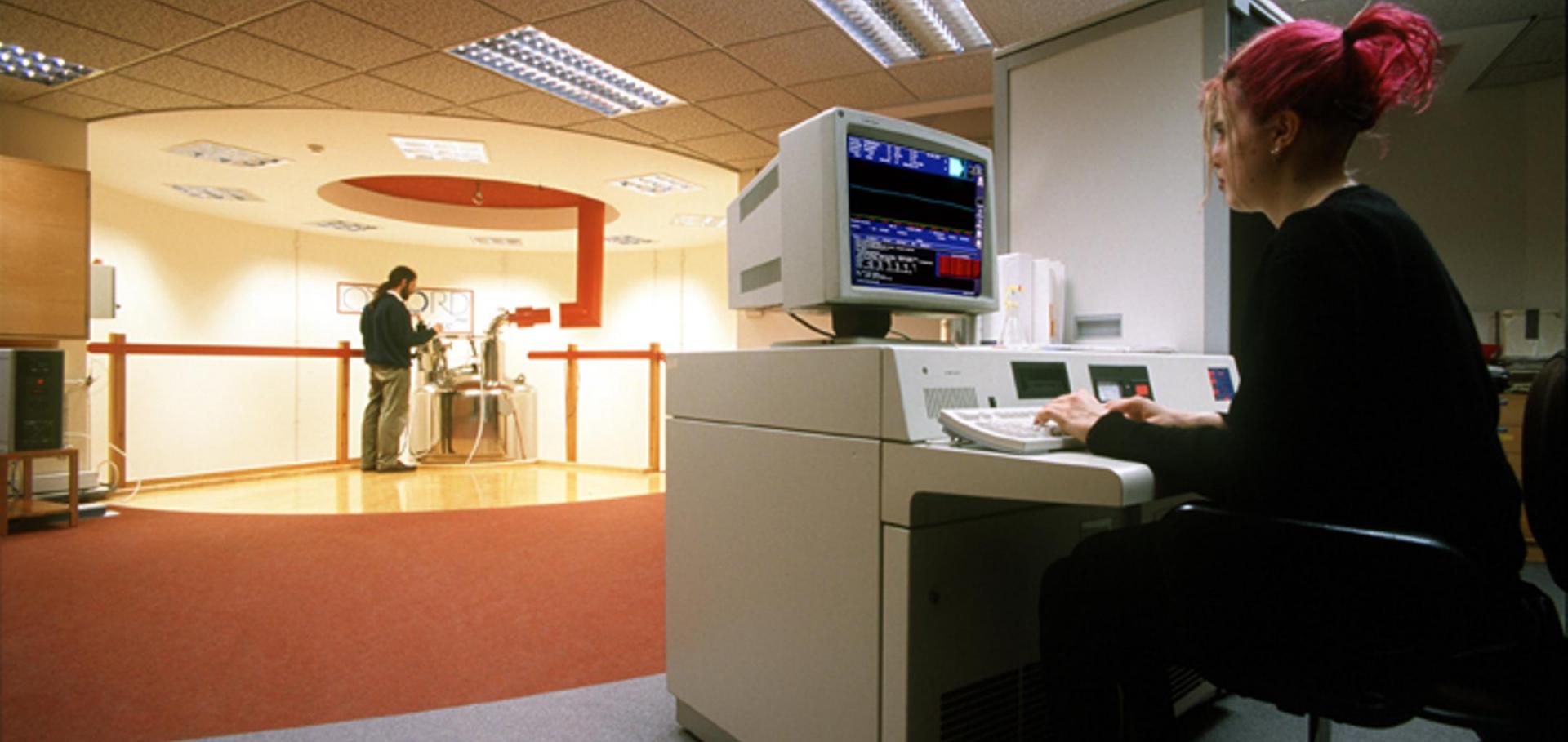
The Oxford 750MHz NMR Spectrometer

The Oxford 750MHz NMR Spectrometer

Prof Jonathan Jones

Professor of Physics

Research theme

  • Quantum information and computation

Sub department

  • Atomic and Laser Physics

Research groups

  • NMR quantum computing
jonathan.jones@physics.ox.ac.uk
  • About
  • Publications

A combined parahydrogen and theoretical study of H2 activation by 16-electron d8 ruthenium(0) complexes and their subsequent catalytic behaviour

DALTON TRANSACTIONS (2004) 3616-3628

Authors:

JP Dunne, D Blazina, S Aiken, HA Carteret, SB Duckett, JA Jones, R Poli, AC Whitwood
More details from the publisher
More details

Course 10 Nuclear magnetic resonance quantum computation

Les Houches - Ecole d'Ete de Physique Theorique Elsevier 79 (2004) 357-400
More details from the publisher

Implementation of NMR quantum computation with parahydrogen-derived high-purity quantum states

PHYSICAL REVIEW A 70:3 (2004) ARTN 032324

Authors:

MS Anwar, JA Jones, D Blazina, SB Duckett, HA Carteret
More details from the publisher
Details from ArXiV

Implementing Grover's quantum search on a para-hydrogen based pure state NMR quantum computer

CHEMICAL PHYSICS LETTERS 400:1-3 (2004) 94-97

Authors:

MS Anwar, D Blazina, HA Carteret, SB Duckett, JA Jones
More details from the publisher
Details from ArXiV

Nuclear magnetic resonance quantum computation

LES HOUCH S 79 (2004) 357-+

Abstract:

Nuclear Magnetic Resonance (NMR) is arguably both the best and the worst technology we have for the implementation of small quantum computers. Its strengths lie in the ease with which arbitrary unitary transformations can be implemented, and the great experimental simplicity arising from the low energy scale and long time scale of radio frequency transitions; its weaknesses lie in the difficulty of implementing essential non-unitary operations, most notably initialisation and measurement. This course will explore both the strengths and weaknesses of NMR as a quantum technology, and describe some topics of current interest.
More details

Pagination

  • First page First
  • Previous page Prev
  • …
  • Page 18
  • Page 19
  • Page 20
  • Page 21
  • Current page 22
  • Page 23
  • Page 24
  • Page 25
  • Page 26
  • …
  • Next page Next
  • Last page Last

Footer Menu

  • Contact us
  • Giving to the Dept of Physics
  • Work with us
  • Media

User account menu

  • Log in

Follow us

FIND US

Clarendon Laboratory,

Parks Road,

Oxford,

OX1 3PU

CONTACT US

Tel: +44(0)1865272200

University of Oxfrod logo Department Of Physics text logo
IOP Juno Champion logo Athena Swan Silver Award logo

© University of Oxford - Department of Physics

Cookies | Privacy policy | Accessibility statement

Built by: Versantus

  • Home
  • Research
  • Study
  • Engage
  • Our people
  • News & Comment
  • Events
  • Our facilities & services
  • About us
  • Giving to Physics
  • Current students
  • Staff intranet