Home
Department Of Physics text logo
  • Research
    • Our research
    • Our research groups
    • Our research in action
    • Research funding support
    • Summer internships for undergraduates
  • Study
    • Undergraduates
    • Postgraduates
  • Engage
    • For alumni
    • For business
    • For schools
    • For the public
  • Support
Menu
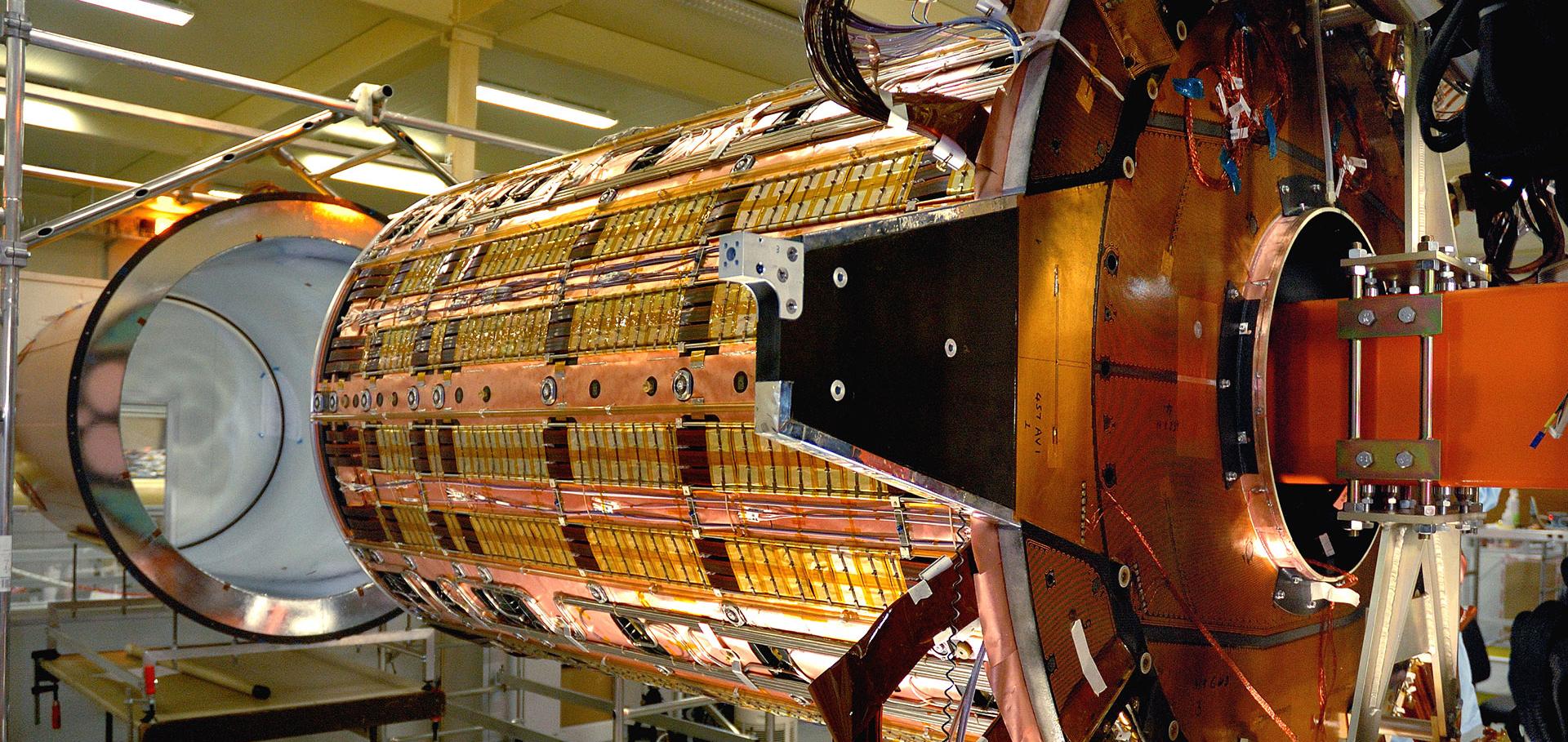
Insertion of STC into TRT at the Department of Physics, Oxford
Credit: CERN

Minoo Kabirnezhad

Royal Society Fellow

Sub department

  • Particle Physics
minoo.kabirnezhad@physics.ox.ac.uk
Telephone: 273449
Denys Wilkinson Building, room 679
  • About
  • Publications

Combined analysis of neutrino and antineutrino oscillations at T2K

Physical Review Letters American Physical Society 118:15 (2017) 151801

Authors:

K Abe, J Amey, C Andreopoulos, Giles D Barr, David Coplowe, Stephen Dolan, Xianguo Lu, Raj Shah, Tomislav Vladisavljevic, David L Wark, Alfons JG Weber

Abstract:

T2K reports its first results in the search for CP violation in neutrino oscillations using appearance and disappearance channels for neutrino- and antineutrino-mode beams. The data include all runs from January 2010 to May 2016 and comprise 7.482×10^{20} protons on target in neutrino mode, which yielded in the far detector 32 e-like and 135  μ-like events, and 7.471×10^{20} protons on target in antineutrino mode, which yielded 4 e-like and 66  μ-like events. Reactor measurements of sin^{2}2θ_{13} have been used as an additional constraint. The one-dimensional confidence interval at 90% for the phase δ_{CP} spans the range (-3.13, -0.39) for normal mass ordering. The CP conservation hypothesis (δ_{CP}=0, π) is excluded at 90% C.L.
More details from the publisher
Details from ORA
More details
More details
Details from ArXiV

First measurement of the muon neutrino charged current single pion production cross section on water with the T2K near detector

Physical Review D American Physical Society 95:1 (2017)

Authors:

K Abe, C Andreopoulos, M Antonova, S Aoki, A Ariga, S Assylbekov, D Autiero, S Ban, M Barbi, GJ Barker, Giles Barr, P Bartet-Friburg, M Batkiewicz, F Bay, V Berardi, S Berkman, S Bhadra, S Bienstock, A Blondel, S Bolognesi, S Bordoni, SB Boyd, D Brailsford, A Bravar, C Bronner, M Buizza Avanzini, RG Calland, T Campbell, S Cao, J Caravaca Rodríguez, SL Cartwright, R Castillo, A Cervera, D Cherdack, N Chikuma, G Christodoulou, A Clifton, J Coleman, G Collazuol, David Coplowe, L Cremonesi, A Dabrowska, G De Rosa, T Dealtry, PF Denner, C Densham, D Dewhurst, F Di Lodovico

Abstract:

The T2K off-axis near detector, ND280, is used to make the first differential cross section measurements of muon neutrino charged current single positive pion production on a water target at energies ∼0.8 GeV. The differential measurements are presented as a function of the muon and pion kinematics, in the restricted phase space defined by pπ+>200 MeV/c, pμ>200 MeV/c, cos(θπ+)>0.3 and cos(θμ)>0.3. The total flux integrated νμ charged current single positive pion production cross section on water in the restricted phase space is measured to be σ
More details from the publisher
Details from ORA
More details
Details from ArXiV

Measurement of coherent π^{+} production in low energy neutrino-carbon scattering

Physical Review Letters American Physical Society 117:19 (2016) 192501

Authors:

K Abe, C Andreopoulos, M Antonova, Giles Barr, David Coplowe, Debra Dewhurst, Stephen Dolan, Kirsty Duffy, Abraham Jacob, Xianguo Lu, Raj Shah, Antonin Vacheret, David Wark, Alfons Weber, Et Et al.

Abstract:

We report the first measurement of the flux-averaged cross section for charged current coherent πþ production on carbon for neutrino energies less than 1.5 GeV, and with a restriction on the final state phase space volume in the T2K near detector, ND280. Comparisons are made with predictions from the ReinSehgal coherent production model and the model by Alvarez-Ruso et al., the latter representing the first implementation of an instance of the new class of microscopic coherent models in a neutrino interaction Monte Carlo event generator. We observe a clear event excess above background, disagreeing with the null results reported by K2K and SciBooNE in a similar neutrino energy region. The measured flux-averaged cross sections are below those predicted by both the Rein-Sehgal and Alvarez-Ruso et al. models.
More details from the publisher
Details from ORA
More details
More details
Details from ArXiV

Measurement of double-differential muon neutrino charged-current interactions on C8H8 without pions in the final state using the T2K off-axis beam

Physical Review D American Physical Society 93:11 (2016) 112012

Authors:

Giles D Barr, Debra Dewhurst, Stephen Dolan, Kirsty E Duffy, Abraham Jacob, Xianguo Lu, Raj Shah, Antonin Vacheret, David L Wark, Alfons Weber

Abstract:

We report the measurement of muon neutrino charged-current interactions on carbon without pions in the final state at the T2K beam energy using 5.734×10²⁰ protons on target. For the first time the measurement is reported as a flux-integrated, double-differential cross section in muon kinematic variables (cosθμ, pμ), without correcting for events where a pion is produced and then absorbed by final state interactions. Two analyses are performed with different selections, background evaluations and cross-section extraction methods to demonstrate the robustness of the results against biases due to model-dependent assumptions. The measurements compare favorably with recent models which include nucleon-nucleon correlations but, given the present precision, the measurement does not distinguish among the available models. The data also agree with Monte Carlo simulations which use effective parameters that are tuned to external data to describe the nuclear effects. The total cross section in the full phase space is σ=(0.417±0.047(syst)±0.005(stat))×10-38 cm2 nucleon-1 and the cross section integrated in the region of phase space with largest efficiency and best signal-over-background ratio (cosθμ>0.6 and pμ>200 MeV) is σ=(0.202±0.036(syst)±0.003(stat))×10-38 cm2 nucleon-1.
More details from the publisher
Details from ORA
More details
Details from ArXiV

Measurement of muon antineutrino oscillations with an accelerator-produced off-axis beam.

Physical Review Letters American Physical Society 116:18 (2016) 181801

Authors:

Giles D Barr, Debra Dewhurst, Stephen Dolan, Kirsty E Duffy, Abraham Jacob, Xianguo Lu, Raj Shah, Antonin Vacheret, David L Wark, Alfons Weber

Abstract:

T2K reports its first measurements of the parameters governing the disappearance of ν¯μ in an off-axis beam due to flavor change induced by neutrino oscillations. The quasimonochromatic ν¯μ beam, produced with a peak energy of 0.6 GeV at J-PARC, is observed at the far detector Super-Kamiokande, 295 km away, where the ν¯μ survival probability is expected to be minimal. Using a data set corresponding to 4.01×10²⁰ protons on target, 34 fully contained μ-like events were observed. The best-fit oscillation parameters are sin2(θ¯23)=0.45 and |Δm¯232|=2.51×10⁻³  eV2 with 68% confidence intervals of 0.38–0.64 and 2.26–2.80×10⁻³  eV2, respectively. These results are in agreement with existing antineutrino parameter measurements and also with the νμ disappearance parameters measured by T2K.
More details from the publisher
Details from ORA
More details
More details
Details from ArXiV

Pagination

  • First page First
  • Previous page Prev
  • Page 1
  • Page 2
  • Page 3
  • Current page 4
  • Page 5
  • Page 6
  • Page 7
  • Next page Next
  • Last page Last

Footer Menu

  • Contact us
  • Giving to the Dept of Physics
  • Work with us
  • Media

User account menu

  • Log in

Follow us

FIND US

Clarendon Laboratory,

Parks Road,

Oxford,

OX1 3PU

CONTACT US

Tel: +44(0)1865272200

University of Oxfrod logo Department Of Physics text logo
IOP Juno Champion logo Athena Swan Silver Award logo

© University of Oxford - Department of Physics

Cookies | Privacy policy | Accessibility statement

Built by: Versantus

  • Home
  • Research
  • Study
  • Engage
  • Our people
  • News & Comment
  • Events
  • Our facilities & services
  • About us
  • Giving to Physics
  • Current students
  • Staff intranet