Home
Department Of Physics text logo
  • Research
    • Our research
    • Our research groups
    • Our research in action
    • Research funding support
    • Summer internships for undergraduates
  • Study
    • Undergraduates
    • Postgraduates
  • Engage
    • For alumni
    • For business
    • For schools
    • For the public
Menu
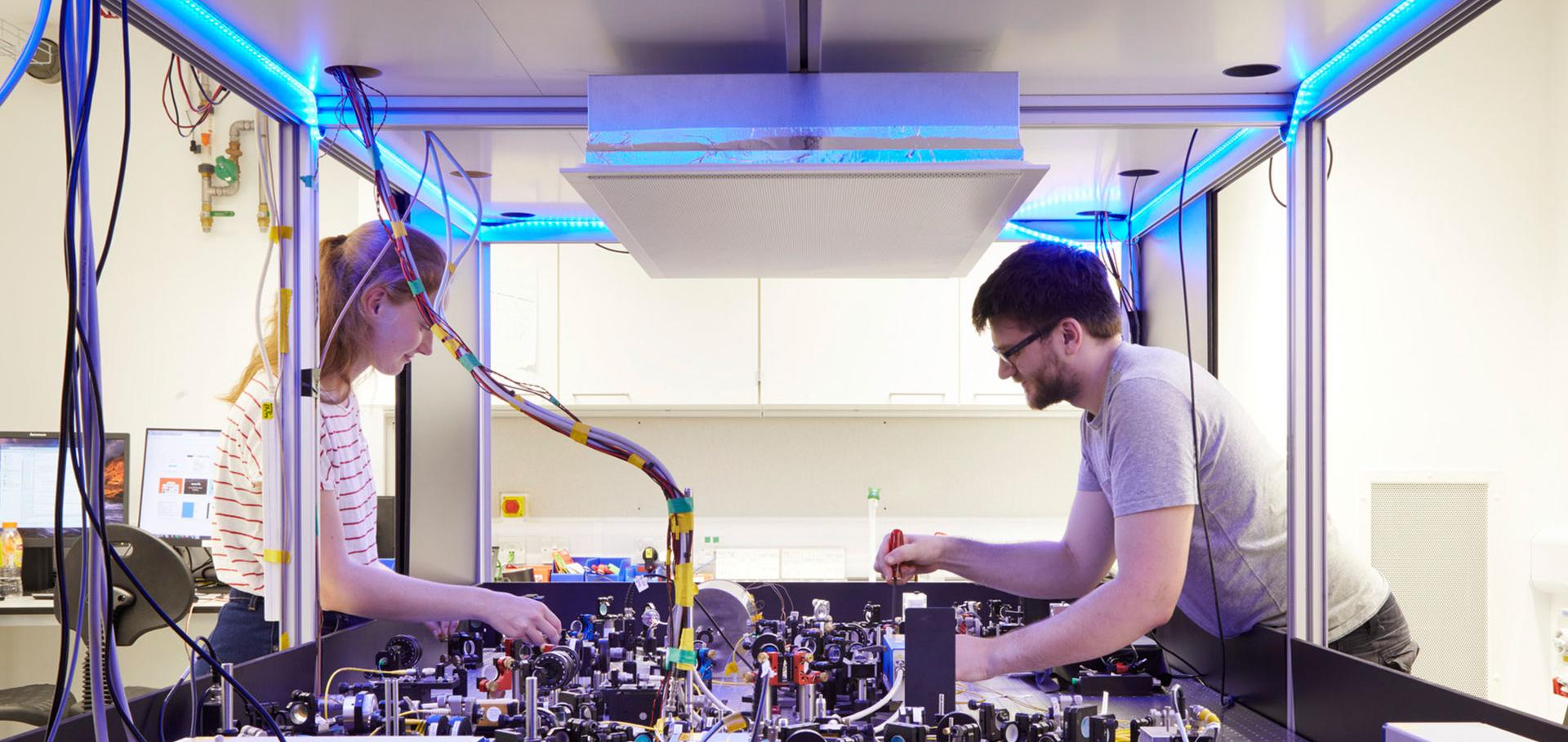
Atomic and Laser Physics
Credit: Jack Hobhouse

Efstratios Kritikos

Postdoctoral Research Associate

Sub department

  • Atomic and Laser Physics
efstratios.kritikos@physics.ox.ac.uk
Clarendon Laboratory, room Simon Room
  • About
  • Publications

Can electrostatic stresses affect charged water structures in weakly ionized plasmas?

Physics of Plasmas AIP Publishing 32:6 (2025) 063702

Authors:

Efstratios M Kritikos, William A Goddard, Paul M Bellan

Abstract:

This theoretical and numerical study investigates the impact of electrostatic stresses on the shape of charged water structures (grains) in weakly ionized plasmas. We developed an analytic model to predict the conditions under which a grain in a plasma is deformed. We find that electrostatic stresses can overcome the opposing surface tension stresses on nanometer-scale grains, causing initially spherical clusters to elongate and become ellipsoidal. The exact size limit of the grain for which electrostatic stress will dominate depends on the floating potential, surface tension, and local radius of curvature. Clusters larger than this limit are not affected by electrostatic stresses due to an insufficient number of electrons on the surface. The model is compared to Molecular Dynamics (MD) simulations performed with a calculated solvated electron potential on initially spherical grains of 2.5 nm radius charged with 0.5%–1% electrons. We find excellent agreement between MD simulations and the analytic theory. We also carried out Quantum Mechanics (QM) computations showing that the surface tension increases with decreasing size of the water molecule cluster and increases even more with the addition of solvated electrons. This increase in surface tension can hinder the elongation of the grains. Our QM computations also show that on the nanosecond time scale, the binding force of electrons to water molecule clusters is stronger than the electrostatic repulsion between adjacent electrons and thus the cluster behaves as an insulator. However, consideration of the very small conductivity of ice shows that on time scales of a fraction of a second, ice clusters behave as conductors, so their surface may be considered to be at an equipotential.
More details from the publisher

Effect of Electric Fields on the Decomposition of Phosphate Esters.

The journal of physical chemistry. C, Nanomaterials and interfaces 128:38 (2024) 15959-15973

Authors:

Zhaoran Zhu, James P Ewen, Efstratios M Kritikos, Andrea Giusti, Daniele Dini

Abstract:

Phosphate esters decompose on metal surfaces and form protective polyphosphate films. For many applications, such as in lubricants for electric vehicles and wind turbines, an understanding of the effect of electric fields on molecular decomposition is urgently required. Experimental investigations have yielded contradictory results, with some suggesting that electric fields improve tribological performance, while others have reported the opposite effect. Here, we use nonequilibrium molecular dynamics (NEMD) simulations to study the decomposition of tri-n-butyl phosphate (TNBP) molecules nanoconfined between ferrous surfaces (iron and iron oxide) under electrostatic fields. The reactive force field (ReaxFF) method is used to model the effects of chemical bonding and molecular dissociation. We show that the charge transfer with the polarization current equalization (QTPIE) method gives more realistic behavior compared to the standard charge equilibration (QEq) method under applied electrostatic fields. The rate of TNBP decomposition via carbon-oxygen bond dissociation is faster in the nanoconfined systems than that in the bulk due to the catalytic action of the surfaces. In all cases, the application of an electric field accelerates TNBP decomposition. When electric fields are applied to the confined systems, the phosphate anions are pulled toward the surface with high electric potential, while the alkyl cations are pulled to the surface with lower potential, leading to asymmetric film growth. Analysis of the temperature- and electric field strength-dependent dissociation rate constants using the Arrhenius equation suggests that, on reactive iron surfaces, the increased reactivity under an applied electric field is driven mostly by an increase in the pre-exponential factor, which is linked to the number of molecule-surface collisions. Conversely, the accelerated decomposition of TNBP on iron oxide surfaces can be attributed to a reduction in the activation energy with increasing electric field strength. Single-molecule nudged-elastic band (NEB) calculations also show a linear reduction in the energy barrier for carbon-oxygen bond breaking with electric field strength, due to stabilization of the charged transition state. The simulation results are consistent with experimental observations of enhanced and asymmetric tribofilm growth under electrostatic fields.
More details from the publisher
More details

Investigation of Iron Nanoparticle Oxidation under External Electrostatic Fields Using Reactive Molecular Dynamics

The Journal of Physical Chemistry C American Chemical Society (ACS) 128:30 (2024) 12364-12385

Authors:

Efstratios M Kritikos, Andrea Giusti
More details from the publisher

Effect of Electric Fields on the Decomposition of Phosphate Esters

(2024)

Authors:

Zhaoran Zhu, James P Ewen, Efstratios M Kritikos, Andrea Giusti, Daniele Dini
More details from the publisher

Investigation of the effect of electrostatic fields and iron nanoparticles on hydrogen-oxygen combustion

Proceedings of the Combustion Institute Elsevier BV 40:1-4 (2024) 105769

Authors:

Emin Saridede, Efstratios M Kritikos, Andrea Giusti
More details from the publisher

Pagination

  • Current page 1
  • Page 2
  • Page 3
  • Next page Next
  • Last page Last

Footer Menu

  • Contact us
  • Giving to the Dept of Physics
  • Work with us
  • Media

User account menu

  • Log in

Follow us

FIND US

Clarendon Laboratory,

Parks Road,

Oxford,

OX1 3PU

CONTACT US

Tel: +44(0)1865272200

University of Oxfrod logo Department Of Physics text logo
IOP Juno Champion logo Athena Swan Silver Award logo

© University of Oxford - Department of Physics

Cookies | Privacy policy | Accessibility statement

Built by: Versantus

  • Home
  • Research
  • Study
  • Engage
  • Our people
  • News & Comment
  • Events
  • Our facilities & services
  • About us
  • Giving to Physics
  • Current students
  • Staff intranet