Home
Department Of Physics text logo
  • Research
    • Our research
    • Our research groups
    • Our research in action
    • Research funding support
    • Summer internships for undergraduates
  • Study
    • Undergraduates
    • Postgraduates
  • Engage
    • For alumni
    • For business
    • For schools
    • For the public
Menu
CMP
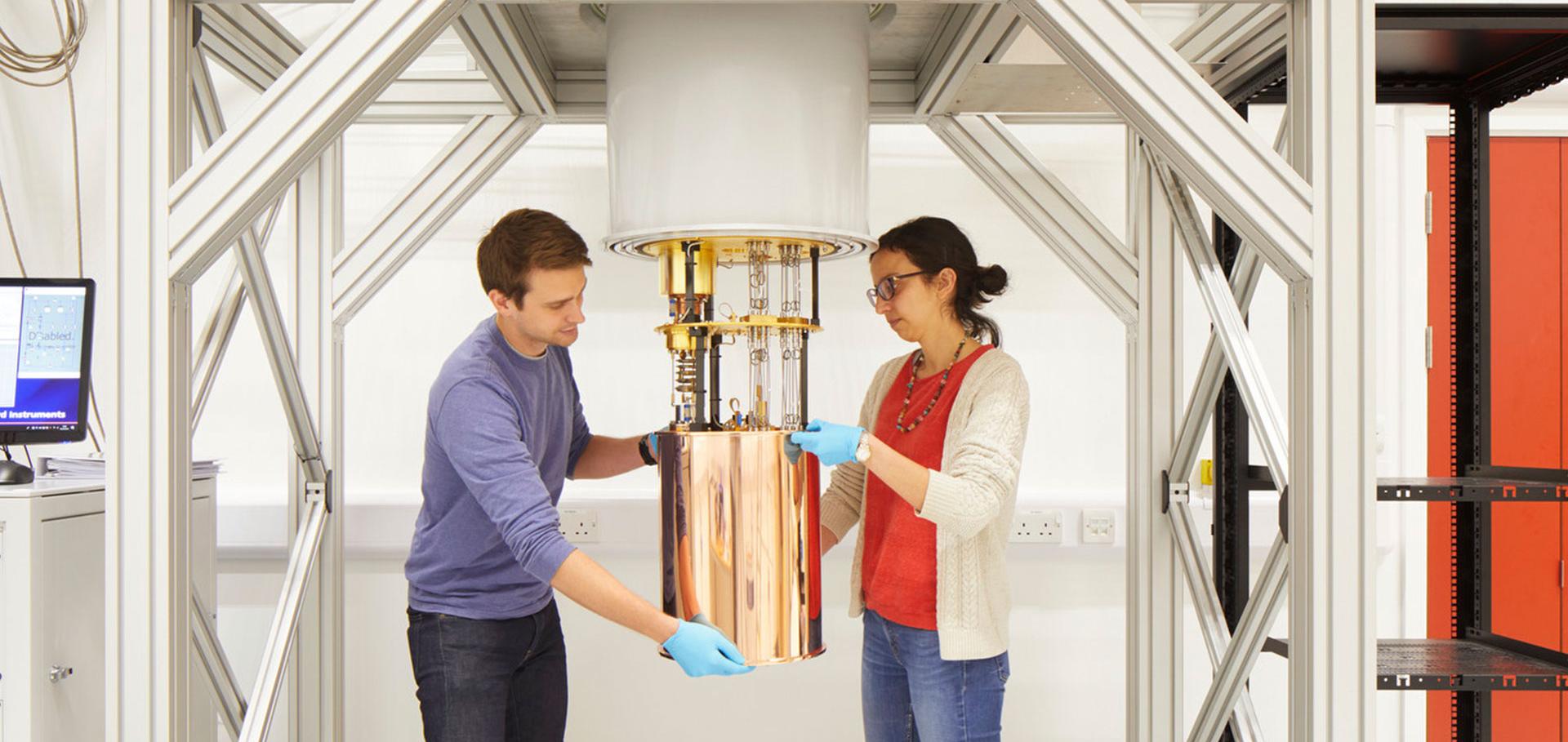
Credit: Jack Hobhouse

Peter Leek

Research Fellow

Sub department

  • Condensed Matter Physics

Research groups

  • Superconducting quantum devices
peter.leek@physics.ox.ac.uk
Telephone: 01865 (2)72364,01865 (2)82066
Clarendon Laboratory, room 018,104
  • About
  • Publications

High Coherence in a Tileable 3D Integrated Superconducting Circuit Architecture

(2021)

Authors:

Peter A Spring, Shuxiang Cao, Takahiro Tsunoda, Giulio Campanaro, Simone D Fasciati, James Wills, Vivek Chidambaram, Boris Shteynas, Mustafa Bakr, Paul Gow, Lewis Carpenter, James Gates, Brian Vlastakis, Peter J Leek
More details from the publisher
Details from ArXiV

Circuit Quantum Electrodynamics with Carbon-Nanotube-Based Superconducting Quantum Circuits

PHYSICAL REVIEW APPLIED 15:6 (2021) 64050

Authors:

Matthias Mergenthaler, Ani Nersisyan, Andrew Patterson, Martina Esposito, Andreas Baumgartner, Christian Schonenberger, G Andrew D Briggs, Edward A Laird, Peter J Leek

Abstract:

Hybrid circuit QED involves the study of coherent quantum physics in solid-state systems via their interactions with superconducting microwave circuits. Here we present a crucial step in the implementation of a hybrid superconducting qubit that employs a carbon nanotube as a Josephson junction. We realize the junction by contacting a carbon nanotube with a superconducting Pd/Al bilayer, and implement voltage tunability of the quantum circuit's frequency using a local electrostatic gate. We demonstrate a strong dispersive coupling to a coplanar waveguide resonator by investigating the gate-tunable resonator frequency. We extract qubit parameters from spectroscopy using dispersive readout and find qubit relaxation and coherence times in the range of 10-200ns.
More details from the publisher
Details from ORA
More details
Details from ArXiV

Critical slowing down in circuit quantum electrodynamics

Science Advances American Association for the Advancement of Science 7:21 (2021) eabe9492

Authors:

Paul Brookes, Giovanna Tancredi, Andrew D Patterson, Joseph Rahamim, Martina Esposito, Themistoklis K Mavrogordatos, Peter J Leek, Eran Ginossar, Marzena H Szymanska

Abstract:

Critical slowing down of the time it takes a system to reach equilibrium is a key signature of bistability in dissipative first-order phase transitions. Understanding and characterizing this process can shed light on the underlying many-body dynamics that occur close to such a transition. Here, we explore the rich quantum activation dynamics and the appearance of critical slowing down in an engineered superconducting quantum circuit. Specifically, we investigate the intermediate bistable regime of the generalized Jaynes-Cummings Hamiltonian (GJC), realized by a circuit quantum electrodynamics (cQED) system consisting of a transmon qubit coupled to a microwave cavity. We find a previously unidentified regime of quantum activation in which the critical slowing down reaches saturation and, by comparing our experimental results with a range of models, we shed light on the fundamental role played by the qubit in this regime.
More details from the publisher
Details from ORA
More details
More details

Radio-frequency characterization of a supercurrent transistor made from a carbon nanotube

(2021)

Authors:

M Mergenthaler, FJ Schupp, A Nersisyan, N Ares, A Baumgartner, C Schönenberger, GAD Briggs, PJ Leek, EA Laird
More details from the publisher
Details from ArXiV

Efficient Hamiltonian programming in qubit arrays with nearest-neighbor couplings

Physical Review A American Physical Society 102:3 (2020) 32405

Authors:

Takahiro Tsunoda, Gaurav Bhole, Stephen A Jones, Jonathan A Jones, Peter J Leek

Abstract:

We consider the problem of selectively controlling couplings in a practical quantum processor with always-on interactions that are diagonal in the computational basis, using sequences of local not gates. This methodology is well known in nuclear magnetic resonance implementations, but previous approaches do not scale efficiently for the general fully connected Hamiltonian, where the complexity of finding time-optimal solutions makes them only practical up to a few tens of qubits. Given the rapid growth in the number of qubits in cutting-edge quantum processors, it is of interest to investigate the applicability of this control scheme to much larger-scale systems with realistic restrictions on connectivity. Here we present an efficient scheme to find near time-optimal solutions that can be applied to engineered qubit arrays with local connectivity for any number of qubits, indicating the potential for practical quantum computing in such systems.
More details from the publisher
Details from ORA
More details
Details from ArXiV

Pagination

  • First page First
  • Previous page Prev
  • …
  • Page 2
  • Page 3
  • Page 4
  • Page 5
  • Current page 6
  • Page 7
  • Page 8
  • Page 9
  • Page 10
  • …
  • Next page Next
  • Last page Last

Footer Menu

  • Contact us
  • Giving to the Dept of Physics
  • Work with us
  • Media

User account menu

  • Log in

Follow us

FIND US

Clarendon Laboratory,

Parks Road,

Oxford,

OX1 3PU

CONTACT US

Tel: +44(0)1865272200

University of Oxfrod logo Department Of Physics text logo
IOP Juno Champion logo Athena Swan Silver Award logo

© University of Oxford - Department of Physics

Cookies | Privacy policy | Accessibility statement

Built by: Versantus

  • Home
  • Research
  • Study
  • Engage
  • Our people
  • News & Comment
  • Events
  • Our facilities & services
  • About us
  • Giving to Physics
  • Current students
  • Staff intranet