Home
Department Of Physics text logo
  • Research
    • Our research
    • Our research groups
    • Our research in action
    • Research funding support
    • Summer internships for undergraduates
  • Study
    • Undergraduates
    • Postgraduates
  • Engage
    • For alumni
    • For business
    • For schools
    • For the public
  • Support
Menu
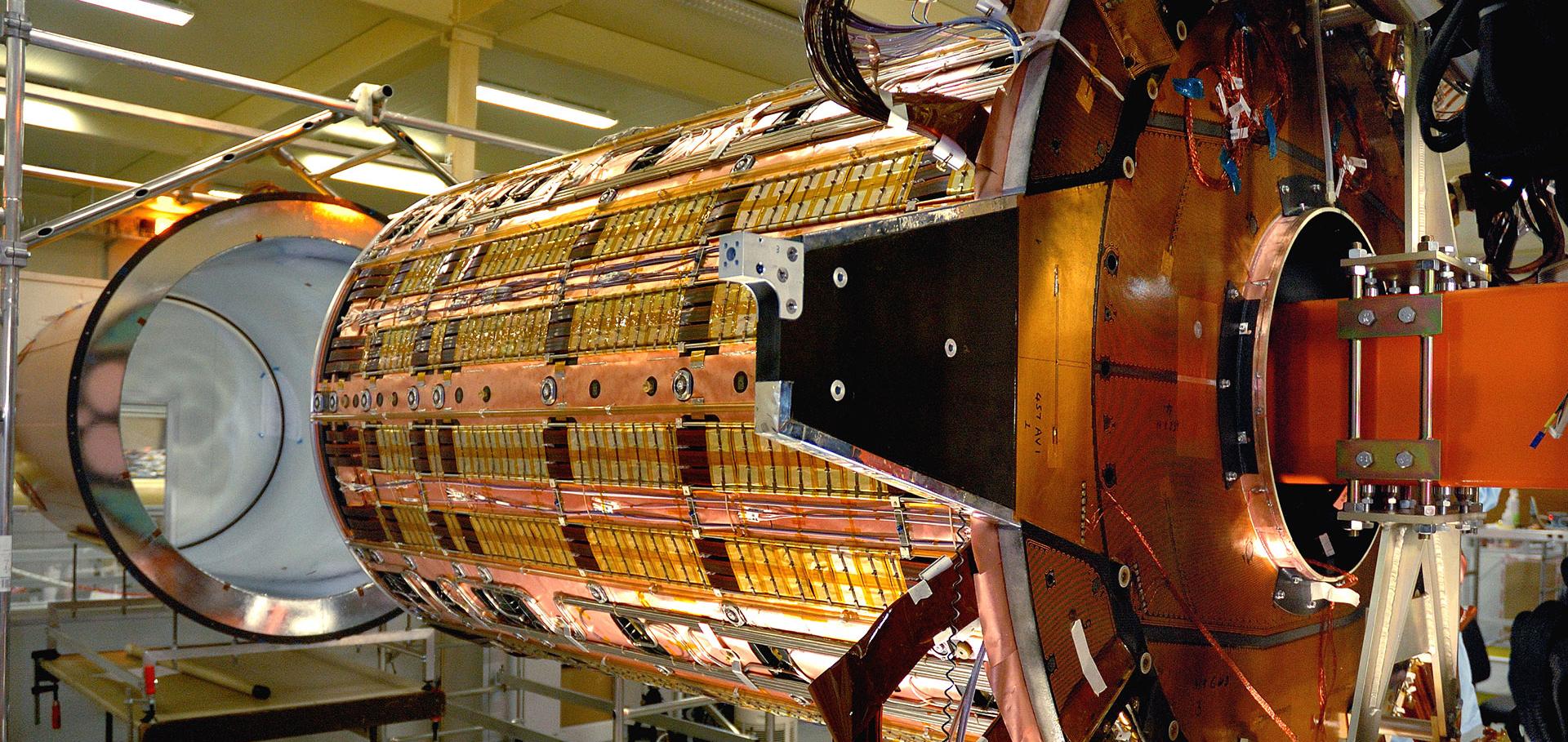
Insertion of STC into TRT at the Department of Physics, Oxford
Credit: CERN

Sneha Malde

Associate Professor of Physics

Sub department

  • Particle Physics

Research groups

  • LHCb
Sneha.Malde@physics.ox.ac.uk
Telephone: 01865 (2)73357
Denys Wilkinson Building, room 673
  • About
  • Publications

Measurement of the CP violation parameter AΓ in D0→K+K- and D0→π+π- decays.

Physical Review Letters American Physical Society 118:26 (2017) 261803

Authors:

R Aaij, B Adeva, M Adinolfi, Tim Evans, Paolo Gandini, Barak R Gruberg Cazon, Thomas Hadavizadeh, Neville Harnew, Donal Hill, Pawel G Jalocha, Malcolm JJ John, Nathan P Jurik, Sneha Malde, Anita K Nandi, Alexandra Rollings, Stig Topp-Joergensen, Giovanni Veneziano, Guy Wilkinson

Abstract:

Asymmetries in the time-dependent rates of D0→K+K- and D0→π+π- decays are measured in a pp collision data sample collected with the LHCb detector during LHC Run 1, corresponding to an integrated luminosity of 3  fb^-1. The asymmetries in effective decay widths between D0 and D¯0 decays, sensitive to indirect CP violation, are measured to be AΓ(K+K-)=(-0.30±0.32±0.10)×10^-3 and AΓ(π+π-)=(0.46±0.58±0.12)×10^-3, where the first uncertainty is statistical and the second systematic. These measurements show no evidence for CP violation and improve on the precision of the previous best measurements by nearly a factor of two.
More details from the publisher
Details from ORA
More details
More details
Details from ArXiV

Measurement of the J/ψ pair production cross-section in pp collisions at √s = 13 TeV

Journal of High Energy Physics Springer 2017:6 (2017) 47

Authors:

R Aaij, B Adeva, M Adinolfi, Tim Evans, Paolo Gandini, Barak R Gruberg Cazon, Thomas Hadavizadeh, Neville Harnew, Donal R Hill, Pawel G Jalocha, Malcolm JJ John, Nathan P Jurik, Sneha Malde, Anita K Nandi, Alexandra Rollings, Stigg Topp-Joergensen, Giovanni Veneziano, Guy R Wilkinson

Abstract:

The production cross-section of J/ψ pairs is measured using a data sample of pp collisions collected by the LHCb experiment at a centre-of-mass energy of s=13 TeV, corresponding to an integrated luminosity of 279 ±11 pb −1 . The measurement is performed for J/ψ mesons with a transverse momentum of less than 10 GeV/c in the rapidity range 2.0 < y < 4.5. The production cross-section is measured to be 15.2 ± 1.0 ± 0.9 nb. The first uncertainty is statistical, and the second is systematic. The differential cross-sections as functions of several kinematic variables of the J/ψ pair are measured and compared to theoretical predictions.
More details from the publisher
Details from ORA
More details
Details from ArXiV

Measurements of prompt charm production cross-sections in pp collisions at s√=5 TeV

Journal of High Energy Physics Springer 2017 (2017) 147

Authors:

R Aaij, B Adeva, M Adinolfi, Tim Evans, Paolo Gandini, Barak R Gruberg Cazon, Thomas Hadavizadeh, Neville Harnew, Donal Hill, Pawel G Jalocha, Malcolm JJ John, Nathan P Jurik, Sneha Malde, Anita K Nandi, Alexandra Rollings, Stig Topp-Joergensen, Giovanni Veneziano, Guy Wilkinson

Abstract:

Production cross-sections of prompt charm mesons are measured using data from pp collisions at the LHC at a centre-of-mass energy of 5TeV. The data sample corresponds to an integrated luminosity of 8:60 ± 0:33 pb^-1 collected by the LHCb experiment. The production cross-sections of D0, D+, D+s, and D*+ mesons are measured in bins of charm meson transverse momentum, pT, and rapidity, y. They cover the rapidity range 2:0 < y < 4:5 and transverse momentum ranges 0 < pT < 10 GeV=c for D0 and D+ and 1 < pT < 10 GeV=c for D+s and D*+ mesons. The inclusive cross-sections for the four mesons, including charge-conjugate states, within the range of 1 < pT < 8 GeV=c are determined to be

σ(pp → D0X) = 1004 ± 3 ± 54 μb;

σ(pp → D+X) = 402 ± 2 ± 30 μb;

σ(pp → D+s X) = 170 ± 4 ± 16 μb;

σ(pp → D*+X) = 421 ± 5 ± 36 μb

where the uncertainties are statistical and systematic, respectively.

More details from the publisher
Details from ORA

Observation of the decay Λb0 → pK−μ+μ− and a search for CP violation

Journal of High Energy Physics Springer 2017:6 (2017) 108

Authors:

R Aaij, B Adeva, M Adinolfi, Tim Evans, Paolo Gandini, Barak R Gruberg Cazon, Thomas Hadavizadeh, Neville Harnew, Donal R Hill, Pawel G Jalocha, Malcolm JJ John, Nathan P Jurik, Sneha Malde, Anita K Nandi, Alexandra Rollings, Stigg Topp-Joergensen, Giovanni Veneziano, Guy R Wilkinson

Abstract:

A search for CP violation in the decay Λb0 → pK−μ+μ− is presented. This decay is mediated by flavour-changing neutral-current transitions in the Standard Model and is potentially sensitive to new sources of CP violation. The study is based on a data sample of proton-proton collisions recorded with the LHCb experiment, corresponding to an integrated luminosity of 3 fb^−1. The Λb0 → pK−μ+μ− decay is observed for the first time, and two observables that are sensitive to different manifestations of CP violation are measured, ΔACP ≡ ACP(Λ0b→pK−μ+μ−) − ACP(Λ0b→pK−J/ψ) and a aT-odd/CP, where the latter is based on asymmetries in the angle between the μ+μ− and pK− decay planes. These are measured to be ΔACP = (−3.5 ±5.0(stat) ±0.2(syst))×10^−2, aT-odd/CP = (1.2 ±5.0 (stat) ±0.7 (syst))×10^−2,and no evidence for CP violation is found.
More details from the publisher
Details from ORA
More details
Details from ArXiV
More details

Observation of the Ξb−→J/ψΛK− decay

Physics Letters B Elsevier 772 (2017) 265-273

Authors:

R Aaij, B Adeva, M Adinolfi, Tim Evans, Paolo Gandini, Barak R Gruberg Cazon, Thomas Hadavizadeh, Neville Harnew, Donal R Hill, Pawel G Jalocha, Malcolm JJ John, Nathan P Jurik, Sneha Malde, Anita K Nandi, Alexandra Rollings, Stigg Topp-Joergensen, Giovanni Veneziano, Guy R Wilkinson

Abstract:

The observation of the decay Ξ b − →J/ψΛK − is reported, using a data sample corresponding to an integrated luminosity of 3fb −1 , collected by the LHCb detector in pp collisions at centre-of-mass energies of 7 and 8TeV. The production rate of Ξ b − baryons detected in the decay Ξ b − →J/ψΛK − is measured relative to that of Λ b 0 baryons using the decay Λ b 0 →J/ψΛ. Integrated over the b-baryon transverse momentum p T < 25GeV/c and rapidity 2.0 < y < 4.5, the measured ratio is [Formula presented][Formula presented] =(4.19±0.29 (stat)±0.15 (syst))×10 −2 , where f Ξ b − and f Λ b 0 are the fragmentation fractions of b→Ξ b − and b→Λ b 0 transitions, and B represents the branching fraction of the corresponding b-baryon decay. The mass difference between Ξ b − and Λ b 0 baryons is measured to be M(Ξ b − )−M(Λ b 0 )=177.08±0.47 (stat)±0.16 (syst)MeV/c 2 .
More details from the publisher
Details from ORA
More details
Details from ArXiV

Pagination

  • First page First
  • Previous page Prev
  • …
  • Page 181
  • Page 182
  • Page 183
  • Page 184
  • Current page 185
  • Page 186
  • Page 187
  • Page 188
  • Page 189
  • …
  • Next page Next
  • Last page Last

Footer Menu

  • Contact us
  • Giving to the Dept of Physics
  • Work with us
  • Media

User account menu

  • Log in

Follow us

FIND US

Clarendon Laboratory,

Parks Road,

Oxford,

OX1 3PU

CONTACT US

Tel: +44(0)1865272200

University of Oxfrod logo Department Of Physics text logo
IOP Juno Champion logo Athena Swan Silver Award logo

© University of Oxford - Department of Physics

Cookies | Privacy policy | Accessibility statement

Built by: Versantus

  • Home
  • Research
  • Study
  • Engage
  • Our people
  • News & Comment
  • Events
  • Our facilities & services
  • About us
  • Giving to Physics
  • Current students
  • Staff intranet