Home
Department Of Physics text logo
  • Research
    • Our research
    • Our research groups
    • Our research in action
    • Research funding support
    • Summer internships for undergraduates
  • Study
    • Undergraduates
    • Postgraduates
  • Engage
    • For alumni
    • For business
    • For schools
    • For the public
  • Support
Menu
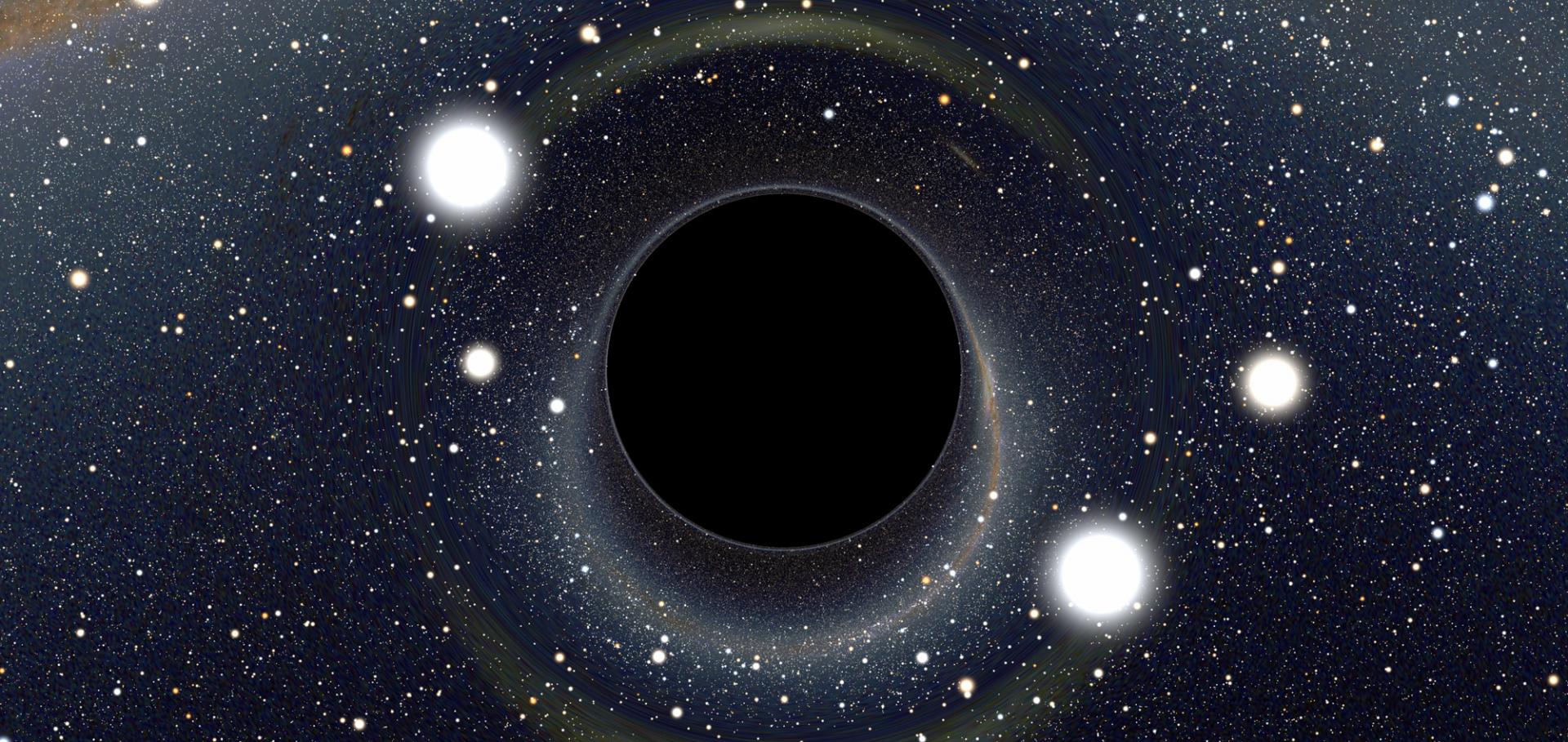
Black Hole

Lensing of space time around a black hole. At Oxford we study black holes observationally and theoretically on all size and time scales - it is some of our core work.

Credit: ALAIN RIAZUELO, IAP/UPMC/CNRS. CLICK HERE TO VIEW MORE IMAGES.

Sara Motta

visitor

Sub department

  • Astrophysics
sara.motta@physics.ox.ac.uk
  • About
  • Publications

Long term radio monitoring of the neutron star X-ray binary Swift J1858.6-0814

(2022)

Authors:

L Rhodes, RP Fender, SE Motta, J van den Eijnden, DRA Williams, JS Bright, GR Sivakoff
More details from the publisher
Details from ArXiV

Quasi-periodic whispers from a transient ULX in M 101: signatures of a fast-spinning neutron star?

Monthly Notices of the Royal Astronomical Society Oxford University Press (OUP) 511:3 (2022) 4528-4550

Authors:

Ryan T Urquhart, Roberto Soria, Rosanne Di Stefano, Kaiming Cui, Paolo Esposito, Gian Luca Israel, Sammarth Kumar, Sara Motta, Fabio Pintore, Giacomo Riva
More details from the publisher
More details

Radio and X-Ray Observations of the Luminous Fast Blue Optical Transient AT 2020xnd

The Astrophysical Journal American Astronomical Society 926:2 (2022) 112-112

Authors:

Joe S Bright, Raffaella Margutti, David Matthews, Daniel Brethauer, Deanne Coppejans, Mark H Wieringa, Brian D Metzger, Lindsay DeMarchi, Tanmoy Laskar, Charles Romero, Kate D Alexander, Assaf Horesh, Giulia Migliori, Ryan Chornock, E Berger, Michael Bietenholz, Mark J Devlin, Simon R Dicker, WV Jacobson-Galán, Brian S Mason, Dan Milisavljevic, Sara E Motta, Tony Mroczkowski, Enrico Ramirez-Ruiz, Lauren Rhodes

Abstract:

The deaths of massive stars are sometimes accompanied by the launch of highly relativistic and collimated jets. If the jet is pointed towards Earth, we observe a "prompt" gamma-ray burst due to internal shocks or magnetic reconnection events within the jet, followed by a long-lived broadband synchrotron afterglow as the jet interacts with the circum-burst material. While there is solid observational evidence that emission from multiple shocks contributes to the afterglow signature, detailed studies of the reverse shock, which travels back into the explosion ejecta, are hampered by a lack of early-time observations, particularly in the radio band. We present rapid follow-up radio observations of the exceptionally bright gamma-ray burst GRB 221009A which reveal an optically thick rising component from the reverse shock in unprecedented detail both temporally and in frequency space. From this, we are able to constrain the size, Lorentz factor, and internal energy of the outflow while providing accurate predictions for the location of the peak frequency of the reverse shock in the first few hours after the burst.Comment: 11 figures, 4 table
More details from the publisher
Details from ORA
More details
More details

Recurrent X-ray flares of the black hole candidate in the globular cluster RZ 2109 in NGC 4472

ArXiv 2202.08478 (2022)

Authors:

A Tiengo, P Esposito, M Toscani, G Lodato, M Arca Sedda, SE Motta, F Contato, M Marelli, R Salvaterra, A De Luca
Details from ArXiV

Phase-resolved spectroscopy of a quasi-periodic oscillation in the black hole X-ray binary GRS 1915+105 with NICER and NuSTAR

Monthly Notices of the Royal Astronomical Society Oxford University Press (OUP) 511:1 (2022) 255-279

Authors:

Edward Nathan, Adam Ingram, Jeroen Homan, Daniela Huppenkothen, Phil Uttley, Michiel van der Klis, Sara Motta, Diego Altamirano, Matthew Middleton
More details from the publisher
More details

Pagination

  • First page First
  • Previous page Prev
  • …
  • Page 8
  • Page 9
  • Page 10
  • Page 11
  • Current page 12
  • Page 13
  • Page 14
  • Page 15
  • Page 16
  • …
  • Next page Next
  • Last page Last

Footer Menu

  • Contact us
  • Giving to the Dept of Physics
  • Work with us
  • Media

User account menu

  • Log in

Follow us

FIND US

Clarendon Laboratory,

Parks Road,

Oxford,

OX1 3PU

CONTACT US

Tel: +44(0)1865272200

University of Oxfrod logo Department Of Physics text logo
IOP Juno Champion logo Athena Swan Silver Award logo

© University of Oxford - Department of Physics

Cookies | Privacy policy | Accessibility statement

Built by: Versantus

  • Home
  • Research
  • Study
  • Engage
  • Our people
  • News & Comment
  • Events
  • Our facilities & services
  • About us
  • Giving to Physics
  • Current students
  • Staff intranet