Home
Department Of Physics text logo
  • Research
    • Our research
    • Our research groups
    • Our research in action
    • Research funding support
    • Summer internships for undergraduates
  • Study
    • Undergraduates
    • Postgraduates
  • Engage
    • For young people
    • For teachers
    • For the public
    • For alumni
    • For business
  • Support
Menu
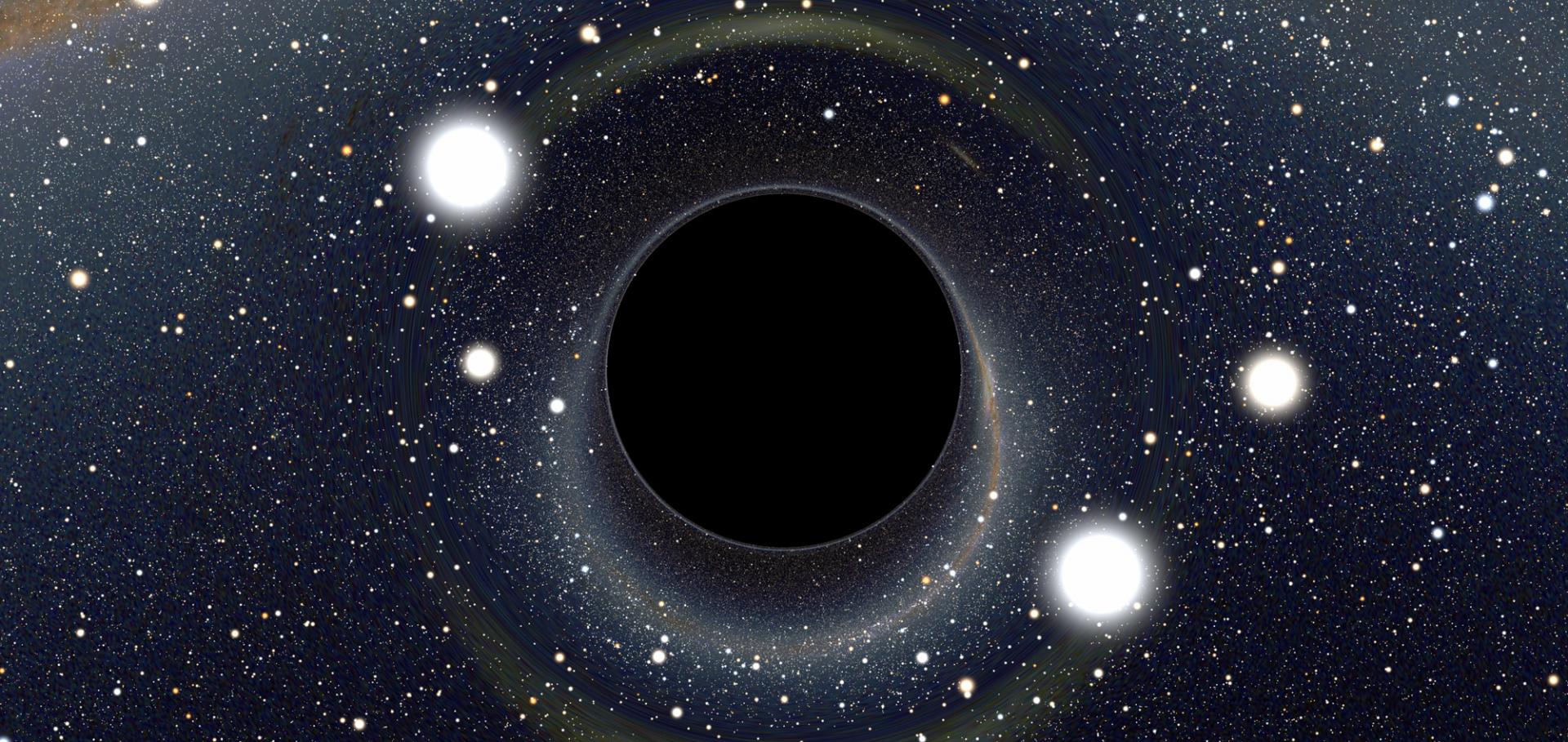
Black Hole

Lensing of space time around a black hole. At Oxford we study black holes observationally and theoretically on all size and time scales - it is some of our core work.

Credit: ALAIN RIAZUELO, IAP/UPMC/CNRS. CLICK HERE TO VIEW MORE IMAGES.

Sara Motta

visitor

Sub department

  • Astrophysics
sara.motta@physics.ox.ac.uk
  • About
  • Publications

The hybrid radio/X-ray correlation of the black hole transient MAXI J1348-630

Monthly Notices of the Royal Astronomical Society Oxford University Press 505:1 (2021) L58-L63

Authors:

F Carotenuto, S Corbel, E Tremou, Td Russell, A Tzioumis, Rp Fender, Pa Woudt, Se Motta, Jca Miller-Jones, Aj Tetarenko, Gr Sivakoff

Abstract:

Black hole (BH) low mass X-ray binaries in their hard spectral state are found to display two different correlations between the radio emission from the compact jets and the X-ray emission from the inner accretion flow. Here, we present a large data set of quasi-simultaneous radio and X-ray observations of the recently discovered accreting BH MAXI J1348–630 during its 2019/2020 outburst. Our results span almost six orders of magnitude in X-ray luminosity, allowing us to probe the accretion–ejection coupling from the brightest to the faintest phases of the outburst. We find that MAXI J1348–630 belongs to the growing population of outliers at the highest observed luminosities. Interestingly, MAXI J1348–630 deviates from the outlier track at LX ≲ 7 × 1035(D/2.2  kpc)2 erg s−1 and ultimately rejoins the standard track at LX ≃ 1033(D/2.2 kpc)2 erg s−1, displaying a hybrid radio/X-ray correlation, observed only in a handful of sources. However, for MAXI J1348–630 these transitions happen at luminosities much lower than what observed for similar sources (at least an order of magnitude). We discuss the behaviour of MAXI J1348–630 in light of the currently proposed scenarios and highlight the importance of future deep monitorings of hybrid correlation sources, especially close to the transitions and in the low luminosity regime.
More details from the publisher
Details from ORA
More details

The Varying Kinematics of Multiple Ejecta from the Black Hole X-ray Binary MAXI J1820+070

(2021)

Authors:

CM Wood, JCA Miller-Jones, J Homan, JS Bright, SE Motta, RP Fender, S Markoff, TM Belloni, EG Körding, D Maitra, S Migliari, DM Russell, TD Russell, CL Sarazin, R Soria, AJ Tetarenko, V Tudose
More details from the publisher
Details from ArXiV

The INTEGRAL view on Black Hole X-ray Binaries

ArXiv 2105.05547 (2021)

Authors:

SE Motta, J Rodriguez, E Jourdain, M Del Santo, G Belanger, F Cangemi, V Grinberg, JJE Kajava, E Kuulkers, J Malzac, K Pottschmidt, JP Roques, C Sanchez-Fernandez, J Wilms
Details from ArXiV

The hybrid radio/X-ray correlation of the black hole transient MAXI J1348-630

(2021)

Authors:

F Carotenuto, S Corbel, E Tremou, TD Russell, A Tzioumis, RP Fender, PA Woudt, SE Motta, JCA Miller-Jones, AJ Tetarenko, GR Sivakoff
More details from the publisher
Details from ArXiV

The rare X-ray flaring activity of the ultraluminous X-ray source NGC 4559 X7

Monthly Notices of the Royal Astronomical Society Oxford University Press (OUP) 504:1 (2021) 551-564

Authors:

Fabio Pintore, S Motta, C Pinto, MG Bernardini, G Rodriguez-Castillo, R Salvaterra, GL Israel, P Esposito, E Ambrosi, C Salvaggio, L Zampieri, A Wolter
More details from the publisher
More details

Pagination

  • First page First
  • Previous page Prev
  • …
  • Page 13
  • Page 14
  • Page 15
  • Page 16
  • Current page 17
  • Page 18
  • Page 19
  • Page 20
  • Page 21
  • …
  • Next page Next
  • Last page Last

Footer Menu

  • Contact us
  • Giving to the Dept of Physics
  • Work with us
  • Media

User account menu

  • Log in

Follow us

FIND US

Clarendon Laboratory,

Parks Road,

Oxford,

OX1 3PU

CONTACT US

Tel: +44(0)1865272200

University of Oxfrod logo Department Of Physics text logo
IOP Juno Champion logo Athena Swan Silver Award logo

© University of Oxford - Department of Physics

Cookies | Privacy policy | Accessibility statement

Built by: Versantus

  • Home
  • Research
  • Study
  • Engage
  • Our people
  • News & Comment
  • Events
  • Our facilities & services
  • About us
  • Giving to Physics
  • Current students
  • Staff intranet