Home
Department Of Physics text logo
  • Research
    • Our research
    • Our research groups
    • Our research in action
    • Research funding support
    • Summer internships for undergraduates
  • Study
    • Undergraduates
    • Postgraduates
  • Engage
    • For alumni
    • For business
    • For schools
    • For the public
  • Support
Menu
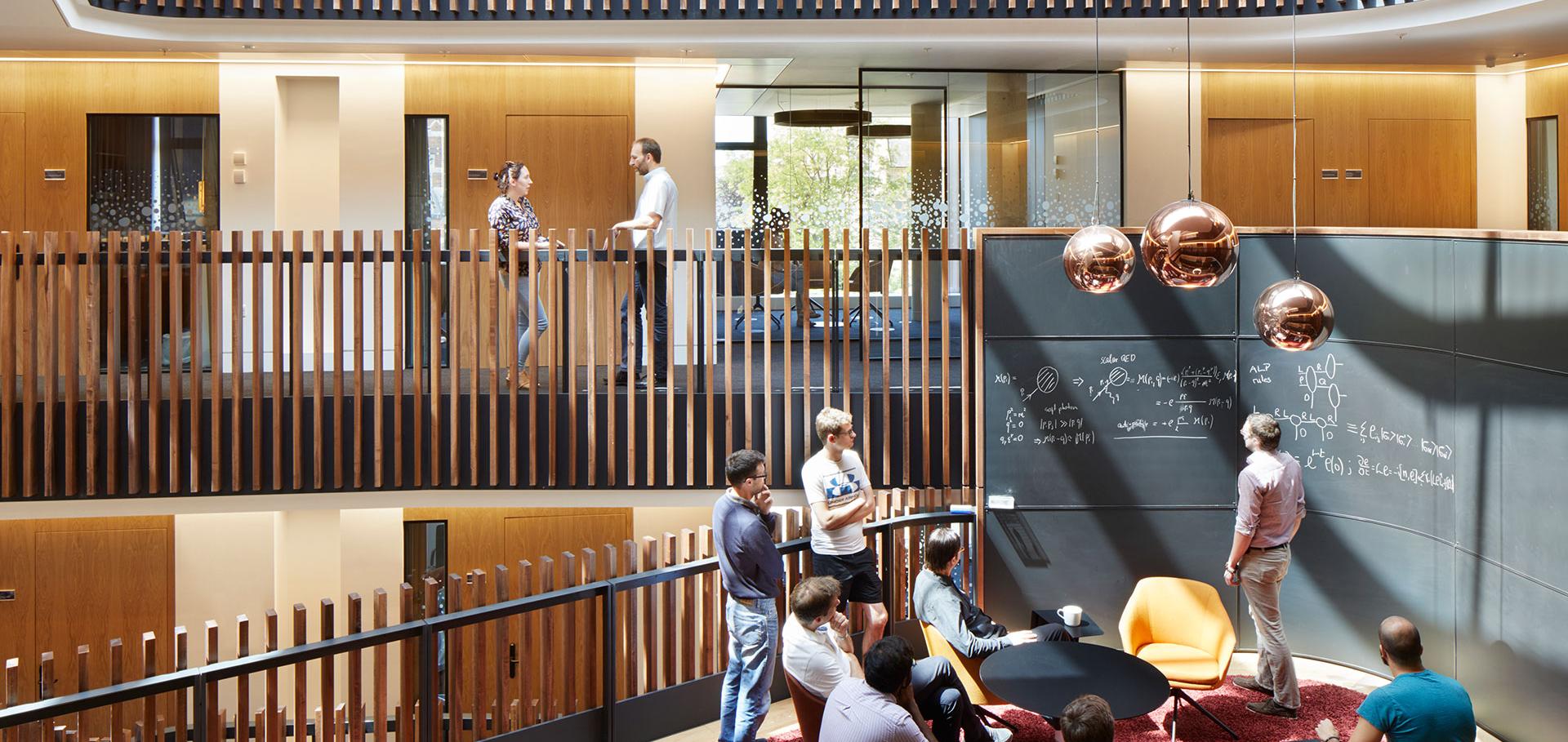
Theoretical physicists working at a blackboard collaboration pod in the Beecroft building.
Credit: Jack Hobhouse

Akshat Pandey

All Souls Fellow

Sub department

  • Rudolf Peierls Centre for Theoretical Physics
akshat.pandey@all-souls.ox.ac.uk
Rudolf Peierls Centre for Theoretical Physics, room 50.28
  • About
  • Publications

Random geometry at an infinite-randomness fixed point

Physical Review B American Physical Society (APS) 108:6 (2023) 064201

Authors:

Akshat Pandey, Aditya Mahadevan, Aditya Cowsik
More details from the publisher

A stability bound on the [Formula: see text]-linear resistivity of conventional metals.

Proceedings of the National Academy of Sciences of the United States of America 120:3 (2023) e2216241120

Authors:

Chaitanya Murthy, Akshat Pandey, Ilya Esterlis, Steven A Kivelson

Abstract:

Perturbative considerations account for the properties of conventional metals, including the range of temperatures where the transport scattering rate is 1/τtr = 2πλT, where λ is a dimensionless strength of the electron-phonon coupling. The fact that measured values satisfy λ ≲ 1 has been noted in the context of a possible "Planckian" bound on transport. However, since the electron-phonon scattering is quasielastic in this regime, no such Planckian considerations can be relevant. We present and analyze Monte Carlo results on the Holstein model which show that a different sort of bound is at play: a "stability" bound on λ consistent with metallic transport. We conjecture that a qualitatively similar bound on the strength of residual interactions, which is often stronger than Planckian, may apply to metals more generally.
More details from the publisher
More details

Interstitial-Induced Ferromagnetism in a Two-Dimensional Wigner Crystal.

Physical review letters 129:22 (2022) 227202

Authors:

Kyung-Su Kim, Chaitanya Murthy, Akshat Pandey, Steven A Kivelson

Abstract:

The two-dimensional Wigner crystal (WC) occurs in the strongly interacting regime (r_{s}≫1) of the two-dimensional electron gas (2DEG). The magnetism of a pure WC is determined by tunneling processes that induce multispin ring-exchange interactions, resulting in fully polarized ferromagnetism for large enough r_{s}. Recently, Hossain et al. [Proc. Natl. Acad. Sci. U.S.A. 117, 32244 (2020)PNASA60027-842410.1073/pnas.2018248117] reported the occurrence of a fully polarized ferromagnetic insulator at r_{s}≳35 in an AlAs quantum well, but at temperatures orders of magnitude larger than the predicted exchange energies for the pure WC. Here, we analyze the large r_{s} dynamics of an interstitial defect in the WC, and show that it produces local ferromagnetism with much higher energy scales. Three hopping processes are dominant, which favor a large, fully polarized ferromagnetic polaron. Based on the above results, we speculate concerning the phenomenology of the magnetism near the metal-insulator transition of the 2DEG.
More details from the publisher
More details

Analytical theory of pyrochlore cooperative paramagnets

Physical Review B American Physical Society (APS) 101:11 (2020) 115107

Authors:

Akshat Pandey, Roderich Moessner, Claudio Castelnovo
More details from the publisher

Pagination

  • First page First
  • Previous page Prev
  • Page 1
  • Current page 2

Footer Menu

  • Contact us
  • Giving to the Dept of Physics
  • Work with us
  • Media

User account menu

  • Log in

Follow us

FIND US

Clarendon Laboratory,

Parks Road,

Oxford,

OX1 3PU

CONTACT US

Tel: +44(0)1865272200

University of Oxfrod logo Department Of Physics text logo
IOP Juno Champion logo Athena Swan Silver Award logo

© University of Oxford - Department of Physics

Cookies | Privacy policy | Accessibility statement

Built by: Versantus

  • Home
  • Research
  • Study
  • Engage
  • Our people
  • News & Comment
  • Events
  • Our facilities & services
  • About us
  • Giving to Physics
  • Current students
  • Staff intranet