Home
Department Of Physics text logo
  • Research
    • Our research
    • Our research groups
    • Our research in action
    • Research funding support
    • Summer internships for undergraduates
  • Study
    • Undergraduates
    • Postgraduates
  • Engage
    • For alumni
    • For business
    • For schools
    • For the public
Menu
Atomic and Laser Physics
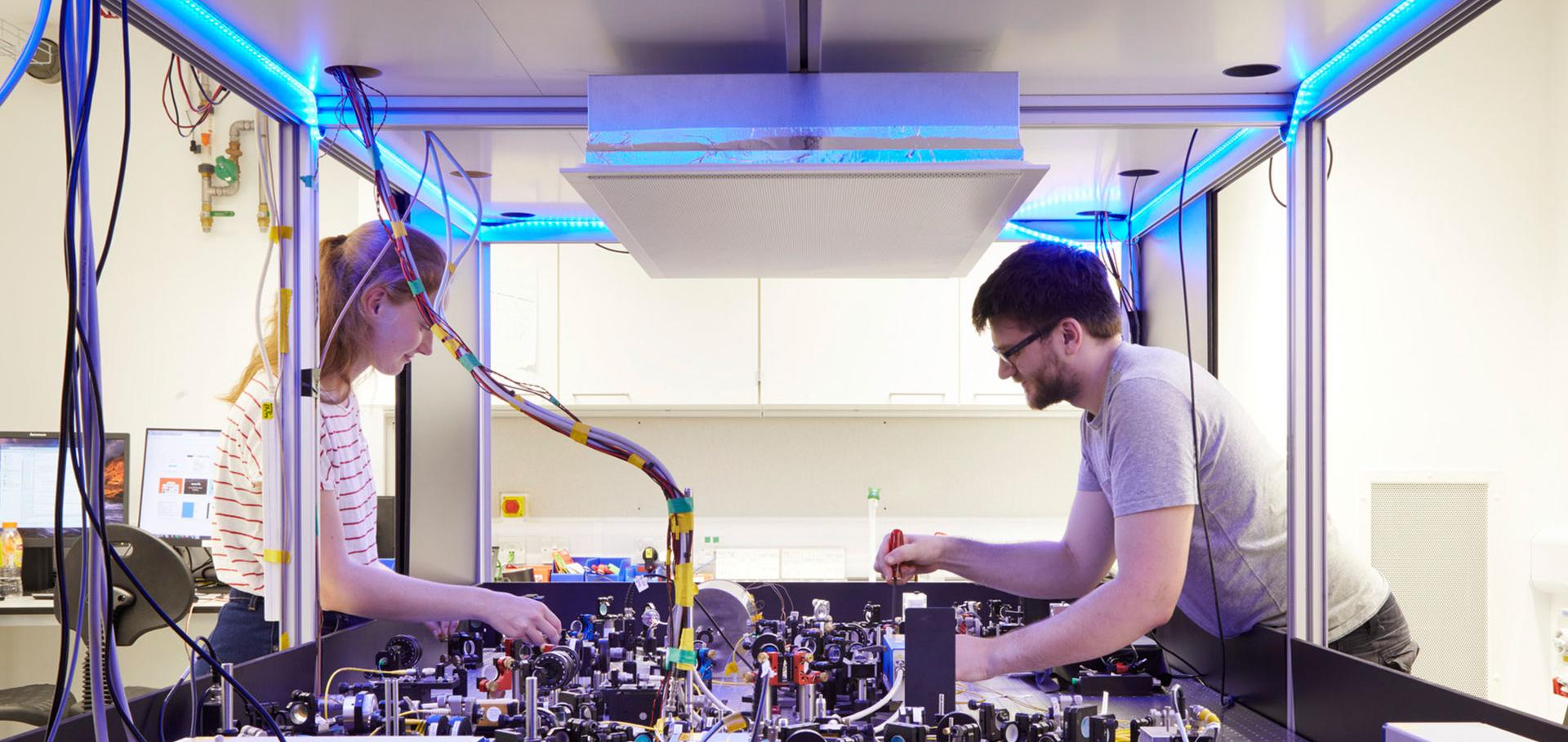
Credit: Jack Hobhouse

Dr. Gabriel Perez-Callejo

Postdoctoral Research Fellow

Research theme

  • Lasers and high energy density science
  • Plasma physics

Sub department

  • Atomic and Laser Physics
gabriel.perezcallejo@physics.ox.ac.uk
  • About
  • Publications

Measurement of L-shell emission from mid-Z targets under non-LTE conditions using Transmission Grating Spectrometer and DANTE power diagnostics

Review of Scientific Instruments, 2021, 92(3), 033502

Authors:

M. Fraenkel, Y. Ehrlich, Z. Shpilman, Z. Henis, Y. Frank, E. V. Marley, G. Pérez-Callejo, J. Emig, R. F. Heeter, D. A. Liedahl, M. E. Foord, M. B. Schneider

Abstract:

In this work, we present the measurement of L-band emission from buried Sc/V targets in experiments performed at the OMEGA laser facility. The goal of these experiments was to study non-local thermodynamic equilibrium plasmas and benchmark atomic physics codes. The L-band emission was measured simultaneously by the time resolved DANTE power diagnostic and the recently fielded time integrated Soreq-Transmission Grating Spectrometer (TGS) diagnostic. The TGS measurement was used to support the spectral reconstruction process needed for the unfolding of the DANTE data. The Soreq-TGS diagnostic allows for broadband spectral measurement in the 120 eV-2000 eV spectral band, covering L- and M-shell emission of mid- and high-Z elements, with spectral resolution λ/Δλ = 8-30 and accuracy better than 25%. The Soreq-TGS diagnostic is compatible with ten-inch-manipulator platforms and can be used for a wide variety of high energy density physics, laboratory astrophysics, and inertial confinement fusion experiments.
More details from the publisher

Demonstration of geometric effects and resonant scattering in the x-ray spectra of high-energy-density plasmas

Physical Review Letters American Physical Society 126 (2021) 085001

Authors:

Gabriel Pérez callejo, Steven Rose, Justin Wark

Abstract:

In a plasma of sufficient size and density, photons emitted within the system have a probability of being re-absorbed and re-emitted multiple times - a phenomenon known in astrophysics as resonant scattering. This effect alters the ratio of optically-thick to optically thin lines, depending on the plasma geometry and viewing angle, and has significant implications for the spectra observed in a number of astrophysical scenarios, but has not previously been studied in a controlled laboratory plasma. We demonstrate the effect in the x-ray spectra emitted by cylindrical plasmas generated by high power laser irradiation, and the results confirm the geometrical interpretation of resonant scattering.
More details from the publisher
Details from ORA
More details
More details

A novel method to measure ion density in ICF experiments using X-ray spectroscopy of cylindrical tracers

Physics of Plasmas AIP Publishing 27:2020 (2020) 112714

Authors:

Gabriel Pérez callejo, MA Barrios, DA Liedahl, Steven Rose, Justin Wark

Abstract:

The indirect drive approach to inertial confinement fusion (ICF) has undergone important advances in the past years. The improvements in temperature and density diagnostic methods are leading to more accurate measurements of the plasma conditions inside the hohlraum and therefore to more efficient experimental designs. The implementation of dot spectroscopy has proven to be a versatile approach to extracting spaceand time-dependent electron temperatures. In this method a microdot of a mid-Z material is placed inside the hohlraum and its K-shell emission spectrum is used to determine the plasma temperature. However, radiation transport of optically thick lines acting within the cylindrical dot geometry influences the outgoing spectral distribution in a manner that depends on the viewing angle. This angular dependence has recently been studied in the high energy density (HED) regime at the OMEGA laser facility, which allowed us to design and benchmark appropriate radiative transfer models that can replicate these geometric effects. By combining these models with the measurements from the dot spectroscopy experiments at the National Ignition Facility (NIF), we demonstrate here a novel technique that exploits the transport effects to obtain time-resolved measurements of the ion density of the tracer dots, without the need for additional diagnostics. We find excellent agreement between experiment and simulation, opening the possibility of using these geometric effects as a density diagnostic in future experiments.
More details from the publisher
Details from ORA
More details

A novel method to measure ion density in ICF experiments using x-ray spectroscopy of cylindrical tracers

Physics of Plasmas, 2020, 27(11), 112714

Authors:

Pérez-Callejo G., Barrios M.A., Liedahl D.A., Schneider M.B., Jones O., Landen O., Kauffman R.L., Suter L.J., Moody J.D., Rose S.J., Wark J.S.

Abstract:

The indirect drive approach to inertial confinement fusion has undergone important advances in the past few years. Improvements in temperature and density diagnostic methods are leading to more accurate measurements of the plasma conditions inside the Hohlraum and therefore to more efficient experimental designs. The implementation of dot spectroscopy has proven to be a versatile approach to extracting space-and time-dependent electron temperatures. In this method, a microdot of a mid-Z material is placed inside the Hohlraum and its K-shell emission spectrum is used to determine the plasma temperature. However, radiation transport of optically thick lines acting within the cylindrical dot geometry influences the outgoing spectral distribution in a manner that depends on the viewing angle. This angular dependence has recently been studied in the high energy density regime at the OMEGA laser facility, which allowed us to design and benchmark appropriate radiative transfer models that can replicate these geometric effects. By combining these models with the measurements from the dot spectroscopy experiments at the National Ignition Facility, we demonstrate here a novel technique that exploits the transport effects to obtain time-resolved measurements of the ion density of the tracer dots, without the need for additional diagnostics. We find excellent agreement between experiment and simulation, opening the possibility of using these geometric effects as a density diagnostic in future experiments.
More details from the publisher

X-ray spectroscopic studies of a solid-density germanium plasma created by a free electron laser

Applied Sciences (Switzerland), 2020, 10(22), pp. 1–13, 8153

Authors:

Pérez-Callejo G., Vinko S.M., Ren S., Royle R., Humphries O., Preston T.R., Hammel B.A., Chung H.-K., Burian T., Vozda V., Lin M.-F., van Driel T.B., Wark J.S.

Abstract:

The generation of solid-density plasmas in a controlled manner using an X-ray free electron laser (XFEL) has opened up the possibility of diagnosing the atomic properties of hot, strongly coupled systems in novel ways. Previous work has concentrated on K-shell emission spectroscopy of low Z (<= 14) elements. Here, we extend these studies to the mid-Z(=32) element Germanium, where the XFEL creates copious L-shell holes, and the plasma conditions are interrogated by recording of the associated L-shell X-ray emission spectra. Given the desirability of generating as uniform a plasma as possible, we present here a study of the effects of the FEL photon energy on the temperatures and electron densities created, and their uniformity in the FEL beam propagation direction. We show that good uniformity can be achieved by tuning the photon energy of the XFEL such that it does not overlap significantly with L-shell to M-shell bound-bound transitions, and lies below the L-edges of the ions formed during the heating process. Reasonable agreement between experiment and simulations is found for the emitted X-ray spectra, demonstrating that for these higher Z elements, the selection of appropriate XFEL parameters is important for achieving uniformity in the plasma conditions.
More details from the publisher

Pagination

  • First page First
  • Previous page Prev
  • Page 1
  • Current page 2
  • Page 3
  • Page 4
  • Next page Next
  • Last page Last

Footer Menu

  • Contact us
  • Giving to the Dept of Physics
  • Work with us
  • Media

User account menu

  • Log in

Follow us

FIND US

Clarendon Laboratory,

Parks Road,

Oxford,

OX1 3PU

CONTACT US

Tel: +44(0)1865272200

University of Oxfrod logo Department Of Physics text logo
IOP Juno Champion logo Athena Swan Silver Award logo

© University of Oxford - Department of Physics

Cookies | Privacy policy | Accessibility statement

Built by: Versantus

  • Home
  • Research
  • Study
  • Engage
  • Our people
  • News & Comment
  • Events
  • Our facilities & services
  • About us
  • Giving to Physics
  • Current students
  • Staff intranet