Home
Department Of Physics text logo
  • Research
    • Our research
    • Our research groups
    • Our research in action
    • Research funding support
    • Summer internships for undergraduates
  • Study
    • Undergraduates
    • Postgraduates
  • Engage
    • For alumni
    • For business
    • For schools
    • For the public
  • Support
Menu
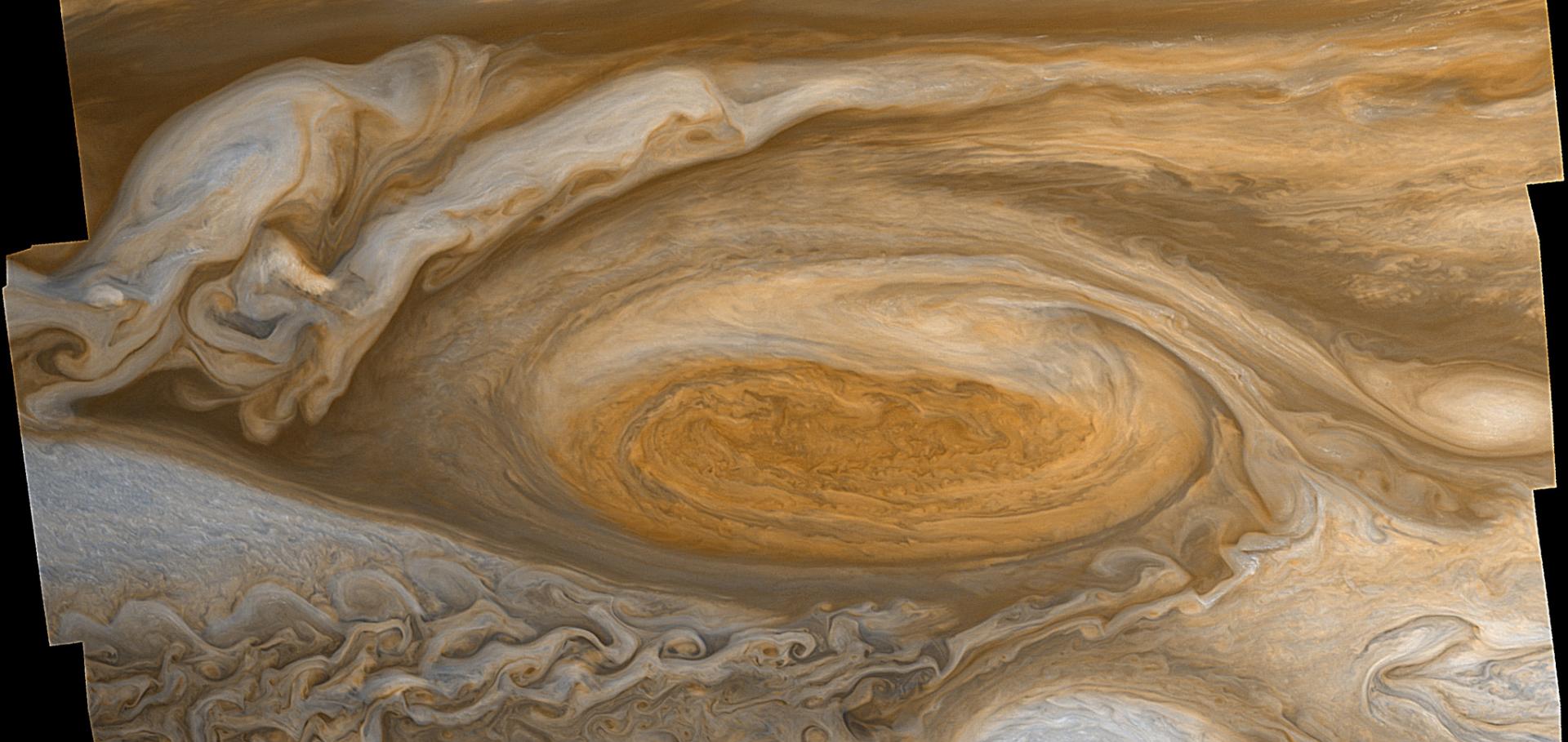
Image of Jupiter's Great Red Spot from Voyager 1

Image of Jupiter's Great Red Spot, obtained during the fly-by of Jupiter by NASA's Voyager 1 spacecraft in 1979.

Credit: NASA/JPL

Prof. Peter Read

Emeritus/researcher

Research theme

  • Climate physics
  • Exoplanets and planetary physics

Sub department

  • Atmospheric, Oceanic and Planetary Physics

Research groups

  • Geophysical and Astrophysical Fluid Dynamics
  • Planetary Climate Dynamics
Peter.Read@physics.ox.ac.uk
Telephone: 01865 (2)72082
Atmospheric Physics Clarendon Laboratory, room 210
  • About
  • Publications

Mode selection, wave breaking and parametric sensitivity in the quasi-biennial oscillation

QUARTERLY JOURNAL OF THE ROYAL METEOROLOGICAL SOCIETY 123:543 (1997) 2041-2068

Authors:

X Li, PL Read, DG Andrews
More details from the publisher

Wave interactions and the transition to chaos of baroclinic waves in a thermally driven rotating annulus

PHILOSOPHICAL TRANSACTIONS OF THE ROYAL SOCIETY A-MATHEMATICAL PHYSICAL AND ENGINEERING SCIENCES 355:1722 (1997) 101-153

Authors:

WG Fruh, PL Read
More details from the publisher

Martian atmospheric data assimilation with a simplified general circulation model: Orbiter and lander networks

PLANET SPACE SCI 44:11 (1996) 1395-1409

Authors:

SR Lewis, PL Read, M Collins

Abstract:

A meteorological data assimilation scheme for the martian atmosphere has been implemented and tested, based on techniques used in the current operational scheme for weather forecasting at the U.K. Meteorological Office. The scheme has been interfaced with a range of simple models and with the martian GCM currently under simultaneous development at Laboratoire de Meteorologie Dynamique du CNRS in Paris and at Oxford. As well as the interpretation of data from any future spacecraft, the assimilation scheme may be used for comparisons between different models, for model validation using earlier martian data, and for data impact studies to assist in planning new missions. Despite proposed new missions to Mars, observations of the atmosphere of Mars in the near future are still likely to be very sparse compared to those of the Earth (perhaps comprising a single orbiter and a few surface stations at any one time) and the scheme has been adapted with this in mind. Twin model experiments are conducted in which simulated observations are generated from a second model started from different initial conditions. Such experiments reveal the importance of surface pressure measurements (in combination with an accurate topographic map, such as will be available from laser altimetry) in the determination of the amplitude of large-scale atmospheric waves. It is shown that atmospheric temperature profiles from a remote-sensing instrument on a polar orbiting satellite combined with simultaneous surface pressure observations at a limited number of sites, as planned for the InterMarsNet mission, is a useful scenario for data assimilation. Copyright (C) 1996 Elsevier Science Ltd
More details from the publisher

A climate database for the Martian atmosphere

European Space Agency, (Special Publication) ESA SP (1996) 323-327

Authors:

M Collins, SR Lewis, PL Read, NPJ Thomas, O Talagrand, F Forget, R Fournier, F Hourdin, JP Huot

Abstract:

A new engineering model of the environment of Mars is outlined. The model is based on a database of statistics computed from a state-of-the-art Global Circulation Model of the martian atmosphere which represents our best knowledge of the atmosphere to date. A novel scheme for the representation of large scale variability in the engineering model, in terms of an optimal set of basis functions derived from the Global Circulation Model, is also outlined and shown to be an efficient and accurate method of representing correlated structures in vertical profiles.

Martian atmospheric data assimilation with a simplified general circulation model: Orbiter and lander networks

Planetary and Space Science 44:11 SPEC. ISS. (1996) 1395-1409

Authors:

SR Lewis, PL Read, M Collins

Abstract:

A meteorological data assimilation scheme for the martian atmosphere has been implemented and tested, based on techniques used in the current operational scheme for weather forecasting at the U.K. Meteorological Office. The scheme has been interfaced with a range of simple models and with the martian GCM currently under simultaneous development at Laboratoire de Météorologie Dynamique du CNRS in Paris and at Oxford. As well as the interpretation of data from any future spacecraft, the assimilation scheme may be used for comparisons between different models, for model validation using earlier martian data, and for data impact studies to assist in planning new missions. Despite proposed new missions to Mars, observations of the atmosphere of Mars in the near future are still likely to be very sparse compared to those of the Earth (perhaps comprising a single orbiter and a few surface stations at any one time) and the scheme has been adapted with this in mind. Twin model experiments are conducted in which simulated observations are generated from a second model started from different initial conditions. Such experiments reveal the importance of surface pressure measurements (in combination with an accurate topographic map, such as will be available from laser altimetry) in the determination of the amplitude of large-scale atmospheric waves. It is shown that atmospheric temperature profiles from a remote-sensing instrument on a polar orbiting satellite combined with simultaneous surface pressure observations at a limited number of sites, as planned for the InterMarsNet mission, is a useful scenario for data assimilation. Copyright © 1996 Elsevier Science Ltd.
More details from the publisher

Pagination

  • First page First
  • Previous page Prev
  • …
  • Page 54
  • Page 55
  • Page 56
  • Page 57
  • Current page 58
  • Page 59
  • Page 60
  • Page 61
  • Page 62
  • …
  • Next page Next
  • Last page Last

Footer Menu

  • Contact us
  • Giving to the Dept of Physics
  • Work with us
  • Media

User account menu

  • Log in

Follow us

FIND US

Clarendon Laboratory,

Parks Road,

Oxford,

OX1 3PU

CONTACT US

Tel: +44(0)1865272200

University of Oxfrod logo Department Of Physics text logo
IOP Juno Champion logo Athena Swan Silver Award logo

© University of Oxford - Department of Physics

Cookies | Privacy policy | Accessibility statement

Built by: Versantus

  • Home
  • Research
  • Study
  • Engage
  • Our people
  • News & Comment
  • Events
  • Our facilities & services
  • About us
  • Giving to Physics
  • Current students
  • Staff intranet