Home
Department Of Physics text logo
  • Research
    • Our research
    • Our research groups
    • Our research in action
    • Research funding support
    • Summer internships for undergraduates
  • Study
    • Undergraduates
    • Postgraduates
  • Engage
    • For young people
    • For teachers
    • For the public
    • For alumni
    • For business
  • Support
Menu
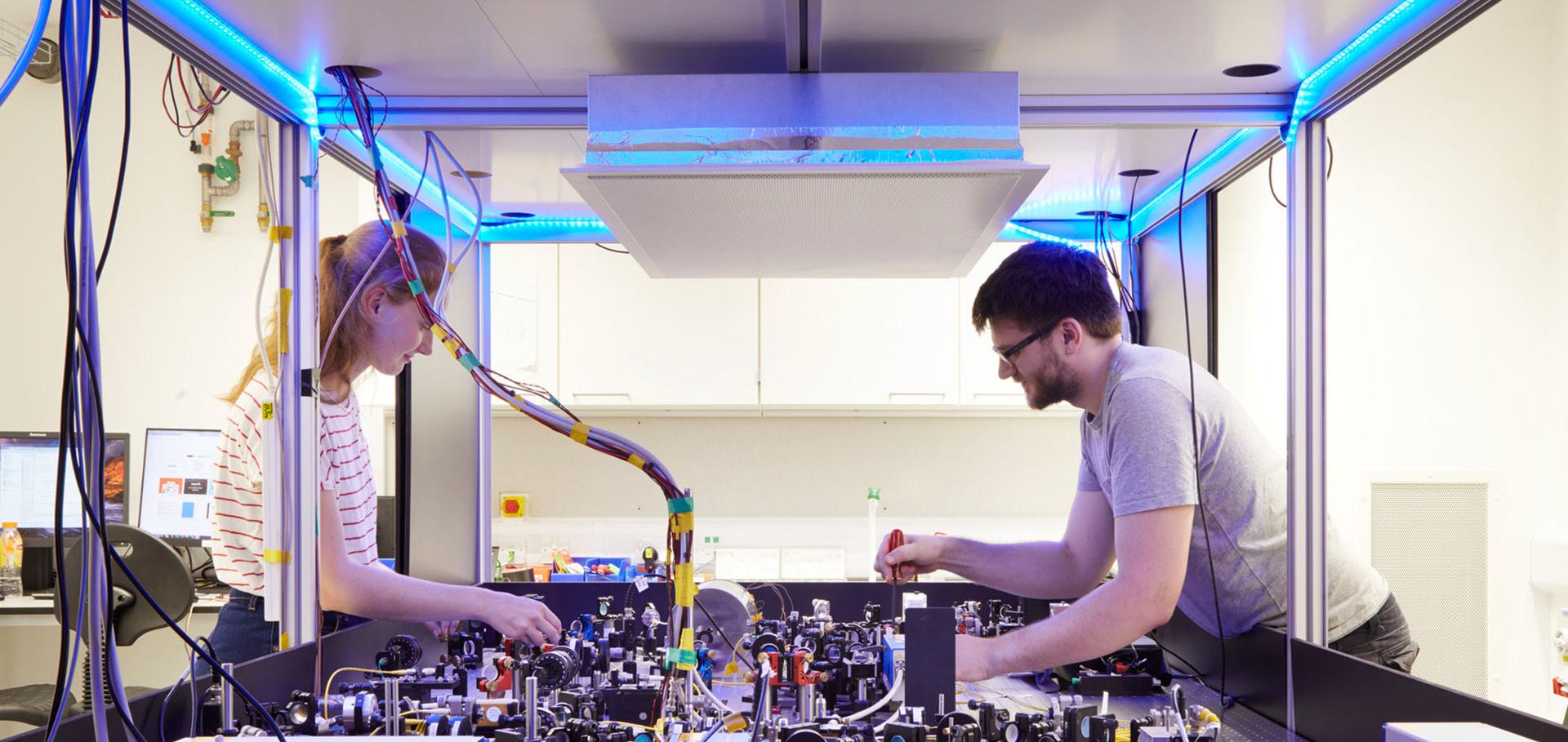
Atomic and Laser Physics
Credit: Jack Hobhouse

Professor Steven Rose

Visiting Professor

Research theme

  • Lasers and high energy density science

Sub department

  • Atomic and Laser Physics

Research groups

  • Oxford Centre for High Energy Density Science (OxCHEDS)
Steven.Rose@physics.ox.ac.uk
Imperial College London webpage
  • About
  • Publications

Response to “Comment on ‘Collisionless shock and supernova remnant simulations on VULCAN’ ” [Phys. Plasmas 9, 727 (2002)]

Physics of Plasmas AIP Publishing 9:2 (2002) 729-730

Authors:

NC Woolsey, Y Abou Ali, RG Evans, RAD Grundy, SJ Pestehe, PG Carolan, NJ Conway, RO Dendy, P Helander, KG McClements, JG Kirk, PA Norreys, MM Notley, SJ Rose
More details from the publisher
More details

Extension of the code suite FLY to a multi-cell postproces sor for hydrodynamic plasma simulation codes

Journal of Quantitative Spectroscopy and Radiative Transfer 71:2-6 (2001) 721-728

Abstract:

The extension of the atomic kinetics code suite FLY to a multi-cell postprocessor for hydrodynamic plasma simulation codes, called SWARM is presented. First, the collisional radiative model on which FLY is based is reviewed as far as it corresponds to the model in SWARM, then more attention is paid to the differences. Multiple cell simulations require a more complicated algorithm to solve the radiative transfer problem, taking into account geometry and point of observation. The feedback of the radiation on the atomic state populations is taken into account in a more sophisticated escape factor model. Finally, the limitations of the model are discussed. © 2001 Elsevier Science Ltd. All rights reserved.
More details from the publisher
More details

Modeling a sonoluminescing bubble as a plasma

Journal of Quantitative Spectroscopy and Radiative Transfer 71:2-6 (2001) 215-223

Authors:

PDS Burnett, DM Chambers, D Heading, A Machacek, WC Moss, S Rose, M Schnittker, RW Lee, P Young, JS Wark

Abstract:

We present detailed simulations of the optical spectra emitted from an Argon plasma whose conditions correspond to those thought to prevail within sonoluminescing bubbles. The model incorporates detailed atomic physics based on atomic data from the Opacity Project database, and includes bound-bound, bound-free, and free-free transitions. Line broadening is treated by use of the modified semi-empirical method. The spectral model is used as a postprocessor of hydrodynamic simulations. We find good agreement with experimental spectra and accurately reproduce experimental pulse widths. We also predict that whilst the majority of the optical emission corresponds to bound-free transitions, there remains the possibility of observing line emission in both the UV and IR regions of the spectrum. © 2001 Elsevier Science Ltd. All rights reserved.
More details from the publisher
More details

The radiative opacity at the Sun centre—a code comparison study

Journal of Quantitative Spectroscopy and Radiative Transfer Elsevier 71:2-6 (2001) 635-638
More details from the publisher
More details

Measurements of the XUV mass absorption coefficient of an overdense liquid metal

Journal of Physics B Atomic Molecular and Optical Physics 34:17 (2001) L565-L570

Authors:

E Wolfrum, AM Allen, I Al'Miev, TW Barbee, PDS Burnett, A Djaoui, C Iglesias, DH Kalantar, RW Lee, R Keenan, MH Key, CLS Lewis, AM Machacek, BA Remington, SJ Rose, R O'Rourke, JS Wark

Abstract:

The increase in the XUV mass absorption coefficient of liquid aluminium, produced by high-power-laser shock-compression, is measured using XUV laser radiography. At a photon energy of 63 eV a change in the mass absorption coefficient by up to a factor of ∼2.2 is determined at densities close to twice that of solid and electron temperatures of the order of 1 eV. Comparison with hydrodynamic simulations indicate that the absorption coefficient scales with density as ρ1.3±0.2.
More details from the publisher
More details

Pagination

  • First page First
  • Previous page Prev
  • …
  • Page 25
  • Page 26
  • Page 27
  • Page 28
  • Current page 29
  • Page 30
  • Page 31
  • Page 32
  • Page 33
  • …
  • Next page Next
  • Last page Last

Footer Menu

  • Contact us
  • Giving to the Dept of Physics
  • Work with us
  • Media

User account menu

  • Log in

Follow us

FIND US

Clarendon Laboratory,

Parks Road,

Oxford,

OX1 3PU

CONTACT US

Tel: +44(0)1865272200

University of Oxfrod logo Department Of Physics text logo
IOP Juno Champion logo Athena Swan Silver Award logo

© University of Oxford - Department of Physics

Cookies | Privacy policy | Accessibility statement

Built by: Versantus

  • Home
  • Research
  • Study
  • Engage
  • Our people
  • News & Comment
  • Events
  • Our facilities & services
  • About us
  • Giving to Physics
  • Current students
  • Staff intranet