Home
Department Of Physics text logo
  • Research
    • Our research
    • Our research groups
    • Our research in action
    • Research funding support
    • Summer internships for undergraduates
  • Study
    • Undergraduates
    • Postgraduates
  • Engage
    • For young people
    • For teachers
    • For the public
    • For alumni
    • For business
  • Support
Menu
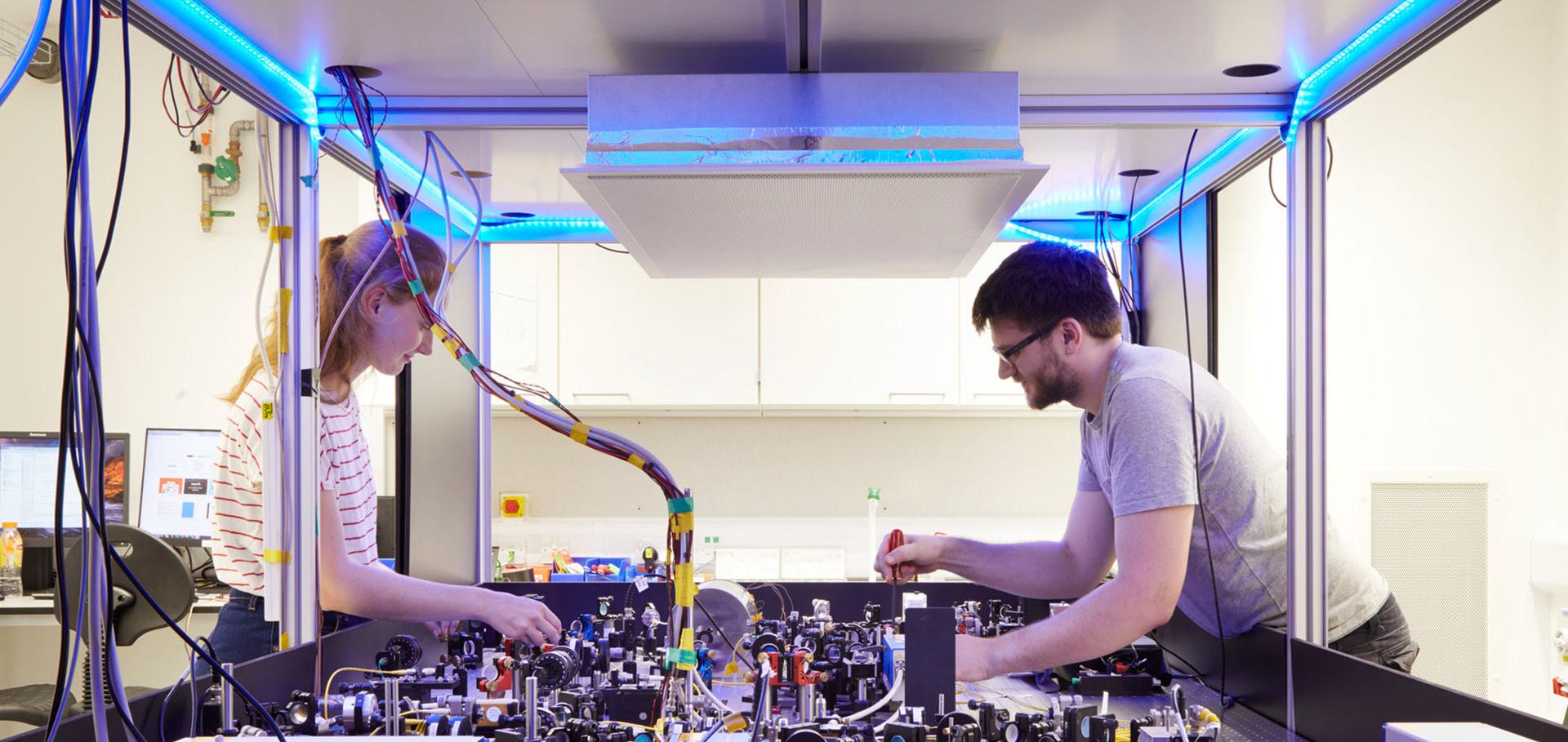
Atomic and Laser Physics
Credit: Jack Hobhouse

Professor Steven Rose

Visiting Professor

Research theme

  • Lasers and high energy density science

Sub department

  • Atomic and Laser Physics

Research groups

  • Oxford Centre for High Energy Density Science (OxCHEDS)
Steven.Rose@physics.ox.ac.uk
Imperial College London webpage
  • About
  • Publications

keV x-ray spectroscopy of plasmas produced by the intense picosecond irradiation of a gas of xenon clusters

JOURNAL OF PHYSICS B-ATOMIC MOLECULAR AND OPTICAL PHYSICS 31:12 (1998) 2825-2831

Authors:

T Ditmire, PK Patel, RA Smith, JS Wark, SJ Rose, D Milathianaki, RS Marjoribanks, MHR Hutchinson
More details from the publisher

Experimental and simulated profiles of the Al XIII Ly-alpha resonance line from a cylindrically expanding plasma

J QUANT SPECTROSC RA 58:4-6 (1997) 835-844

Authors:

PK Patel, JS Wark, O Renner, A Djaoui, SJ Rose, DJ Heading, A Hauer

Abstract:

Spectral profiles of optically thick line radiation emitted by an expanding cylindrical laser-produced plasma have been recorded in high resolution using a vertical dispersion variant of the double-crystal spectrometer. By uniformly irradiating a narrow wire with a 1 ns pulse a quasi-steady plasma expansion is generated with a velocity gradient in excess of 10(9) s(-1). Such velocity fields strongly influence the transfer of radiation through a plasma, resulting in a complex distortion of the lineshapes of optically thick lines. We have computed theoretical profiles of the Al XIII Ly-alpha resonance line. Simulation of the laser-plasma interaction is performed using the 1D Lagrangian hydrocode MED103 which incorporates a non-LTE time-dependent excitation and ionisation package based on the average-atom model. Line emission profiles are calculated by the method of multi-frequency line transfer in the co-moving frame. We investigate the sensitivity of the lineshape on plasma parameters such as the velocity profile, comparing our theoretical predictions with experiment. (C) 1997 Published by Elsevier Science Ltd. All rights reserved.
More details from the publisher
More details

The calculation of photoionization of highly-ionized iron using R-matrix theory

Journal of Quantitative Spectroscopy and Radiative Transfer Elsevier 58:4-6 (1997) 491-493

Authors:

G Black, SJ Rose, KL Bell, FP Keenan
More details from the publisher

Transient multicentre electronic structure in dense plasmas

Journal of Quantitative Spectroscopy and Radiative Transfer Elsevier 58:4-6 (1997) 577-583

Authors:

DL Foulis, SJ Rose, TD Beynon
More details from the publisher

Astrophysically relevant experiments on radiation transfer through plasmas with large velocity gradients

PHYS PLASMAS 4:5 (1997) 2004-2010

Authors:

JS Wark, SJ Rose, PK Patel, A Djaoui, O Renner, A Hauer

Abstract:

The transfer of radiation through plasmas with large velocity gradients is of relevance to several astrophysical situations, such as supernova explosions, maser operation, and stellar winds. Similar conditions often prevail in laser-produced plasmas, with velocity gradients of order 10(9) s(-1) significantly altering the effective optical depth and line shape. Some of the simplest cases to study experimentally are the hydrogenic resonance lines. Experiments performed in both planar and cylindrical geometry, comparing the observed line profiles with those modeled using a one-dimensional Lagrangian hydrocode, incorporating average-atom nonlocal thermodynamic equilibrium (non-LTE) atomic physics are described. The opacity effects on the ion populations an treated within the escape factor approximation, taking into account the effects of the velocity gradient. The hydrocode gives time- and space-dependent values of the electron and ion densities, excited state fractions, electron and ion temperatures, and velocities, The hydrodynamic output is post-processed with a radiative transfer routine to construct the simulated line shape. Details of the experiments and results are presented, and relevance to the astrophysical situations discussed. (C) 1997 American Institute of Physics.
More details from the publisher

Pagination

  • First page First
  • Previous page Prev
  • …
  • Page 33
  • Page 34
  • Page 35
  • Page 36
  • Current page 37
  • Page 38
  • Page 39
  • Page 40
  • Page 41
  • …
  • Next page Next
  • Last page Last

Footer Menu

  • Contact us
  • Giving to the Dept of Physics
  • Work with us
  • Media

User account menu

  • Log in

Follow us

FIND US

Clarendon Laboratory,

Parks Road,

Oxford,

OX1 3PU

CONTACT US

Tel: +44(0)1865272200

University of Oxfrod logo Department Of Physics text logo
IOP Juno Champion logo Athena Swan Silver Award logo

© University of Oxford - Department of Physics

Cookies | Privacy policy | Accessibility statement

Built by: Versantus

  • Home
  • Research
  • Study
  • Engage
  • Our people
  • News & Comment
  • Events
  • Our facilities & services
  • About us
  • Giving to Physics
  • Current students
  • Staff intranet