Home
Department Of Physics text logo
  • Research
    • Our research
    • Our research groups
    • Our research in action
    • Research funding support
    • Summer internships for undergraduates
  • Study
    • Undergraduates
    • Postgraduates
  • Engage
    • For alumni
    • For business
    • For schools
    • For the public
  • Support
Menu
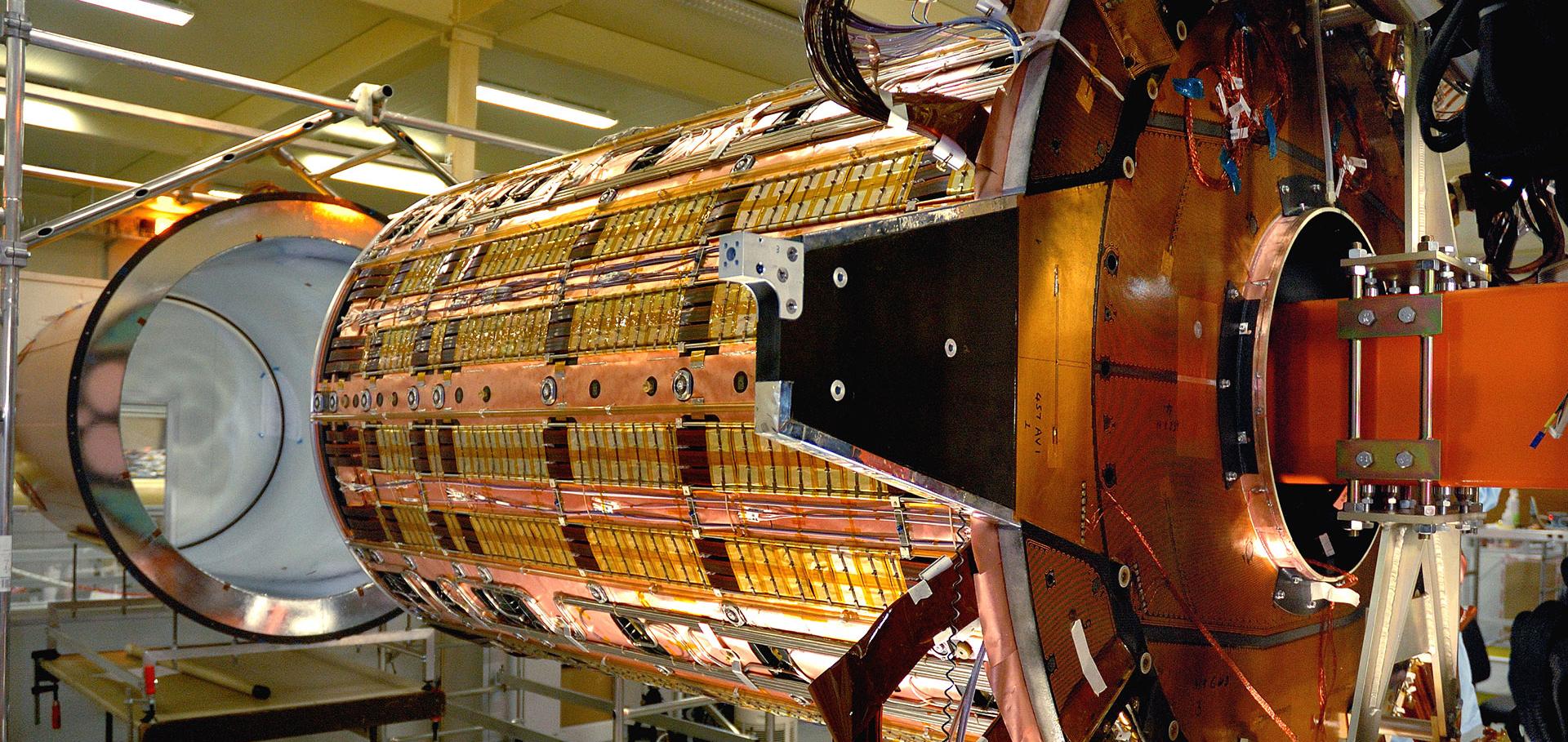
Insertion of STC into TRT at the Department of Physics, Oxford
Credit: CERN

Dr Kevin Thieme

Postdoctoral Research Assistant

Research theme

  • Particle astrophysics & cosmology

Sub department

  • Particle Physics

Research groups

  • LUX-ZEPLIN
kevin.thieme@physics.ox.ac.uk
Denys Wilkinson Building, room 504A
INSPIRE HEP
ORCID
  • About
  • CV
  • Publications

Design and construction of Xenoscope — a full-scale vertical demonstrator for the DARWIN observatory

Journal of Instrumentation IOP Publishing 16:08 (2021) P08052-P08052

Authors:

L Baudis, Y Biondi, M Galloway, F Girard, A Manfredini, N McFadden, R Peres, P Sanchez-Lucas, K Thieme

Abstract:

Abstract The DARWIN observatory is a proposed next-generation experiment to search for particle dark matter and other rare interactions. It will operate a 50 t liquid xenon detector, with 40 t in the time projection chamber (TPC). To inform the final detector design and technical choices, a series of technological questions must first be addressed. Here we describe a full-scale demonstrator in the vertical dimension, Xenoscope, with the main goal of achieving electron drift over a 2.6 m distance, which is the scale of the DARWIN TPC. We have designed and constructed the facility infrastructure, including the cryostat, cryogenic and purification systems, the xenon storage and recuperation system, as well as the slow control system. We have also designed a xenon purity monitor and the TPC, with the fabrication of the former nearly complete. In a first commissioning run of the facility without an inner detector, we demonstrated the nominal operational reach of Xenoscope and benchmarked the components of the cryogenic and slow control systems, demonstrating reliable and continuous operation of all subsystems over 40 days. The infrastructure is thus ready for the integration of the purity monitor, followed by the TPC. Further applications of the facility include R&D on the high voltage feedthrough for DARWIN, measurements of electron cloud diffusion, as well as measurements of optical properties of liquid xenon. In the future, Xenoscope will be available as a test platform for the DARWIN collaboration to characterise new detector technologies.
More details from the publisher
More details

Flow and thermal modelling of the argon volume in the DarkSide-20k TPC

Journal of Instrumentation IOP Publishing 20:06 (2025) P06046

Authors:

F Acerbi, P Adhikari, P Agnes, I Ahmad, S Albergo, IF Albuquerque, T Alexander, AK Alton, P Amaudruz, M Angiolilli, E Aprile, M Atzori Corona, DJ Auty, M Ave, IC Avetisov, O Azzolini, HO Back, Z Balmforth, A Barrado Olmedo, P Barrillon, G Batignani, P Bhowmick, M Bloem, S Blua

Abstract:

The DarkSide-20k dark matter experiment, currently under construction at LNGS, features a dual-phase time projection chamber (TPC) with a ∼ 50 t argon target from an underground well. At this scale, it is crucial to optimise the argon flow pattern for efficient target purification and for fast distribution of internal gaseous calibration sources with lifetimes of the order of hours. To this end, we have performed computational fluid dynamics simulations and heat transfer calculations. The residence time distribution shows that the detector is well-mixed on time-scales of the turnover time (∼ 40 d). Notably, simulations show that despite a two-order-of-magnitude difference between the turnover time and the half-life of 83mKr of 1.83 h, source atoms have the highest probability to reach the centre of the TPC 13 min after their injection, allowing for a homogeneous distribution before undergoing radioactive decay. We further analyse the thermal aspects of dual-phase operation and define the requirements for the formation of a stable gas pocket on top of the liquid. We find a best-estimate value for the heat transfer rate at the liquid-gas interface of 62 W with an upper limit of 144 W and a minimum gas pocket inlet temperature of 89 K to avoid condensation on the acrylic anode. This study also informs the placement of liquid inlets and outlets in the TPC. The presented techniques are widely applicable to other large-scale, noble-liquid detectors.
More details from the publisher
Details from ORA
More details

Production, quality assurance and quality control of the SiPM Tiles for the DarkSide-20k Time Projection Chamber

The European Physical Journal C SpringerOpen 85:11 (2025) 1334

Authors:

F Acerbi, P Adhikari, P Agnes, I Ahmad, S Albergo, IF Albuquerque, T Alexander, AK Alton, P Amaudruz, M Angiolilli, E Aprile, M Atzori Corona, DJ Auty, M Ave, IC Avetisov, O Azzolini, HO Back, Z Balmforth, A Barrado Olmedo, P Barrillon, G Batignani, P Bhowmick, M Bloem, S Blua, V Bocci, W Bonivento, B Bottino, MG Boulay, T Braun, A Buchowicz, S Bussino, J Busto, M Cadeddu, M Cadoni, R Calabrese, V Camillo, A Caminata, N Canci, M Caravati, M Cárdenas-Montes, N Cargioli, M Carlini, A Castellani, P Cavalcante, S Cebrian, S Chashin, A Chepurnov, S Choudhary, L Cifarelli, B Cleveland

Abstract:

Abstract The DarkSide-20k dark matter direct detection experiment will employ a $${21}\,\hbox {m}^{2}$$ 21 m 2 silicon photomultiplier (SiPM) array, instrumenting a dual-phase 50 tonnes liquid argon Time Projection Chamber (TPC). SiPMs are arranged into modular photosensors called Tiles , each integrating 24 SiPMs onto a printed circuit board (PCB) that provides signal amplification, power distribution, and a single-ended output for simplified readout. $$16$$ 16 Tiles are further grouped into Photo-Detector Units (PDUs). This paper details the production of the Tiles and the Quality Assurance and Quality Control (QA-QC) protocol established to ensure their performance and uniformity. The production and QA-QC of the Tiles are carried out at Nuova Officina Assergi (NOA), an ISO-6 clean room facility at LNGS. This process includes wafer-level cryogenic characterisation, precision die attaching, wire bonding, and extensive electrical and optical validation of each Tile. The overall production yield exceeds 83.5%, matching the requirements of the DarkSide-20k production plan. These results validate the robustness of the Tile design and its suitability for operation in a cryogenic environment.
More details from the publisher
Details from ORA
More details

Flow and thermal modelling of the argon volume in the DarkSide-20k TPC

Journal of Instrumentation IOP Publishing 20:06 (2025) P06046

Authors:

F Acerbi, P Adhikari, P Agnes, I Ahmad, S Albergo, IF Albuquerque, T Alexander, AK Alton, P Amaudruz, M Angiolilli, E Aprile, M Atzori Corona, DJ Auty, M Ave, IC Avetisov, O Azzolini, HO Back, Z Balmforth, A Barrado Olmedo, P Barrillon, G Batignani, P Bhowmick, M Bloem, S Blua

Abstract:

The DarkSide-20k dark matter experiment, currently under construction at LNGS, features a dual-phase time projection chamber (TPC) with a ∼ 50 t argon target from an underground well. At this scale, it is crucial to optimise the argon flow pattern for efficient target purification and for fast distribution of internal gaseous calibration sources with lifetimes of the order of hours. To this end, we have performed computational fluid dynamics simulations and heat transfer calculations. The residence time distribution shows that the detector is well-mixed on time-scales of the turnover time (∼ 40 d). Notably, simulations show that despite a two-order-of-magnitude difference between the turnover time and the half-life of 83mKr of 1.83 h, source atoms have the highest probability to reach the centre of the TPC 13 min after their injection, allowing for a homogeneous distribution before undergoing radioactive decay. We further analyse the thermal aspects of dual-phase operation and define the requirements for the formation of a stable gas pocket on top of the liquid. We find a best-estimate value for the heat transfer rate at the liquid-gas interface of 62 W with an upper limit of 144 W and a minimum gas pocket inlet temperature of 89 K to avoid condensation on the acrylic anode. This study also informs the placement of liquid inlets and outlets in the TPC. The presented techniques are widely applicable to other large-scale, noble-liquid detectors.
More details from the publisher
Details from ORA
More details

Quality assurance and quality control of the 26 m 2 SiPM production for the DarkSide-20k dark matter experiment

The European Physical Journal C SpringerOpen 85:5 (2025) 534

Authors:

F Acerbi, P Adhikari, P Agnes, I Ahmad, S Albergo, IF Albuquerque, T Alexander, AK Alton, P Amaudruz, M Angiolilli, E Aprile, M Atzori Corona, DJ Auty, M Ave, IC Avetisov, O Azzolini, HO Back, Z Balmforth, A Barrado Olmedo, P Barrillon, G Batignani, P Bhowmick, M Bloem, S Blua

Abstract:

DarkSide-20k is a novel liquid argon dark matter detector currently under construction at the Laboratori Nazionali del Gran Sasso (LNGS) of the Istituto Nazionale di Fisica Nucleare (INFN) that will push the sensitivity for Weakly Interacting Massive Particle (WIMP) detection into the neutrino fog. The core of the apparatus is a dual-phase Time Projection Chamber (TPC), filled with 50 tonnes of low radioactivity underground argon (UAr) acting as the WIMP target. NUV-HD-cryo Silicon Photomultipliers (SiPM)s designed by Fondazione Bruno Kessler (FBK) (Trento, Italy) were selected as the photon sensors covering two 10.5m2 Optical Planes, one at each end of the TPC, and a total of 5m2 photosensitive surface for the liquid argon veto detectors. This paper describes the Quality Assurance and Quality Control (QA/QC) plan and procedures accompanying the production of FBK NUV-HD-cryo SiPM wafers manufactured by LFoundry s.r.l. (Avezzano, AQ, Italy). SiPM characteristics are measured at 77 K at the wafer level with a custom-designed probe station. As of March 2025, 1314 of the 1400 production wafers (94% of the total) for DarkSide-20k were tested. The wafer yield is 93.2±2.5%, which exceeds the 80% specification defined in the original DarkSide-20k production plan.
More details from the publisher
Details from ORA
More details

Pagination

  • Current page 1
  • Page 2
  • Page 3
  • Page 4
  • Page 5
  • Page 6
  • Next page Next
  • Last page Last

Footer Menu

  • Contact us
  • Giving to the Dept of Physics
  • Work with us
  • Media

User account menu

  • Log in

Follow us

FIND US

Clarendon Laboratory,

Parks Road,

Oxford,

OX1 3PU

CONTACT US

Tel: +44(0)1865272200

University of Oxfrod logo Department Of Physics text logo
IOP Juno Champion logo Athena Swan Silver Award logo

© University of Oxford - Department of Physics

Cookies | Privacy policy | Accessibility statement

Built by: Versantus

  • Home
  • Research
  • Study
  • Engage
  • Our people
  • News & Comment
  • Events
  • Our facilities & services
  • About us
  • Giving to Physics
  • Current students
  • Staff intranet