Home
Department Of Physics text logo
  • Research
    • Our research
    • Our research groups
    • Our research in action
    • Research funding support
    • Summer internships for undergraduates
  • Study
    • Undergraduates
    • Postgraduates
  • Engage
    • For alumni
    • For business
    • For schools
    • For the public
  • Support
Menu
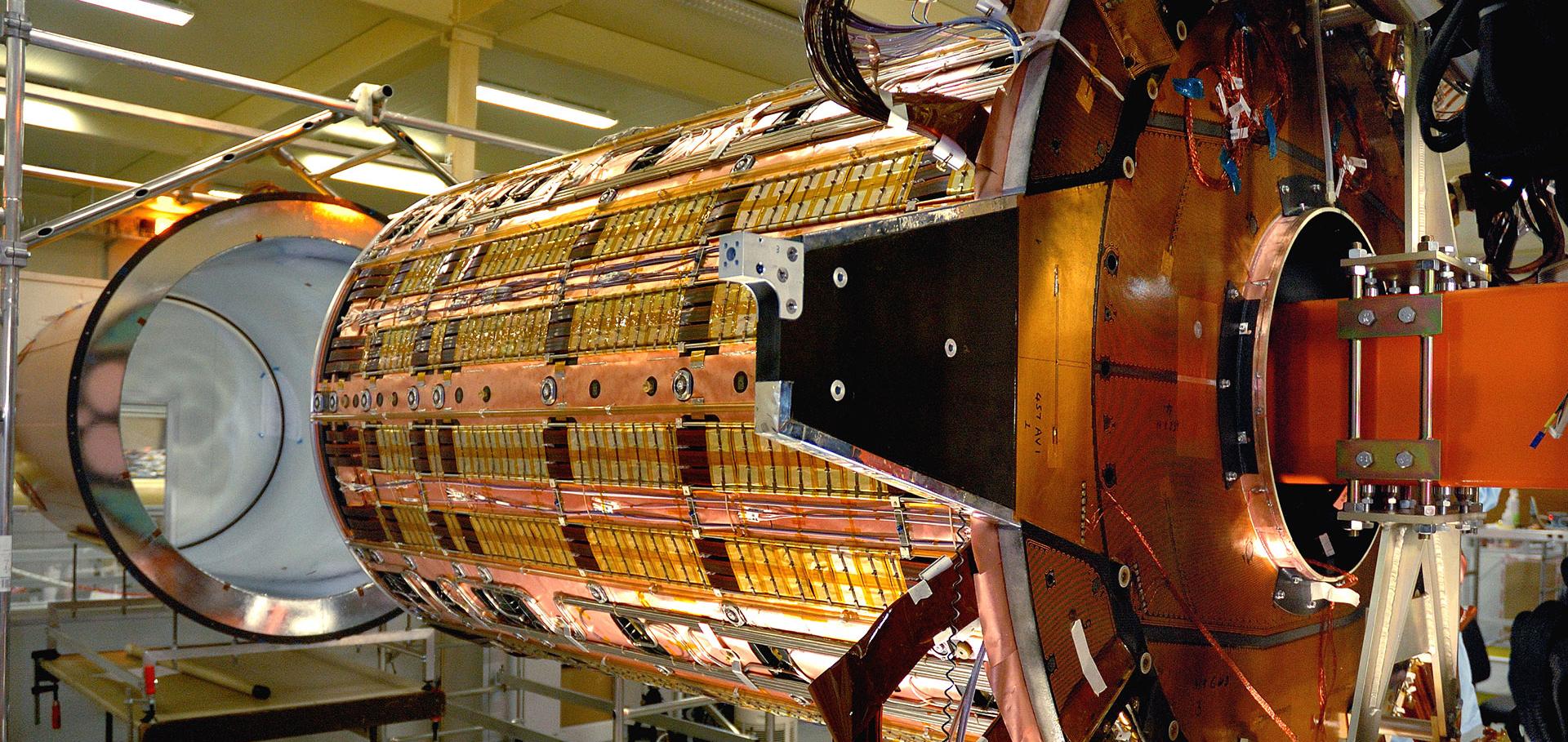
Insertion of STC into TRT at the Department of Physics, Oxford
Credit: CERN

Georg Viehhauser

University Research Lecturer

Sub department

  • Particle Physics

Research groups

  • ePIC
Georg.Viehhauser@physics.ox.ac.uk
Telephone: 01865 (2)73410
Denys Wilkinson Building, room 602
  • About
  • Publications

A limit on the mass of the ντ

Physics Letters, Section B: Nuclear, Elementary Particle and High-Energy Physics 431:1-2 (1998) 209-218

Authors:

R Ammar, P Baringer, A Bean, D Besson, D Coppage, C Darling, R Davis, S Kotov, I Kravchenko, N Kwak, L Zhou, S Anderson, Y Kubota, SJ Lee, JJ O'Neill, R Poling, T Riehle, A Smith, MS Alam, SB Athar, Z Ling, AH Mahmood, S Timm, F Wappler, A Anastassov, JE Duboscq, D Fujino, KK Gan, T Hart, K Honscheid, H Kagan, R Kass, J Lee, H Schwarthoff, MB Spencer, M Sung, A Undrus, A Wolf, MM Zoeller, SJ Richichi, H Severini, P Skubic, M Bishai, J Fast, JW Hinson, N Menon, DH Miller, EI Shibata, IPJ Shipsey, M Yurko, S Glenn, Y Kwon, AL Lyon, S Roberts, EH Thorndike, CP Jessop, K Lingel, H Marsiske, ML Perl, V Savinov, D Ugolini, X Zhou, TE Coan, V Fadeyev, I Korolkov, Y Maravin, I Narsky, V Shelkov, J Staeck, R Stroynowski, I Volobouev, J Ye, M Artuso, F Azfar, A Efimov, M Goldberg, D He, S Kopp, GC Moneti, R Mountain, S Schuh, T Skwarnicki, S Stone, G Viehhauser, JC Wang, X Xing, J Bartelt, SE Csorna, V Jain, KW McLean, S Marka, R Godang, K Kinoshita, IC Lai, P Pomianowski, S Schrenk, G Bonvicini, D Cinabro, R Greene, LP Perera

Abstract:

A limit on the mass of the tau neutrino mντ is derived from 4.5 × 10⁶ tau pairs produced in an integrated luminosity of 5.0 fb-1 of e+e- → γ * → τ+τ- reactions at center of mass energies ≈ 10.6 GeV. The measurement technique involves a two-dimensional extended likelihood analysis, including the dependence of the end-point population on mντ, and allows for the first time an explicit background contribution. We use the the decays τ → 5πντ and τ → 3π2π0ντ to obtain an upper limit of 30 MeV/c2 at 95% C.L. © 1998 Elsevier Science B.V. All rights reserved.
More details from the publisher

Status of construction and first tests of the CLEO III RICH

IEEE T NUCL SCI 45:3 (1998) 643-647

Authors:

M Artuso, F Azfar, A Efimov, S Kopp, R Mountain, S Schuh, T Skwarnicki, S Stone, G Viehhauser, S Anderson, A Smith, Y Kubota, E Lipeles, T Coan, J Staeck, V Fadeyev, I Volobouev, J Ye

Abstract:

The CLEO collaboration is preparing a major upgrade of its present detector including a RICH detector for particle identification. This subdetector system follows the 'proximity focussing' design and uses Lithium Fluoride (LiF) crystal radiators and MWPCs as photon detectors. These chambers are filled with a CH4/TEA gas mixture and have a Calcium Fluoride (CaF2) crystal photon entrance window. Part of the radiator crystals will have the new 'sawtooth' geometry.We have constructed two of the 30 detector modules and tested these together with the first planar and 'sawtooth' radiator crystals in a muon halo beam at Fermilab. For the measurement of the Cherenkov angle we obtain a single photon measurement error of 13.5 mrad for the conventional planar radiator. With 14 detected photons we find a resolution per track of 4.5 mrad. In the first measurement ever of a 'sawtooth' radiator we achieve a resolution of 11.8 mrad for single photons and 4.8 mrad per track for 12.3 detected photons With a reduced geometric acceptance. These results fulfill CLEO III requirements.
More details from the publisher

The CLEO III Ring Imaging Cherenkov detector

Nuclear Instruments and Methods in Physics Research Section A Accelerators Spectrometers Detectors and Associated Equipment 409:1-3 (1998) 375-378

Authors:

M Artuso, F Azfar, A Efimov, D He, S Kopp, R Mountain, S Schuh, T Skwarnicki, S Stone, G Viehhauser, X Xing, S Anderson, Y Kubota, R Poling, A Smith, S Alam, S Timm, T Coan, V Fadeyev, J Staeck, I Volobouev, D Cinabro, L Perera

Abstract:

The CLEO detector is undergoing major improvements in conjunction with a high luminosity upgrade of the CESR e+e- collider. A novel element is a state of the art particle identification system, based on a proximity focused Ring Imaging Cherenkov detector. This detector will provide an excellent hadron identification at all the momenta relevant to the study of the decays of B mesons produced at the Υ(4S) resonance. Some features unique to our design will be discussed together with some results achieved on individual components. © 1998 Elsevier Science B.V. All rights reserved.
More details from the publisher

The CLEO III Ring Imaging Cherenkov detector

NUCL INSTRUM METH A 409:1-3 (1998) 375-378

Authors:

M Artuso, F Azfar, A Efimov, D He, S Kopp, R Mountain, S Schuh, T Skwarnicki, S Stone, G Viehhauser, X Xing, S Anderson, Y Kubota, R Poling, A Smith, S Alam, S Timm, T Coan, V Fadeyev, J Staeck, I Volobouev, D Cinabro, L Perera

Abstract:

The CLEO detector is undergoing major improvements in conjunction with a high luminosity upgrade of the CESR e(+)e(-) collider. A novel element is a state of the art particle identification system, based on a proximity focused Ring Imaging Cherenkov detector. This detector will provide an excellent hadron identification at all the momenta relevant to the study of the decays of B mesons produced at the Upsilon(4S) resonance. Some features unique to our design will be discussed together with some results achieved on individual components. (C) 1998 Elsevier Science B.V. All rights reserved.
More details from the publisher
More details

First search for CP violation in tau lepton decay

Physical Review Letters 81:18 (1998) 3823-3827

Authors:

S Anderson, Y Kubota, SJ Lee, JJ O’neill, R Poling, T Riehle, A Smith, MS Alam, SB Athar, Z Ling, AH Mahmood, S Timm, F Wappler, A Anastassov, JE Duboscq, D Fujino, KK Gan, T Hart, K Honscheid, H Kagan, R Kass, J Lee, H Schwarthoff, MB Spencer, M Sung, A Undrus, A Wolf, MM Zoeller, SJ Richichi, H Severini, P Skubic, M Bishai, J Fast, JW Hinson, N Menson, DH Miller, EI Shibata, IPJ Shipsey, M Yurko, S Glenn, Y Kwon, AL Lyon, S Roberts, EH Thorndike, CP Jessop, K Lingel, H Marsiske, ML Perl, V Savinov, D Ugolini, X Zhou, TE Coan, V Fadeyev, I Korolkov, Y Maravin, I Narsky, V Shelkov, J Staeck, R Stroynowski, I Volobouev, J Ye, M Artuso, F Azfar, A Efimov, M Goldberg, D He, S Kopp, GC Moneti, R Mountain, S Schuh, T Skwarnicki, S Stone, G Viehhauser, JC Wang, X Xing, J Bartelt, SE Csorna, V Jain, KW McLean, S Marka, R Godang, K Kinoshita, IC Lai, P Pomianowski, S Schrenk, G Bonvicini, D Cinabro, R Greene, LP Perera, GJ Zhou, M Chadha, S Chan, G Eigen, JS Miller, M Schmidtler, J Urheim, AJ Weinstein, F Würthwein, DW Bliss, DE Jaffe

Abstract:

We have performed the first search for CP violation in tau lepton decay. CP violation in lepton decay does not occur in the minimal standard model but can occur in extensions such as the multi-Higgs doublet model. It appears as a characteristic difference between the τ− and τ+ decay angular distributions for the semileptonic decay modes such as τ− → K0 π− ν. We define an observable asymmetry to exploit this and find no evidence for any CP violation. © 1998 The American Physical Society.
More details from the publisher
More details

Pagination

  • First page First
  • Previous page Prev
  • …
  • Page 299
  • Page 300
  • Page 301
  • Page 302
  • Current page 303
  • Page 304
  • Page 305
  • Page 306
  • Page 307
  • …
  • Next page Next
  • Last page Last

Footer Menu

  • Contact us
  • Giving to the Dept of Physics
  • Work with us
  • Media

User account menu

  • Log in

Follow us

FIND US

Clarendon Laboratory,

Parks Road,

Oxford,

OX1 3PU

CONTACT US

Tel: +44(0)1865272200

University of Oxfrod logo Department Of Physics text logo
IOP Juno Champion logo Athena Swan Silver Award logo

© University of Oxford - Department of Physics

Cookies | Privacy policy | Accessibility statement

Built by: Versantus

  • Home
  • Research
  • Study
  • Engage
  • Our people
  • News & Comment
  • Events
  • Our facilities & services
  • About us
  • Giving to Physics
  • Current students
  • Staff intranet