

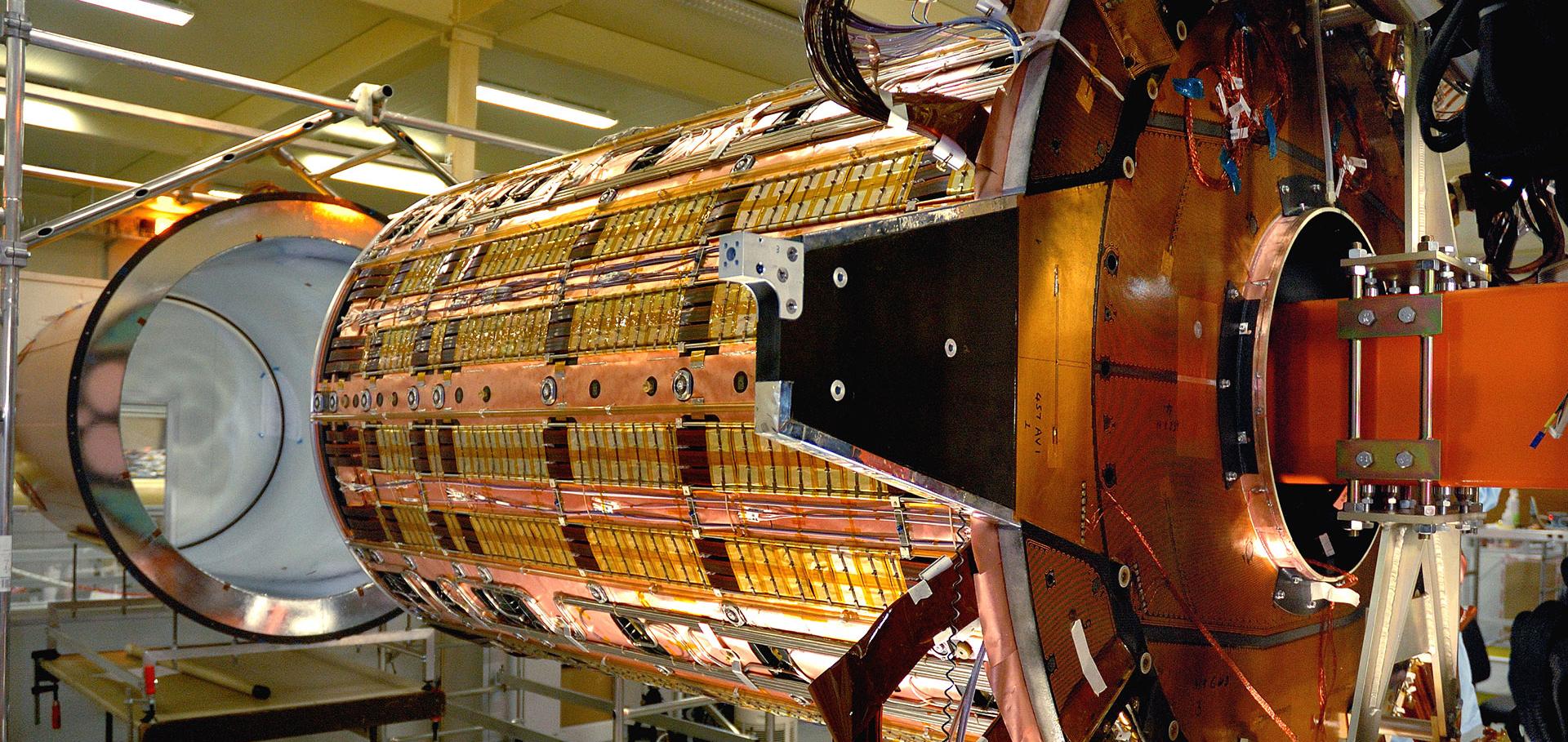

Search for neutral-current induced single photon production at the ND280 near detector in T2K
Journal of Physics G: Nuclear and Particle Physics IOP Publishing 46:8 (2019) 08LT01
Abstract:
All rights reserved. Neutrino neutral-current (NC) induced single photon production is a subleading order process for accelerator-based neutrino beam experiments including T2K. It is, however, an important process to understand because it is a background for electron (anti)neutrino appearance oscillation experiments. Here, we performed the first search of this process below 1 GeV using the finegrained detector at the T2K ND280 off-axis near detector. By reconstructing single photon kinematics from electron positron pairs, we achieved 95% pure gamma ray sample from 5.738 1020 protons-on-targets neutrino mode data. We do not find positive evidence of NC induced single photon production in this sample. We set the model-dependent upper limit on the cross-section for this process, at 0.114 10-38 cm2 (90% C.L.) per nucleon, using the J-PARC off-axis neutrino beam with an average energy of .En. ~ 0.6 GeV. This is the first limit on this process below 1.GeV which is important for current and future oscillation experiments looking for electron neutrino appearance oscillation signals.Measurement of neutron production in atmospheric neutrino interactions at the Sudbury Neutrino Observatory
Physical Review D American Physical Society 99:11 (2019) 112007
Abstract:
Neutron production in giga electron volt–scale neutrino interactions is a poorly studied process. We have measured the neutron multiplicities in atmospheric neutrino interactions in the Sudbury Neutrino Observatory experiment and compared them to the prediction of a Monte Carlo simulation using genie and a minimally modified version of geant4. We analyzed 837 days of exposure corresponding to Phase I, using pure heavy water, and Phase II, using a mixture of Cl in heavy water. Neutrons produced in atmospheric neutrino interactions were identified with an efficiency of 15.3% and 44.3%, for Phases I and II respectively. The neutron production is measured as a function of the visible energy of the neutrino interaction and, for charged current quasielastic interaction candidates, also as a function of the neutrino energy. This study is also performed by classifying the complete sample into two pairs of event categories: charged current quasielastic and non charged current quasielastic, and νμ and νe. Results show good overall agreement between data and Monte Carlo for both phases, with some small tension with a statistical significance below 2σ for some intermediate energies.Atmospheric neutrino oscillation analysis with improved event reconstruction in Super-Kamiokande IV
Progress of Theoretical and Experimental Physics Oxford University Press (OUP) 2019:5 (2019)
Search for light sterile neutrinos with the T2K far detector Super-Kamiokande at a baseline of 295km
Physical Review D American Physical Society 99:7 (2019) 071103
Abstract:
We perform a search for light sterile neutrinos using the data from the T2K far detector at a baseline of 295 km, with an exposure of 14.7(7.6)×10^20 protons on target in neutrino (antineutrino) mode. A selection of neutral-current interaction samples is also used to enhance the sensitivity to sterile mixing. No evidence of sterile neutrino mixing in the 3+1 model was found from a simultaneous fit to the charged-current muon, electron and neutral-current neutrino samples. We set the most stringent limit on the sterile oscillation amplitude sin^2θ24 for the sterile neutrino mass splitting Δm^2v41<3×10^−3eV^2/c^4.Measurement of the $\nu_{\mu}$ charged-current cross sections on water, hydrocarbon, iron, and their ratios with the T2K on-axis detectors
(2019)