Home
Department Of Physics text logo
  • Research
    • Our research
    • Our research groups
    • Our research in action
    • Research funding support
    • Summer internships for undergraduates
  • Study
    • Undergraduates
    • Postgraduates
  • Engage
    • For alumni
    • For business
    • For schools
    • For the public
  • Support
Menu
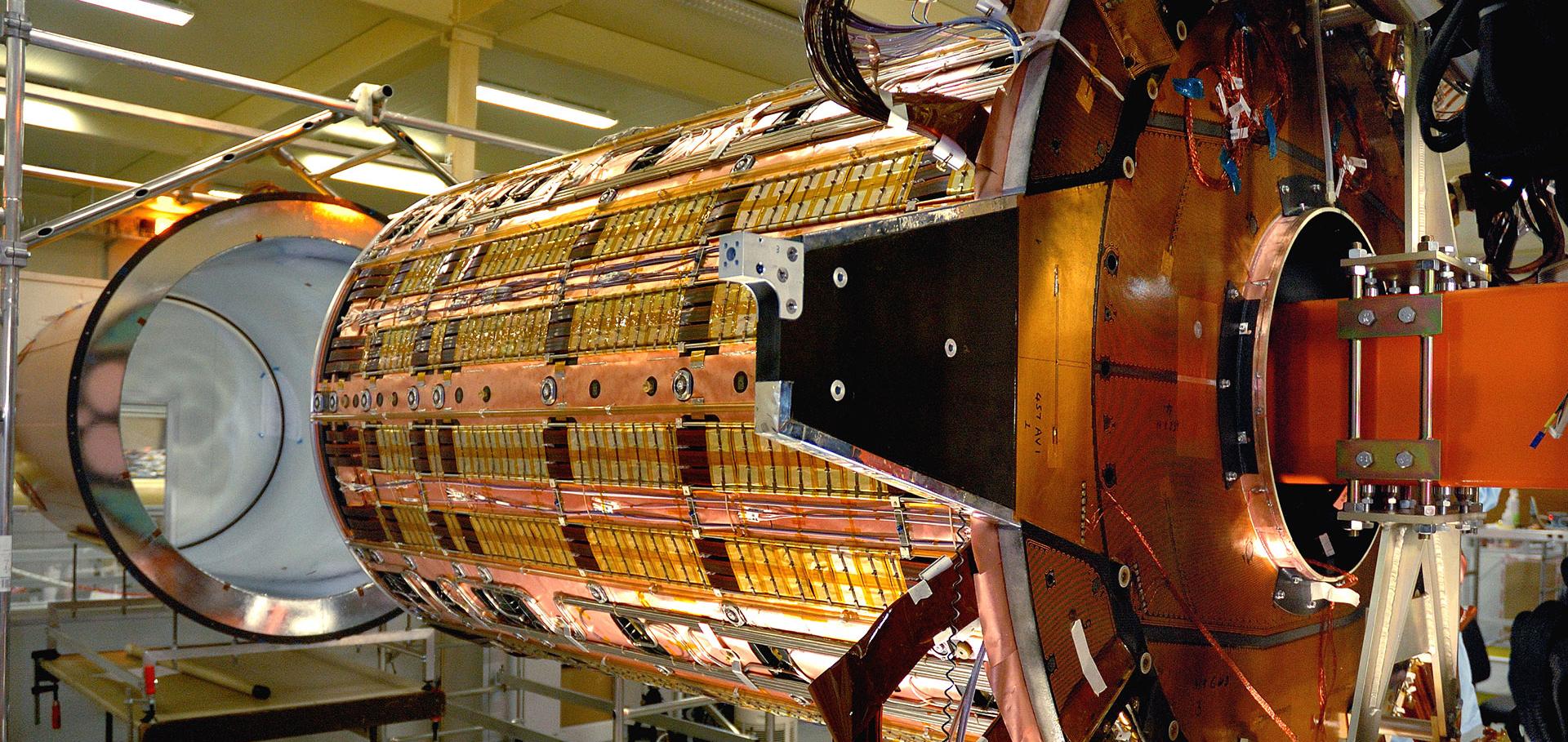
Insertion of STC into TRT at the Department of Physics, Oxford
Credit: CERN

David Wark

Professor of Particle Physics

Sub department

  • Particle Physics

Research groups

  • Accelerator Neutrinos
dave.wark@physics.ox.ac.uk
Telephone: 01865 (2)73400
Denys Wilkinson Building, room 626
  • About
  • Publications

Measurement of final-state correlations in neutrino muon-proton mesonless production on hydrocarbon at < E-v >=3 GeV

Physical Review Letters American Physical Society 121:2 (2018) 022504

Authors:

Xianguo Lu, M Betancourt, T Walton, F Akbar, L Aliaga, O Altinok, DA Andrade, M Ascencio, L Bellantoni, A Bercellie, A Bodek, A Bravar, H Budd, T Cai, MF Carneiro, J Chaves, David Coplowe, H Da Motta, Dytman, GA Diaz, J Felix, L Fields, R Fine, AM Gago, R Galindo, H Gallagher, A Ghosh, R Gran, DA Harris, S Henry, S Jena, D Jena, J Kleykamp, M Kordosky, T Le, E Maher, S Manly, WA Mann, CM Marshall, KS McFarland, AM McGowan, B Messerly, J Miller, A Mislivec, JG Morfin, J Mousseau, D Naples, JK Nelson, C Nguyen, A Norrick

Abstract:

Final-state kinematic imbalances are measured in mesonless production of νμ+A→μ-+p+X in the MINERvA tracker. Initial- and final-state nuclear effects are probed using the direction of the μ - p transverse momentum imbalance and the initial-state momentum of the struck neutron. Differential cross sections are compared to predictions based on current approaches to medium modeling. These models underpredict the cross section at intermediate intranuclear momentum transfers that generally exceed the Fermi momenta. As neutrino interaction models need to correctly incorporate the effect of the nucleus in order to predict neutrino energy resolution in oscillation experiments, this result points to a region of phase space where additional cross section strength is needed in current models, and demonstrates a new technique that would be suitable for use in fine-grained liquid argon detectors where the effect of the nucleus may be even larger.
More details from the publisher
Details from ORA
More details
More details
Details from ArXiV

Physics potentials with the second Hyper-Kamiokande detector in Korea

Progress of Theoretical and Experimental Physics Oxford University Press 2018:6 (2018)

Authors:

K Abe, K Abe, SH Ahn, H Aihara, A Aimi, R Akutsu, C Andreopoulos, I Anghel, LHV Anthony, M Antonova, Y Ashida, V Aushev, M Barbi, GJ Barker, Giles Barr, P Beltrame, V Berardi, M Bergevin, S Berkman, L Berns, T Berry, S Bhadra, FDM Blaszczyk, A Blondel, S Bolognesi

Abstract:

Hyper-Kamiokande consists of two identical water-Cherenkov detectors of total 520~kt with the first one in Japan at 295~km from the J-PARC neutrino beam with 2.5$^{\textrm{o}}$ Off-Axis Angles (OAAs), and the second one possibly in Korea in a later stage. Having the second detector in Korea would benefit almost all areas of neutrino oscillation physics mainly due to longer baselines. There are several candidate sites in Korea with baselines of 1,000$\sim$1,300~km and OAAs of 1$^{\textrm{o}}$$\sim$3$^{\textrm{o}}$. We conducted sensitivity studies on neutrino oscillation physics for a second detector, either in Japan (JD $\times$ 2) or Korea (JD + KD) and compared the results with a single detector in Japan. Leptonic CP violation sensitivity is improved especially when the CP is non-maximally violated. The larger matter effect at Korean candidate sites significantly enhances sensitivities to non-standard interactions of neutrinos and mass ordering determination. Current studies indicate the best sensitivity is obtained at Mt. Bisul (1,088~km baseline, $1.3^\circ$ OAA). Thanks to a larger (1,000~m) overburden than the first detector site, clear improvements to sensitivities for solar and supernova relic neutrino searches are expected.
More details from the publisher
Details from ORA
More details
Details from ArXiV

Search for boosted dark matter interacting with electrons in Super-Kamiokande

Physical Review Letters American Physical Society 120:22 (2018) 221301

Authors:

C Kachulis, K Abe, C Bronner, Y Hayato, M Ikeda, K Iyogi, J Kameda, Y Kato, Y Kishimoto, L Marti, M Miura, S Moriyama, M Nakahata, Y Nakano, S Nakayama, Y Okajima, A Orii, G Pronost, H Sekiya, M Shiozawa, Y Sonoda, A Takeda, A Takenaka, H Tanaka, S Tasaka, T Tomura, R Akutsu, T Kajita, K Kaneyuki, Y Nishimura, K Okumura, KM Tsui, L Labarga, P Fernandez, FDM Blaszczyk, J Gustafson, E Kearns, JL Raaf, JL Stone, LR Sulak, S Berkman, S Tobayama, M Goldhaber, M Elnimr, WR Kropp, S Mine, S Locke, P Weatherly, MB Smy, HW Sobel

Abstract:

A search for boosted dark matter using 161.9 kt yr of Super-Kamiokande IV data is presented. We search for an excess of elastically scattered electrons above the atmospheric neutrino background, with a visible energy between 100 MeV and 1 TeV, pointing back to the Galactic center or the Sun. No such excess is observed. Limits on boosted dark matter event rates in multiple angular cones around the Galactic center and Sun are calculated. Limits are also calculated for a baseline model of boosted dark matter produced from cold dark matter annihilation or decay. This is the first experimental search for boosted dark matter from the Galactic center or the Sun interacting in a terrestrial detector.
More details from the publisher
Details from ORA
More details
More details

Measurement of final-state correlations in neutrino muon-proton mesonless production on hydrocarbon at $\langle E_\nu\rangle=3$ GeV

(2018)

Authors:

X-G Lu, M Betancourt, T Walton, F Akbar, L Aliaga, O Altinok, DA Andrade, M Ascencio, L Bellantoni, A Bercellie, A Bodek, A Bravar, H Budd, T Cai, MF Carneiro, J Chaves, D Coplowe, H da Motta, SA Dytman, GA Diaz, J Felix, L Fields, R Fine, AM Gago, R Galindo, H Gallagher, A Ghosh, R Gran, DA Harris, S Henry, S Jena, D Jena, J Kleykamp, M Kordosky, T Le, E Maher, S Manly, WA Mann, CM Marshall, KS McFarland, AM McGowan, B Messerly, J Miller, A Mislivec, JG Morfin, J Mousseau, D Naples, JK Nelson, C Nguyen, A Norrick, Nuruzzaman, A Olivier, V Paolone, CE Patrick, GN Perdue, MA Ramirez, RD Ransome, L Ren, D Rimal, PA Rodrigues, D Ruterbories, H Schellman, JT Sobczyk, CJ Solano Salinas, H Su, M Sultana, E Valencia, D Wark, A Weber, J Wolcott, M Wospakrik, B Yaeggy
More details from the publisher

Search for neutrinos in super-kamiokande associated with the GW170817 neutron-star merger

Astrophysical Journal Letters American Astronomical Society 857:1 (2018) 1-6

Authors:

Y Sonoda, A Takenaka, T Yano, T Kajita, V Takhistov, J Hill, JY Kim, E O'Sullivan, K Scholberg, M Gonin, J Imber, K Choi, B Richards, R Tacik, SB Kim, B Quilain, Charles Simpson, Y Suzuki, HA Tanaka, T Towstego, A Konaka, S Chen, L Wan, A Minamino

Abstract:

We report the results of a neutrino search in Super-Kamiokande (SK) for coincident signals with the first detected gravitational wave (GW) produced by a binary neutron-star merger, GW170817, which was followed by a short gamma-ray burst, GRB170817A, and a kilonova/macronova. We searched for coincident neutrino events in the range from 3.5 MeV to ∼100 PeV, in a time window ±500 s around the gravitational wave detection time, as well as during a 14-day period after the detection. No significant neutrino signal was observed for either time window. We calculated 90% confidence level upper limits on the neutrino fluence for GW170817. From the upward-going-muon events in the energy region above 1.6 GeV, the neutrino fluence limit is () cm -2 for muon neutrinos (muon antineutrinos), with an error range of ±5around the zenith angle of NGC4993, and the energy spectrum is under the assumption of an index of-2. The fluence limit for neutrino energies less than 100 MeV, for which the emission mechanism would be different than for higher-energy neutrinos, is also calculated. It is 6.6 × 10 7 cm -2 for anti-electron neutrinos under the assumption of a Fermi-Dirac spectrum with average energy of 20 MeV.
More details from the publisher
Details from ORA
More details

Pagination

  • First page First
  • Previous page Prev
  • …
  • Page 16
  • Page 17
  • Page 18
  • Page 19
  • Current page 20
  • Page 21
  • Page 22
  • Page 23
  • Page 24
  • …
  • Next page Next
  • Last page Last

Footer Menu

  • Contact us
  • Giving to the Dept of Physics
  • Work with us
  • Media

User account menu

  • Log in

Follow us

FIND US

Clarendon Laboratory,

Parks Road,

Oxford,

OX1 3PU

CONTACT US

Tel: +44(0)1865272200

University of Oxfrod logo Department Of Physics text logo
IOP Juno Champion logo Athena Swan Silver Award logo

© University of Oxford - Department of Physics

Cookies | Privacy policy | Accessibility statement

Built by: Versantus

  • Home
  • Research
  • Study
  • Engage
  • Our people
  • News & Comment
  • Events
  • Our facilities & services
  • About us
  • Giving to Physics
  • Current students
  • Staff intranet