Home
Department Of Physics text logo
  • Research
    • Our research
    • Our research groups
    • Our research in action
    • Research funding support
    • Summer internships for undergraduates
  • Study
    • Undergraduates
    • Postgraduates
  • Engage
    • For alumni
    • For business
    • For schools
    • For the public
  • Support
Menu
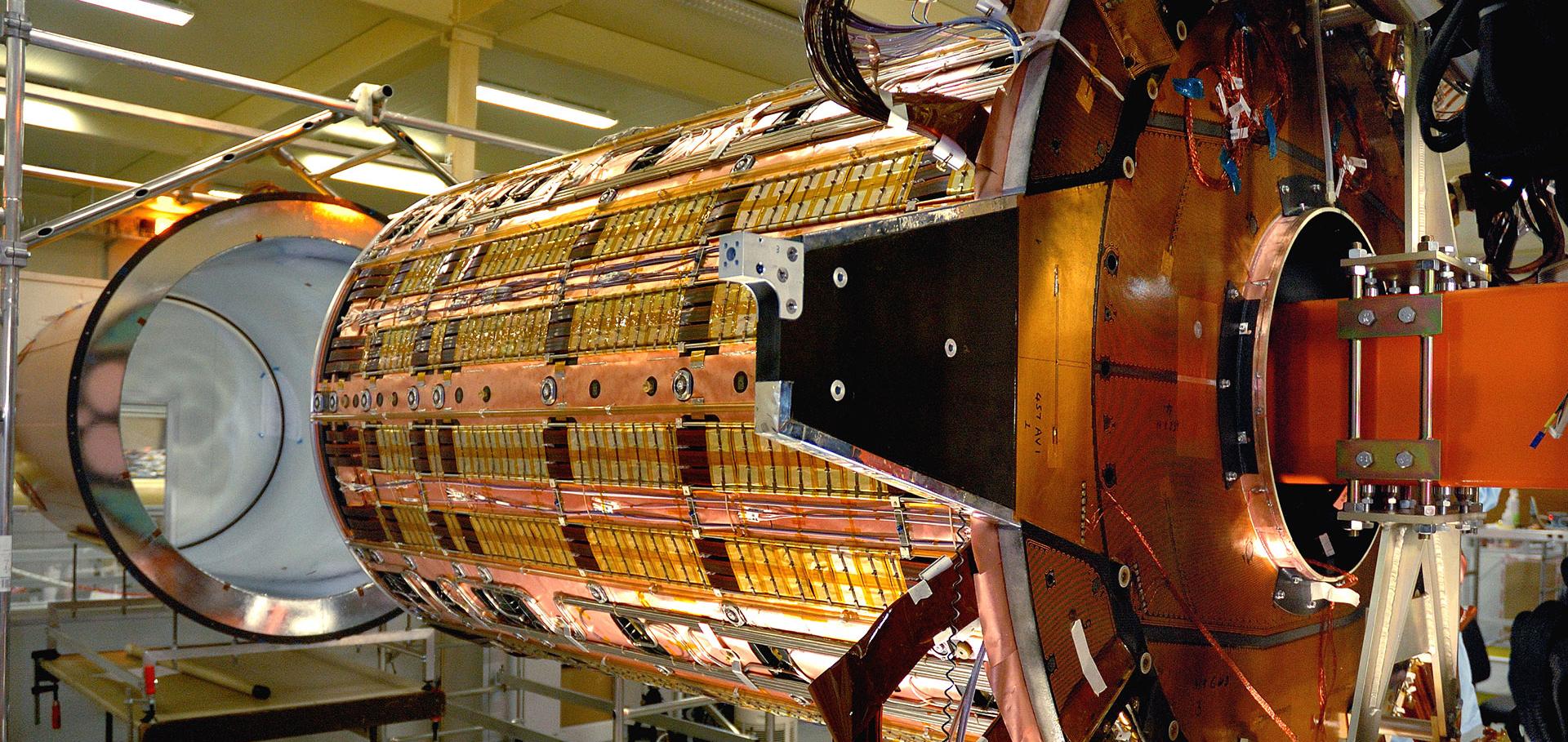
Insertion of STC into TRT at the Department of Physics, Oxford
Credit: CERN

Guy Wilkinson

Professor of Physics

Sub department

  • Particle Physics

Research groups

  • LHCb
Guy.Wilkinson@physics.ox.ac.uk
Telephone: 01865 (2)83110
Denys Wilkinson Building, room 608a
  • About
  • Publications

The LHCb detector at the LHC

Journal of Instrumentation 3:8 (2008)

Authors:

A Augusto Alves, LM Andrade Filho, AF Barbosa, I Bediaga, G Cernicchiaro, G Guerrer, HP Lima, AA Machado, J Magnin, F Manijo, JM De Miranda, A Reis, A Santos, A Toledo, K Akiba, S Amato, B De Paula, L De Paula, T Da Silva, M Gandelman, JH Lopes, B Maréchal, D Moraes, E Polycarpo, F Rodrigues, J Ballansat, Y Bastían, D Boget, I De Bonis, V Coco, PY David, D Decamp, P Delebecque, C Drancourt, N Dumont-Dayot, C Girard, B Lieunard, MN Minard, B Pietrzyk, T Rambure, G Rospabe, S T'Jampens, Z Ajaltouni, G Bohner, R Bonnefoy, D Borras, C Carloganu, H Chanal, E Conte, R Cornat, M Crouau, E Delage, O Deschamps, P Henrard, P Jacquet, C Lacan, J Laubser, J Lecoq, R Lefèvre, M Magne, M Martemiyanov, ML Mercier, S Monteil, V Niess, P Perret, G Reinmuth, A Robert, S Suchorski, K Arnaud, E Aslanides, J Babel, C Benchouk, JP Cachemiche, J Cogan, F Derue, B Dinkespiler, PY Duval, V Garonne, S Favard, R Le Gac, F Leon, O Leroy, PL Liotard, F Marin, M Menouni, P Ollive, S Poss, A Roche, M Sapunov, L Tocco, B Viaud, A Tsaregorodtsev, Y Amhis, G Barrand, S Barsuk, C Beigbeder, R Beneyton, D Breton, O Callot, D Charlet

Abstract:

Large detector systems for particle and astroparticle physics; Particle tracking detectors; Gaseous detectors; Calorimeters; Cherenkov detectors; Particle identification methods; Photon detectors for UV. visible and IR photons; Detector alignment and calibration methods; Detector cooling and thermo-stabilization; Detector design and construction technologies and materials. The LHCb experiment is dedicated to precision measurements of CP violation and rare decays of B hadrons at the Large Hadron Collider (LHC) at CERN (Geneva). The initial configuration and expected performance of the detector and associated systems. as established by test beam measurements and simulation studies. is described. © 2008 IOP Publishing Ltd and SISSA.
More details from the publisher
More details

Two-photon widths of the χcJ states of charmonium

Physical Review D - Particles, Fields, Gravitation and Cosmology 78:9 (2008)

Authors:

KM Ecklund, W Love, V Savinov, A Lopez, H Mendez, J Ramirez, JY Ge, DH Miller, IPJ Shipsey, B Xin, GS Adams, M Anderson, JP Cummings, I Danko, D Hu, B Moziak, J Napolitano, Q He, J Insler, H Muramatsu, CS Park, EH Thorndike, F Yang, M Artuso, S Blusk, S Khalil, J Li, R Mountain, S Nisar, K Randrianarivony, N Sultana, T Skwarnicki, S Stone, JC Wang, LM Zhang, G Bonvicini, D Cinabro, M Dubrovin, A Lincoln, P Naik, J Rademacker, DM Asner, KW Edwards, J Reed, RA Briere, T Ferguson, G Tatishvili, H Vogel, ME Watkins, JL Rosner, JP Alexander, DG Cassel, JE Duboscq, R Ehrlich, L Fields, RS Galik, L Gibbons, R Gray, SW Gray, DL Hartill, D Hertz, JM Hunt, J Kandaswamy, DL Kreinick, VE Kuznetsov, J Ledoux, H Mahlke-Krüger, D Mohapatra, PUE Onyisi, JR Patterson, D Peterson, D Riley, A Ryd, AJ Sadoff, X Shi, S Stroiney, WM Sun, T Wilksen, SB Athar, R Patel, J Yelton, P Rubin, BI Eisenstein, I Karliner, S Mehrabyan, N Lowrey, M Selen, EJ White, J Wiss, RE Mitchell, MR Shepherd, D Besson, TK Pedlar, D Cronin-Hennessy, KY Gao, J Hietala, Y Kubota, T Klein, BW Lang, R Poling

Abstract:

Using a data sample of 24.5×10⁶ ψ(2S) the reactions ψ(2S)→γχcJ, χcJ→γγ have been studied for the first time to determine the two-photon widths of the χcJ states of charmonium in their decay into two photons. The measured quantities are B(ψ(2S)→γχc0)×B(χc0→γγ)=(2. 17±0.32±0.10)×10-5 and B(ψ(2S)→γχc2) ×B(χc2→γγ)=(2.68±0.28±0.15)×10-5. Using values for B(ψ(2S)→γχc0,c2) and Γ(χc0,c2) from the literature the two-photon widths are derived to be Γγ γ(χc0)=(2.36±0.35±0.22)keV, Γγγ(χ c2)=(0.66±0.07±0.06)keV, and R≡Γγγ(χ c2)/Γγγ(χc0)=0.278±0.050±0.036. The importance of the measurement of R is emphasized. For the forbidden transition, χc1→γγ, an upper limit of Γγγ(χc1) <0.03keV is established. © 2008 The American Physical Society.
More details from the publisher

Inclusive χbJ(nP) decays to D0X

Physical Review D Particles Fields Gravitation and Cosmology 78:9 (2008)

Authors:

RA Briere, T Ferguson, G Tatishvili, H Vogel, ME Watkins, JL Rosner, JP Alexander, DG Cassel, JE Duboscq, R Ehrlich, L Fields, RS Galik, L Gibbons, R Gray, SW Gray, DL Hartill, BK Heltsley, D Hertz, J Kandaswamy, DL Kreinick, VE Kuznetsov, H Mahlke-Krüger, D Mohapatra, PUE Onyisi, JR Patterson, D Peterson, D Riley, A Ryd, AJ Sadoff, X Shi, S Stroiney, WM Sun, T Wilksen, SB Athar, R Patel, J Yelton, P Rubin, BI Eisenstein, I Karliner, S Mehrabyan, N Lowrey, M Selen, EJ White, J Wiss, RE Mitchell, MR Shepherd, D Besson, TK Pedlar, D Cronin-Hennessy, KY Gao, J Hietala, Y Kubota, T Klein, BW Lang, R Poling, AW Scott, P Zweber, S Dobbs, Z Metreveli, KK Seth, A Tomaradze, J Libby, A Powell, G Wilkinson, KM Ecklund, W Love, V Savinov, A Lopez, H Mendez, J Ramirez, JY Ge, DH Miller, IPJ Shipsey, B Xin, GS Adams, M Anderson, JP Cummings, I Danko, D Hu, B Moziak, J Napolitano, Q He, J Insler, H Muramatsu, CS Park, EH Thorndike, F Yang, M Artuso, S Blusk, S Khalil, J Li, R Mountain, S Nisar, K Randrianarivony, N Sultana, T Skwarnicki, S Stone, JC Wang, LM Zhang, G Bonvicini

Abstract:

Using Υ(2S) and Υ(3S) data collected with the CLEO III detector we have searched for decays of χbJ to final states with open charm. We fully reconstruct D0 mesons with pD0>2.5GeV/c in three decay modes (K-π+, K-π+π0, and K-π-π+π+) in coincidence with radiative transition photons that tag the production of one of the χbJ(nP) states. Significant signals are obtained for the two J=1 states. Recent nonrelativistic QCD (NRQCD) calculations of χbJ(nP)→cc̄X depend on one nonperturbative parameter per χbJ triplet. The extrapolation from the observed D0X rate over a limited momentum range to a full cc̄X rate also depends on these same parameters. Using our data to fit for these parameters, we extract results which agree well with NRQCD predictions, confirming the expectation that charm production is largest for the J=1 states. In particular, for J=1, our results are consistent with cc̄g accounting for about one-quarter of all hadronic decays. © 2008 The American Physical Society.
More details from the publisher

Observation of X bJ(1P,2P) decays to light hadrons

Physical Review D - Particles, Fields, Gravitation and Cosmology 78:9 (2008)

Authors:

DM Asner, KW Edwards, J Reed, RA Briere, G Tatishvili, H Vogel, PUE Onyisi, JL Rosner, JP Alexander, DG Cassel, JE Duboscq, R Ehrlich, L Fields, RS Galik, L Gibbons, R Gray, SW Gray, DL Hartill, BK Heltsley, D Hertz, JM Hunt, J Kandaswamy, DL Kreinick, VE Kuznetsov, J Ledoux, H Mahlke-Krüger, D Mohapatra, JR Patterson, D Peterson, D Riley, A Ryd, AJ Sadoff, X Shi, S Stroiney, WM Sun, T Wilksen, SB Athar, J Yelton, P Rubin, BI Eisenstein, I Karliner, S Mehrabyan, N Lowrey, M Selen, EJ White, J Wiss, RE Mitchell, MR Shepherd, D Besson, TK Pedlar, D Cronin-Hennessy, KY Gao, J Hietala, Y Kubota, T Klein, BW Lang, R Poling, AW Scott, P Zweber, S Dobbs, Z Metreveli, KK Seth, BJY Tan, A Tomaradze, J Libby, L Martin, A Powell, G Wilkinson, KM Ecklund, W Love, V Savinov, H Mendez, JY Ge, DH Miller, IPJ Shipsey, B Xin, GS Adams, D Hu, B Moziak, J Napolitano, Q He, J Insler, H Muramatsu, CS Park, EH Thorndike, F Yang, M Artuso, S Blusk, S Khalil, J Li, R Mountain, K Randrianarivony, N Sultana, T Skwarnicki, S Stone, JC Wang, LM Zhang, G Bonvicini, D Cinabro, M Dubrovin

Abstract:

Analyzing Y(nS) decays acquired with the CLEO detector operating at the CESR e+e- collider, we measure for the first time the product branching fractions B[Y(nS)→YX bJ((n-1)P)]B[X bJ(n-1)P)→Xi] for n=2 and 3, where Xi denotes, for each i, one of the 14 exclusive light-hadron final states for which we observe significant signals in both X bJ(1P) and X bJ(2P) decays. We also determine upper limits for the electric dipole (E1) transitions Y(3S)→YX bJ(1P). © 2008 The American Physical Society.
More details from the publisher

Observation of Υ(2S)→ηΥ(1S) and search for related transitions

Physical Review Letters 101:19 (2008)

Authors:

Q He, J Insler, H Muramatsu, CS Park, EH Thorndike, F Yang, M Artuso, S Blusk, S Khalil, J Li, R Mountain, S Nisar, K Randrianarivony, N Sultana, T Skwarnicki, S Stone, JC Wang, LM Zhang, G Bonvicini, D Cinabro, M Dubrovin, A Lincoln, P Naik, J Rademacker, DM Asner, KW Edwards, J Reed, RA Briere, T Ferguson, G Tatishvili, H Vogel, ME Watkins, JL Rosner, JP Alexander, DG Cassel, JE Duboscq, R Ehrlich, L Fields, RS Galik, L Gibbons, R Gray, SW Gray, DL Hartill, BK Heltsley, D Hertz, JM Hunt, J Kandaswamy, DL Kreinick, VE Kuznetsov, J Ledoux, H Mahlke-Krüger, D Mohapatra, PUE Onyisi, JR Patterson, D Peterson, D Riley, A Ryd, AJ Sadoff, X Shi, S Stroiney, WM Sun, T Wilksen, SB Athar, R Patel, J Yelton, P Rubin, BI Eisenstein, I Karliner, S Mehrabyan, N Lowrey, M Selen, EJ White, J Wiss, RE Mitchell, MR Shepherd, D Besson, TK Pedlar, JV Xavier, D Cronin-Hennessy, KY Gao, J Hietala, Y Kubota, T Klein, BW Lang, R Poling, AW Scott, P Zweber, S Dobbs, Z Metreveli, KK Seth, A Tomaradze, J Libby, L Martin, A Powell, G Wilkinson, KM Ecklund, W Love, V Savinov, H Mendez, JY Ge

Abstract:

We report the first observation of Υ(2S)→ηΥ(1S), with a branching fraction B=(2.1-0.6+0.7(stat)±0.3(syst))×10-4 and a statistical significance 5.3σ. Data were acquired with the CLEO III detector at the CESR e+e- symmetric collider. This is the first process observed involving a b-quark spin flip. For related transitions, 90% confidence limits in units of 10-4 are B(Υ(2S)→π0Υ(1S))<1.8, B(Υ(3S)→ηΥ(1S))<1.8, B(Υ(3S)→π0Υ(1S)) <0.7, and B(Υ(3S)→π0Υ(2S))<5.1. © 2008 The American Physical Society.
More details from the publisher

Pagination

  • First page First
  • Previous page Prev
  • …
  • Page 279
  • Page 280
  • Page 281
  • Page 282
  • Current page 283
  • Page 284
  • Page 285
  • Page 286
  • Page 287
  • …
  • Next page Next
  • Last page Last

Footer Menu

  • Contact us
  • Giving to the Dept of Physics
  • Work with us
  • Media

User account menu

  • Log in

Follow us

FIND US

Clarendon Laboratory,

Parks Road,

Oxford,

OX1 3PU

CONTACT US

Tel: +44(0)1865272200

University of Oxfrod logo Department Of Physics text logo
IOP Juno Champion logo Athena Swan Silver Award logo

© University of Oxford - Department of Physics

Cookies | Privacy policy | Accessibility statement

Built by: Versantus

  • Home
  • Research
  • Study
  • Engage
  • Our people
  • News & Comment
  • Events
  • Our facilities & services
  • About us
  • Giving to Physics
  • Current students
  • Staff intranet