Home
Department Of Physics text logo
  • Research
    • Our research
    • Our research groups
    • Our research in action
    • Research funding support
    • Summer internships for undergraduates
  • Study
    • Undergraduates
    • Postgraduates
  • Engage
    • For alumni
    • For business
    • For schools
    • For the public
  • Support
Menu
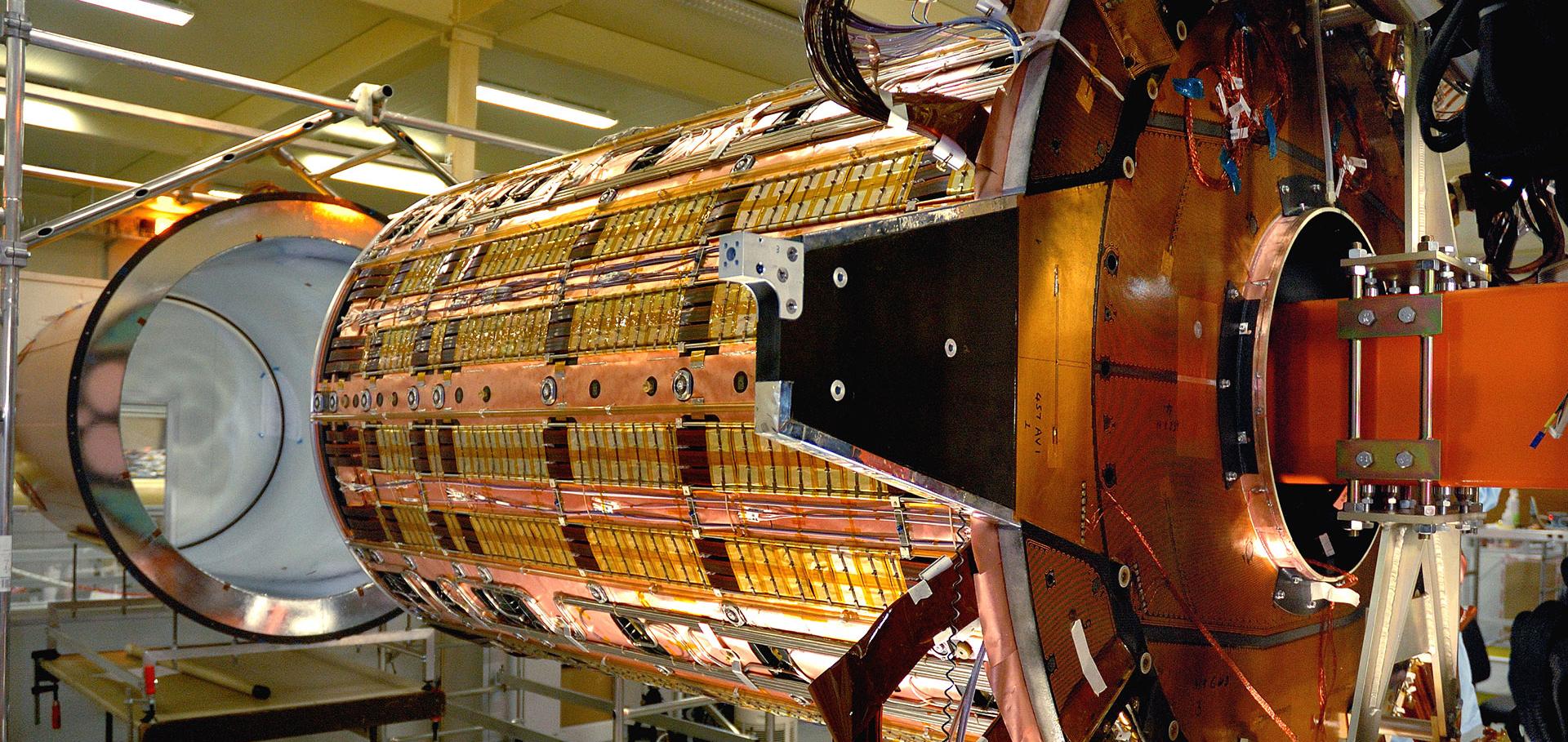
Insertion of STC into TRT at the Department of Physics, Oxford
Credit: CERN

Guy Wilkinson

Professor of Physics

Sub department

  • Particle Physics

Research groups

  • LHCb
Guy.Wilkinson@physics.ox.ac.uk
Telephone: 01865 (2)83110
Denys Wilkinson Building, room 608a
  • About
  • Publications

Charmonium decays to γπ0, γη, and γη′

Physical Review D - Particles, Fields, Gravitation and Cosmology 79:11 (2009)

Authors:

TK Pedlar, J Xavier, D Cronin-Hennessy, KY Gao, J Hietala, T Klein, R Poling, P Zweber, S Dobbs, Z Metreveli, KK Seth, BJY Tan, A Tomaradze, J Libby, L Martin, A Powell, C Thomas, G Wilkinson, H Mendez, JY Ge, DH Miller, IPJ Shipsey, B Xin, GS Adams, D Hu, B Moziak, J Napolitano, KM Ecklund, Q He, J Insler, H Muramatsu, CS Park, EH Thorndike, F Yang, M Artuso, S Blusk, S Khalil, R Mountain, K Randrianarivony, T Skwarnicki, S Stone, JC Wang, LM Zhang, G Bonvicini, D Cinabro, M Dubrovin, A Lincoln, MJ Smith, P Zhou, J Zhu, P Naik, J Rademacker, DM Asner, KW Edwards, J Reed, AN Robichaud, G Tatishvili, EJ White, RA Briere, H Vogel, PUE Onyisi, JL Rosner, JP Alexander, DG Cassel, R Ehrlich, L Fields, RS Galik, L Gibbons, R Gray, SW Gray, DL Hartill, BK Heltsley, D Hertz, JM Hunt, J Kandaswamy, DL Kreinick, VE Kuznetsov, J Ledoux, H Mahlke-Krüger, JR Patterson, D Peterson, D Riley, A Ryd, AJ Sadoff, X Shi, S Stroiney, WM Sun, T Wilksen, J Yelton, P Rubin, N Lowrey, S Mehrabyan, M Selen, J Wiss, M Kornicer, RE Mitchell, MR Shepherd, C Tarbert, D Besson

Abstract:

Using data acquired with the CLEO-c detector at the CESR e+e- collider, we measure branching fractions for J/ψ, ψ(2S), and ψ(3770) decays to γπ0, γη, and γη′. Defining Rn B[ψ(nS)→γη]/B[ψ(nS)→γη′], we obtain R1=(21.1±0.9)% and, unexpectedly, an order of magnitude smaller limit, R2<1.8% at 90% C.L. We also use J/ψ→γη′ events to determine branching fractions of improved precision for the five most copious η′ decay modes. © 2009 The American Physical Society.
More details from the publisher

Search for D0→p̄e+ and D0→pe-

Physical Review D Particles Fields Gravitation and Cosmology 79:9 (2009)

Authors:

P Rubin, N Lowrey, S Mehrabyan, M Selen, J Wiss, RE Mitchell, MR Shepherd, D Besson, TK Pedlar, D Cronin-Hennessy, KY Gao, J Hietala, Y Kubota, T Klein, R Poling, AW Scott, P Zweber, S Dobbs, Z Metreveli, KK Seth, BJY Tan, A Tomaradze, J Libby, L Martin, A Powell, G Wilkinson, H Mendez, JY Ge, DH Miller, IPJ Shipsey, B Xin, GS Adams, D Hu, B Moziak, J Napolitano, KM Ecklund, Q He, J Insler, H Muramatsu, CS Park, EH Thorndike, F Yang, M Artuso, S Blusk, S Khalil, J Li, R Mountain, K Randrianarivony, N Sultana, T Skwarnicki, S Stone, JC Wang, LM Zhang, G Bonvicini, D Cinabro, M Dubrovin, A Lincoln, MJ Smith, P Zhou, J Zhu, P Naik, J Rademacker, DM Asner, KW Edwards, J Reed, AN Robichaud, G Tatishvili, EJ White, RA Briere, H Vogel, PUE Onyisi, JL Rosner, JP Alexander, DG Cassel, JE Duboscq, R Ehrlich, L Fields, L Gibbons, R Gray, SW Gray, DL Hartill, BK Heltsley, D Hertz, JM Hunt, J Kandaswamy, DL Kreinick, VE Kuznetsov, J Ledoux, H Mahlke-Krüger, JR Patterson, D Peterson, D Riley, A Ryd, AJ Sadoff, X Shi, S Stroiney, WM Sun, T Wilksen, J Yelton

Abstract:

We search for simultaneous baryon and lepton number violating decays of the D0 meson. Specifically, we use 281pb-1 of data taken on the ψ(3770) resonance with the CLEO-c detector at the CESR collider to look for decays D0→p̄e+, D̄0→p̄e+, D0→pe-, and D̄0→pe-. We find no significant signals and set the following branching fraction upper limits: D0→p̄e+(D̄0→p̄e+)<1.1×10⁻⁵ and D0→pe-(D̄0→pe-)<1.0×10⁻⁵, both at the 90% confidence level. © 2009 The American Physical Society.
More details from the publisher

Dalitz plot analysis of Ds+→K+K-π+

Physical Review D - Particles, Fields, Gravitation and Cosmology 79:7 (2009)

Authors:

RE Mitchell, MR Shepherd, D Besson, TK Pedlar, J Xavier, D Cronin-Hennessy, KY Gao, J Hietala, Y Kubota, T Klein, R Poling, AW Scott, P Zweber, S Dobbs, Z Metreveli, KK Seth, BJY Tan, A Tomaradze, J Libby, L Martin, A Powell, C Thomas, G Wilkinson, H Mendez, JY Ge, DH Miller, IPJ Shipsey, B Xin, GS Adams, D Hu, B Moziak, J Napolitano, KM Ecklund, Q He, J Insler, H Muramatsu, CS Park, EH Thorndike, F Yang, M Artuso, S Blusk, S Khalil, R Mountain, K Randrianarivony, N Sultana, T Skwarnicki, S Stone, JC Wang, LM Zhang, G Bonvicini, D Cinabro, M Dubrovin, A Lincoln, MJ Smith, P Zhou, J Zhu, P Naik, J Rademacker, DM Asner, KW Edwards, J Reed, AN Robichaud, G Tatishvili, EJ White, RA Briere, H Vogel, PUE Onyisi, JL Rosner, JP Alexander, DG Cassel, JE Duboscq, R Ehrlich, L Fields, L Gibbons, R Gray, SW Gray, DL Hartill, BK Heltsley, D Hertz, JM Hunt, J Kandaswamy, DL Kreinick, VE Kuznetsov, J Ledoux, H Mahlke-Krüger, JR Patterson, D Peterson, D Riley, A Ryd, AJ Sadoff, X Shi, S Stroiney, WM Sun, T Wilksen, J Yelton, P Rubin, N Lowrey, S Mehrabyan, M Selen, J Wiss

Abstract:

We perform a Dalitz plot analysis of the decay Ds+→K+K-π+ with the CLEO-c data set of 586pb-1 of e+e- collisions accumulated at s=4.17GeV. This corresponds to about 0.57×10⁶ Ds±Ds* pairs from which we select 14400 candidates with a background of roughly 15%. In contrast to previous measurements we find good agreement with our data only by including an additional f0(1370)π+ contribution. We measure the magnitude, phase, and fit fraction of K*(892)0K+, (1020)π+, K0*(1430)K+, f0(980)π+, f0(1710)π+, and f0(1370)π+ contributions and limit the possible contributions of other KK and Kπ resonances that could appear in this decay. © 2009 The American Physical Society.
More details from the publisher

New measurement of exclusive decays of the χc0 and χc2 to two-meson final states

Physical Review D - Particles, Fields, Gravitation and Cosmology 79:7 (2009)

Authors:

DM Asner, KW Edwards, J Reed, AN Robichaud, G Tatishvili, RA Briere, H Vogel, PUE Onyisi, JL Rosner, JP Alexander, DG Cassel, JE Duboscq, R Ehrlich, L Fields, RS Galik, L Gibbons, R Gray, SW Gray, DL Hartill, BK Heltsley, D Hertz, JM Hunt, J Kandaswamy, DL Kreinick, VE Kuznetsov, J Ledoux, H Mahlke-Krüger, D Mohapatra, JR Patterson, D Peterson, D Riley, A Ryd, AJ Sadoff, X Shi, S Stroiney, WM Sun, T Wilksen, SB Athar, J Yelton, P Rubin, S Mehrabyan, N Lowrey, M Selen, EJ White, J Wiss, RE Mitchell, MR Shepherd, D Besson, TK Pedlar, D Cronin-Hennessy, KY Gao, J Hietala, Y Kubota, T Klein, R Poling, AW Scott, P Zweber, S Dobbs, Z Metreveli, KK Seth, BJY Tan, A Tomaradze, J Libby, L Martin, A Powell, G Wilkinson, H Mendez, JY Ge, DH Miller, V Pavlunin, B Sanghi, IPJ Shipsey, B Xin, GS Adams, D Hu, B Moziak, J Napolitano, KM Ecklund, Q He, J Insler, H Muramatsu, CS Park, EH Thorndike, F Yang, M Artuso, S Blusk, S Khalil, J Li, R Mountain, K Randrianarivony, N Sultana, T Skwarnicki, S Stone, JC Wang, LM Zhang, G Bonvicini, D Cinabro, M Dubrovin, A Lincoln, P Naik

Abstract:

Using a sample of 2.59×10⁷ ψ(2S) decays collected by the CLEO-c detector, we present results of a study of χc0 and χc2 decays into two-meson final states. We present the world's most precise measurements of the χcJ,(J=0,2)→π+π-, π0π0, K+K-, KS0KS0, ηη, and η′η′ branching fractions, and a search for χc decays into ηη′. These results shed light on the mechanism of charmonium decays into pseudoscalar mesons. © 2009 The American Physical Society.
More details from the publisher

Improved measurement of absolute branching fraction of Ds+→τ+ν τ

Physical Review D - Particles, Fields, Gravitation and Cosmology 79:5 (2009)

Authors:

PUE Onyisi, JL Rosner, JP Alexander, DG Cassel, JE Duboscq, R Ehrlich, L Fields, RS Galik, L Gibbons, R Gray, SW Gray, DL Hartill, BK Heltsley, D Hertz, JM Hunt, J Kandaswamy, DL Kreinick, VE Kuznetsov, J Ledoux, H Mahlke-Krüger, D Mohapatra, JR Patterson, D Peterson, D Riley, A Ryd, AJ Sadoff, X Shi, S Stroiney, WM Sun, T Wilksen, SB Athar, J Yelton, P Rubin, N Lowrey, S Mehrabyan, M Selen, J Wiss, RE Mitchell, MR Shepherd, D Besson, TK Pedlar, D Cronin-Hennessy, KY Gao, J Hietala, Y Kubota, T Klein, R Poling, AW Scott, P Zweber, S Dobbs, Z Metreveli, KK Seth, BJY Tan, A Tomaradze, J Libby, L Martin, A Powell, G Wilkinson, H Mendez, JY Ge, DH Miller, V Pavlunin, B Sanghi, IPJ Shipsey, B Xin, GS Adams, D Hu, B Moziak, J Napolitano, KM Ecklund, Q He, J Insler, H Muramatsu, CS Park, EH Thorndike, F Yang, M Artuso, S Blusk, S Khalil, J Li, R Mountain, K Randrianarivony, N Sultana, T Skwarnicki, S Stone, JC Wang, LM Zhang, G Bonvicini, D Cinabro, M Dubrovin, A Lincoln, MJ Smith, P Naik, J Rademacker, DM Asner, KW Edwards, J Reed, AN Robichaud, G Tatishvili, EJ White

Abstract:

We have studied the leptonic decay Ds+→τ+ντ, via the decay channel τ+→e+νeν̄τ, using a sample of tagged Ds+ decays collected near the Ds*±Ds peak production energy in e+e- collisions with the CLEO-c detector. We obtain B(Ds+→τ+ντ)=( 5.30±0.47±0.22)% and determine the decay constant fDs=(252.5±11.1± 5.2)MeV, where the first uncertainties are statistical and the second are systematic. © 2009 The American Physical Society.
More details from the publisher

Pagination

  • First page First
  • Previous page Prev
  • …
  • Page 276
  • Page 277
  • Page 278
  • Page 279
  • Current page 280
  • Page 281
  • Page 282
  • Page 283
  • Page 284
  • …
  • Next page Next
  • Last page Last

Footer Menu

  • Contact us
  • Giving to the Dept of Physics
  • Work with us
  • Media

User account menu

  • Log in

Follow us

FIND US

Clarendon Laboratory,

Parks Road,

Oxford,

OX1 3PU

CONTACT US

Tel: +44(0)1865272200

University of Oxfrod logo Department Of Physics text logo
IOP Juno Champion logo Athena Swan Silver Award logo

© University of Oxford - Department of Physics

Cookies | Privacy policy | Accessibility statement

Built by: Versantus

  • Home
  • Research
  • Study
  • Engage
  • Our people
  • News & Comment
  • Events
  • Our facilities & services
  • About us
  • Giving to Physics
  • Current students
  • Staff intranet