

Holographic imaging of antiferromagnetic domains with in-situ magnetic field
Revealing Emergent Magnetic Charge in an Antiferromagnet with Diamond Quantum Magnetometry
Spatially reconfigurable topological textures in freestanding antiferromagnetic nanomembranes
Experimental Evidence of
t 2 g
Route towards stable homochrial topological textures in A-type antiferromagnets
Abstract:
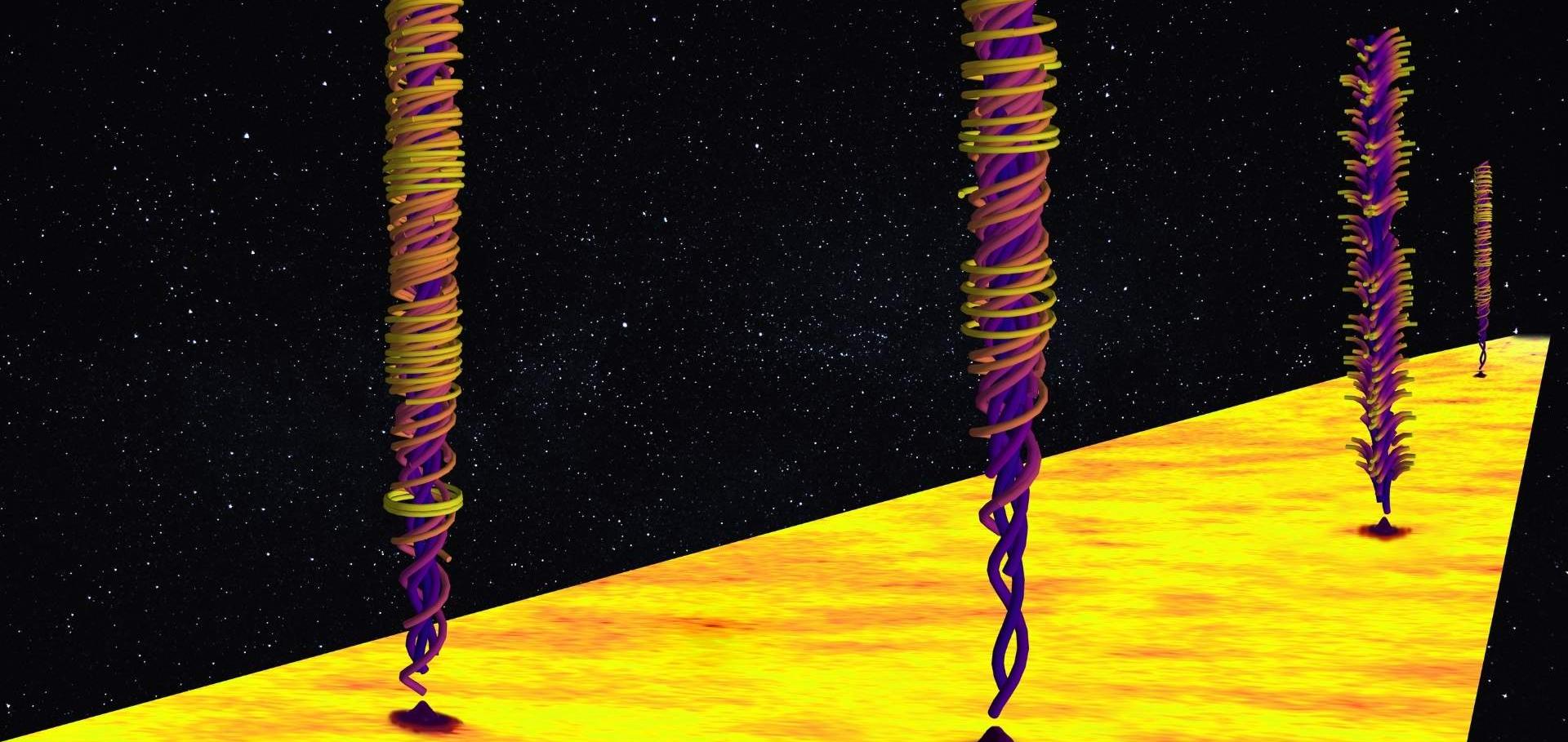
Topologically protected whirling magnetic textures could emerge as data carriers in next-generation post-Moore computing. Such textures are abundantly observed in ferromagnets (FMs); however, their antiferromagnetic (AFM) counterparts are expected to be even more relevant for device applications, as they promise ultrafast, deflection-free dynamics while being robust against external fields. Unfortunately, such textures have remained elusive; hence identifying materials hosting them is key to developing this technology. Here, we present comprehensive micromagnetic and analytical models investigating topological textures in the broad material class of A-type antiferromagnets, specifically focusing on the prototypical case of α-Fe2O3—an emerging candidate for AFM spintronics. By exploiting a symmetry-breaking interfacial Dzyaloshinskii-Moriya interaction (iDMI), it is possible to stabilize a wide topological family, including AFM (anti)merons, bimerons, and the hitherto undiscovered AFM skyrmions. While iDMI enforces homochirality and improves the stability of these textures, the widely tunable anisotropy and exchange interactions enable precise control of their core dimensions. We then present a unifying framework to model the scaling of texture sizes based on a simple dimensional analysis. As the parameters required to host and tune homochiral AFM textures may be obtained by rational materials design of α-Fe2O3, it could emerge as a promising platform to initiate AFM topological spintronics.