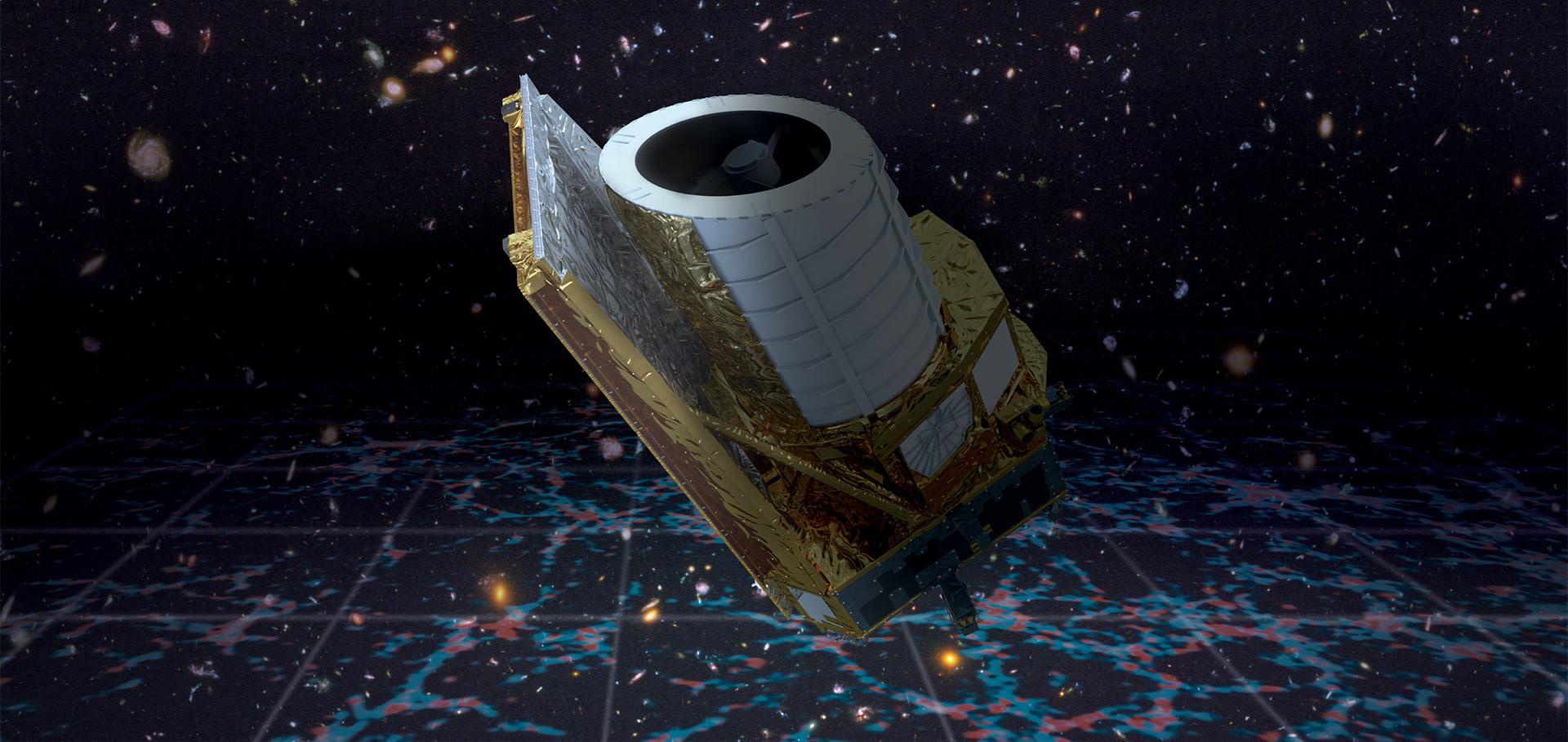
A filament of dark matter between two clusters of galaxies

Nature 487:7406 (2012) 202-204

Authors:

JP Dietrich, N Werner, D Clowe, A Finoguenov, T Kitching, L Miller, A Simionescu

Abstract:

It is a firm prediction of the concordance cold-dark-matter cosmological model that galaxy clusters occur at the intersection of large-scale structure filaments. The thread-like structure of this 'cosmic web' has been traced by galaxy redshift surveys for decades. More recently, the warm-hot intergalactic medium (a sparse plasma with temperatures of 10 5 kelvin to 10 7 kelvin) residing in low-redshift filaments has been observed in emission and absorption. However, a reliable direct detection of the underlying dark-matter skeleton, which should contain more than half of all matter, has remained elusive, because earlier candidates for such detections were either falsified or suffered from low signal-to-noise ratios and unphysical misalignments of dark and luminous matter. Here we report the detection of a dark-matter filament connecting the two main components of the Abell 222/223 supercluster system from its weak gravitational lensing signal, both in a non-parametric mass reconstruction and in parametric model fits. This filament is coincident with an overdensity of galaxies and diffuse, soft-X-ray emission, and contributes a mass comparable to that of an additional galaxy cluster to the total mass of the supercluster. By combining this result with X-ray observations, we can place an upper limit of 0.09 on the hot gas fraction (the mass of X-ray-emitting gas divided by the total mass) in the filament. © 2012 Macmillan Publishers Limited. All rights reserved.

Modeling the FeK line profiles in type i active galactic nuclei with a compton-thick disk wind

Astrophysical Journal 752:2 (2012)

Authors:

MM Tatum, TJ Turner, SA Sim, L Miller, JN Reeves, AR Patrick, KS Long

Abstract:

We have modeled a small sample of Seyfert galaxies that were previously identified as having simple X-ray spectra with little intrinsic absorption. The sources in this sample all contain moderately broad components of FeK-shell emission and are ideal candidates for testing the applicability of a Compton-thick accretion disk wind model to active galactic nucleus (AGN) emission components. Viewing angles through the wind allow the observer to see the absorption signature of the gas, whereas face-on viewing angles allow the observer to see the scattered light from the wind. We find that the FeK emission line profiles are well described with a model of a Compton-thick accretion disk wind of solar abundances, arising tens to hundreds of gravitational radii from the central black hole. Further, the fits require a neutral component of FeKα emission that is too narrow to arise from the inner part of the wind, and likely comes from a more distant reprocessing region. Our study demonstrates that a Compton-thick wind can have a profound effect on the observed X-ray spectrum of an AGN, even when the system is not viewed through the flow. © 2012. The American Astronomical Society. All rights reserved..

Observations of outflowing ultraviolet absorbers in NGC4051 with the cosmic origins spectrograph

Astrophysical Journal 751:2 (2012)

Authors:

SB Kraemer, DM Crenshaw, JP Dunn, TJ Turner, AP Lobban, L Miller, JN Reeves, TC Fischer, V Braito

Abstract:

We present new Hubble Space Telescope (HST)/Cosmic Origins Spectrograph (COS) observations of the narrow-line Seyfert 1 galaxy NGC4051. These data were obtained as part of a coordinated observing program including X-ray observations with the Chandra/High Energy Transmission Grating (HETG) spectrometer and Suzaku. We detected nine kinematic components of UV absorption, which were previously identified using the HST/Space Telescope Imaging Spectrograph (STIS). None of the absorption components showed evidence for changes in column density or profile within the 10 yr between the STIS and COS observations, which we interpret as evidence of (1) saturation, for the stronger components, or (2) very low densities, i.e., n H < 1 cm-3, for the weaker components. After applying a +200 km s-1 offset to the HETG spectrum, we found that the radial velocities of the UV absorbers lay within the O VII profile. Based on photoionization models, we suggest that, while UV components 2, 5, and 7 produce significant O VII absorption, the bulk of the X-ray absorption detected in the HETG analysis occurs in more highly ionized gas. Moreover, the mass-loss rate is dominated by high-ionization gas which lacks a significant UV footprint. © 2012. The American Astronomical Society. All rights reserved..

X-ray signatures of circumnuclear gas in AGN

AIP Conference Proceedings 1427 (2012) 165-172

Authors:

TJ Turner, L Miller, M Tatum

Abstract:

X-ray spectra of AGN are complex. X-ray absorption and emission features trace gas covering a wide range of column densities and ionization states. High resolution spectra show the absorbing gas to be outflowing, perhaps in the form of an accretion disk wind. The absorbing complex shapes the form of the X-ray spectrum while X-ray reverberation and absorption changes explain the spectral and timing behaviour of AGN. We discuss recent progress, highlighting some new results and reviewing the implications that can be drawn from the data. © 2012 American Institute of Physics.

CFHTLenS: Improving the quality of photometric redshifts with precision photometry

Monthly Notices of the Royal Astronomical Society 421:3 (2012) 2355-2367

Authors:

H Hildebrandt, T Erben, K Kuijken, L van Waerbeke, C Heymans, J Coupon, J Benjamin, C Bonnett, L Fu, H Hoekstra, TD Kitching, Y Mellier, L Miller, M Velander, MJ Hudson, BTP Rowe, T Schrabback, E Semboloni, N Benítez

Abstract:

Here we present the results of various approaches to measure accurate colours and photometric redshifts (photo-z) from wide-field imaging data. We use data from the Canada-France-Hawaii Telescope Legacy Survey which have been re-processed by the Canada-France-Hawaii Telescope Lensing Survey (CFHTLenS) team in order to carry out a number of weak gravitational lensing studies. An emphasis is put on the correction of systematic effects in the photo-z arising from the different point spread functions (PSFs) in the five optical bands. Different ways of correcting these effects are discussed and the resulting photo-z accuracies are quantified by comparing the photo-z to large spectroscopic redshift (spec-z) data sets. Careful homogenization of the PSF between bands leads to increased overall accuracy of photo-z. The gain is particularly pronounced at fainter magnitudes where galaxies are smaller and flux measurements are affected more by PSF effects. We discuss ways of defining more secure subsamples of galaxies as well as a shape- and colour-based star-galaxy separation method, and we present redshift distributions for different magnitude limits. We also study possible re-calibrations of the photometric zero-points (ZPs) with the help of galaxies with known spec-z. We find that if PSF effects are properly taken into account, a re-calibration of the ZPs becomes much less important suggesting that previous such re-calibrations described in the literature could in fact be mostly corrections for PSF effects rather than corrections for real inaccuracies in the ZPs. The implications of this finding for future surveys like the Kilo Degree Survey (KiDS), Dark Energy Survey (DES), Large Synoptic Survey Telescope or Euclid are mixed. On the one hand, ZP re-calibrations with spec-z values might not be as accurate as previously thought. On the other hand, careful PSF homogenization might provide a way out and yield accurate, homogeneous photometry without the need for full spectroscopic coverage. This is the first paper in a series describing the technical aspects of CFHTLenS. © 2012 The Authors Monthly Notices of the Royal Astronomical Society © 2012 RAS.