

A compact high energy camera for the cherenkov telescope array
Proceedings of the 33rd International Cosmic Rays Conference Icrc 2013 2013-October (2013)
Abstract:
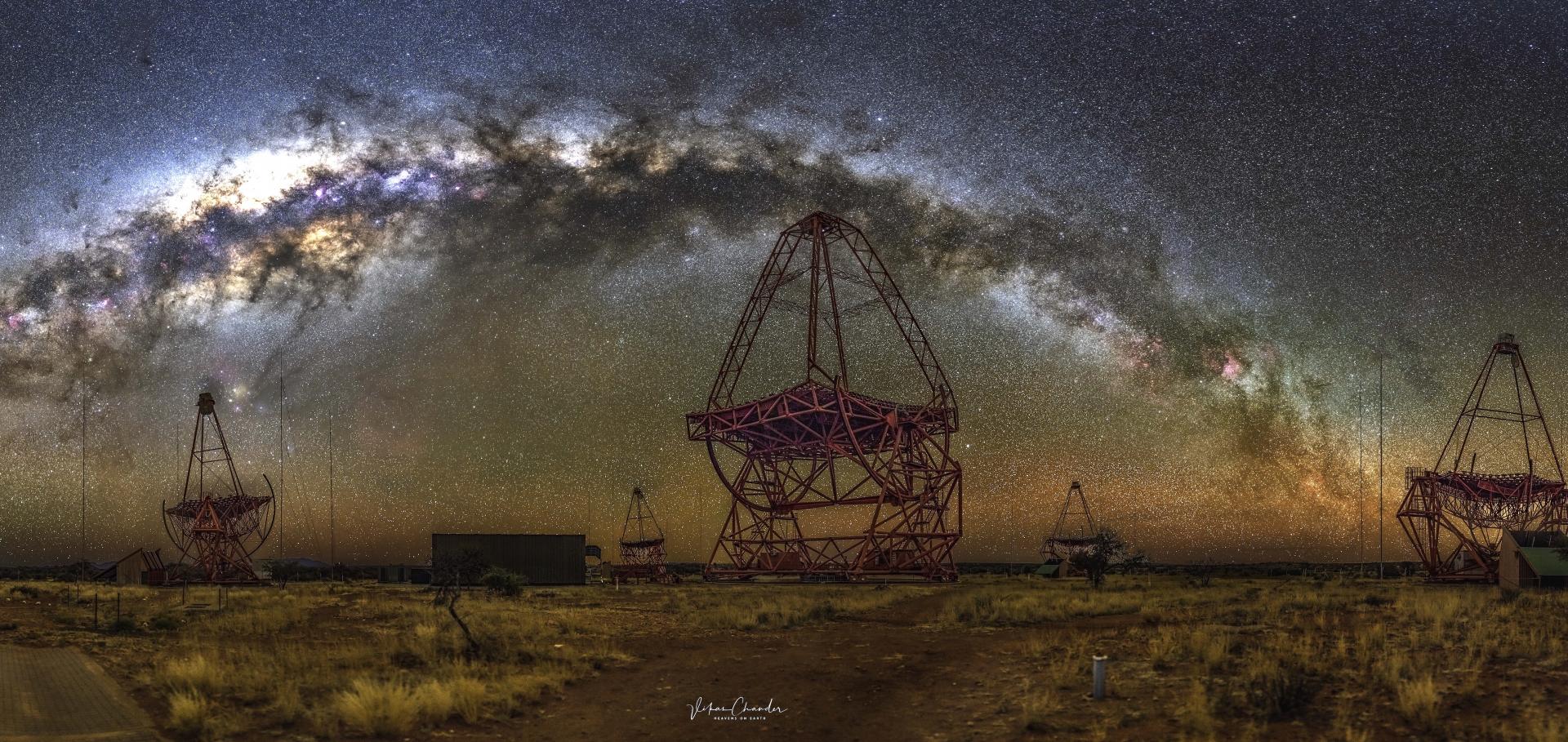
The Compact High Energy Camera (CHEC) is a camera-development project involving UK, US, Japanese and Dutch institutes for the dual-mirror Small-Sized Telescopes (SST-2M) of the Cherenkov Telescope Array (CTA). Two CHEC prototypes, based on different photosensors are funded and will be assembled and tested in the UK over the next ≈18 months. CHEC is designed to record flashes of Cherenkov light lasting from a few to a hundred nanoseconds, with typical RMS image width and length of ∼ 0.2◦ × 1.0◦, and has a 9◦ field of view. The physical camera geometry is dictated by the telescope optics: a curved focal surface with radius of curvature 1 m and diameter ∼35 cm is required. CHEC is designed to work with both the ASTRI and GATE SST-2M telescope structures and will include an internal LED flasher system for calibration. The first CHEC prototype will be based on multi-anode photomultipliers (MAPMs) and the second on silicon photomultipliers (SiPMs or MPPCs). The first prototype will soon be installed on the ASTRI SST-2M prototype structure on Mt. Etna.Broad-band monitoring tracing the evolution of the jet and disc in the black hole candidate X-ray binary MAXI J1659-152
Monthly Notices of the Royal Astronomical Society 436:3 (2013) 2625-2638
Abstract:
MAXI J1659-152 was discovered on 2010 September 25 as a new X-ray transient, initially identified as a gamma-ray burst, but was later shown to be a new X-ray binary with a black hole as the most likely compact object. Dips in the X-raylight curves have revealed that MAXI J1659-152 is the shortest period black hole candidate identified to date. Here we present the results of a large observing campaign at radio, submillimetre, near-infrared (nIR), optical and ultraviolet (UV) wavelengths. We have combined this very rich data set with the available X-ray observations to compile a broad-band picture of the evolution of this outburst. We have performed broad-band spectral modelling, demonstrating the presence of a spectral break at radio frequencies and a relationship between the radio spectrum and X-ray states. Also, we have determined physical parameters of the accretion disc and put them into context with respect to the other parameters of thebinary system. Finally, we have investigated the radio-X-ray and nIR/optical/UV-X-ray correlations up to ̃3 yr after the outburst onset to examine the link between the jet and the accretion disc, and found that there is no significant jet contribution to the nIR emission when the source is in the soft or intermediateX-ray spectral state, consistent withour detection of the jet break at radio frequencies during these states. © 2013 The Authors Published by Oxford University Press on behalf of the Royal Astronomical Society.Calibrating high-precision Faraday rotation measurements for LOFAR and the next generation of low-frequency radio telescopes
Astronomy and Astrophysics 552 (2013)
Abstract:
Faraday rotation measurements using the current and next generation of low-frequency radio telescopes will provide a powerful probe of astronomical magnetic fields. However, achieving the full potential of these measurements requires accurate removal of the time-variable ionospheric Faraday rotation contribution. We present ionFR, a code that calculates the amount of ionospheric Faraday rotation for a specific epoch, geographic location, and line-of-sight. ionFR uses a number of publicly available, GPS-derived total electron content maps and the most recent release of the International Geomagnetic Reference Field. We describe applications of this code for the calibration of radio polarimetric observations, and demonstrate the high accuracy of its modeled ionospheric Faraday rotations using LOFAR pulsar observations. These show that we can accurately determine some of the highest-precision pulsar rotation measures ever achieved. Precision rotation measures can be used to monitor rotation measure variations-either intrinsic or due to the changing line-of-sight through the interstellar medium. This calibration is particularly important for nearby sources, where the ionosphere can contribute a significant fraction of the observed rotation measure. We also discuss planned improvements to ionFR, as well as the importance of ionospheric Faraday rotation calibration for the emerging generation of low-frequency radio telescopes, such as the SKA and its pathfinders. © 2013 ESO.Detecting highly dispersed bursts with next-generation radio telescopes
Monthly Notices of the Royal Astronomical Society 436:1 (2013) 371-379
Abstract:
Recently, there have been reports of six bright, dispersed bursts of coherent radio emission found in pulsar surveys with the Parkes Multibeam Receiver. Not much is known about the progenitors of these bursts, but they are highly energetic, and probably of extragalactic origin. Their properties suggest extreme environments and interesting physics, but in order to understand and study these events, more examples need to be found. Fortunately, the recent boom in radio astronomy means many 'next-generation' radio telescopes are set to begin observing in the near future. In this paper we discuss the prospects of detecting short extragalactic bursts, in both beamformed and imaging data, using these instruments. We find that often the volume of space probed by radio surveys of fast transients is limited by the dispersion measure of the source, rather than its physical distance (although the two quantities are related). This effect is larger for low-frequency telescopes, where propagation effects are more prominent, but their larger fields-of-view are often enough to compensate for this. Our simulations suggest that the low-frequency component of Square Kilometre Array Phase 1 could find an extragalactic burst every hour.We also show that if the sensitivity of the telescope is above a certain threshold, imaging surveysmay prove more fruitful than beamformed surveys in finding these sorts of transients. © 2013 The Authors Published by Oxford University Press on behalf of the Royal Astronomical Society.Early science with the Karoo Array Telescope test array KAT-7
South African Journal of Science 109:7-8 (2013)