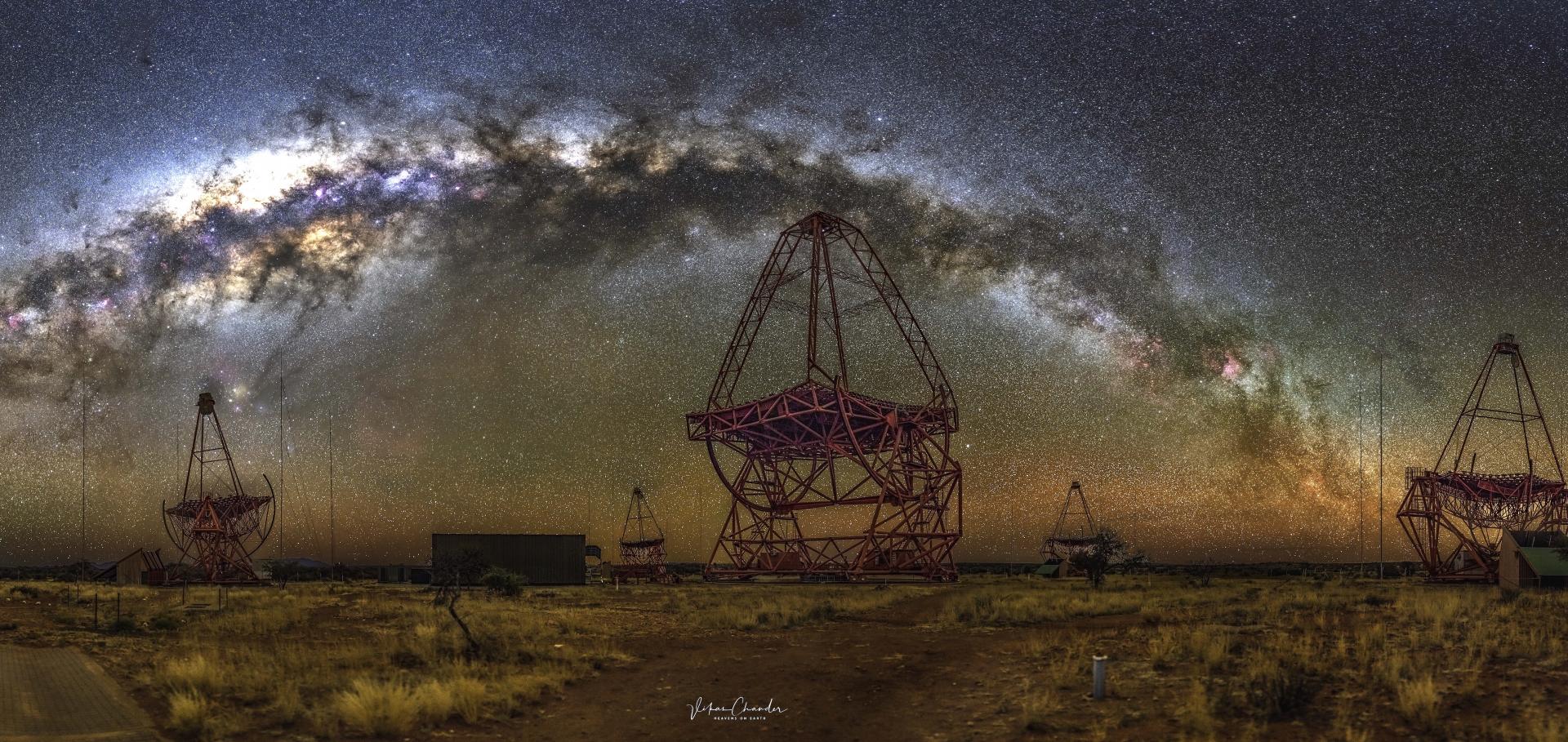
TeV flaring activity of the AGN PKS 0625–354 in November 2018

Astronomy & Astrophysics EDP Sciences 683 (2024) A70-A70

Authors:

F Aharonian, F Ait Benkhali, J Aschersleben, H Ashkar, M Backes, A Baktash, V Barbosa Martins, J Barnard, R Batzofin, Y Becherini, D Berge, K Bernlöhr, B Bi, M Böttcher, C Boisson, J Bolmont, M de Bony de Lavergne, J Borowska, F Bradascio, M Breuhaus, R Brose, A Brown, F Brun, B Bruno, T Bulik, G Cotter

Abstract:

Most γ-ray detected active galactic nuclei are blazars with one of their relativistic jets pointing towards the Earth. Only a few objects belong to the class of radio galaxies or misaligned blazars. Here, we investigate the nature of the object PKS 0625−354, its γ-ray flux and spectral variability and its broad-band spectral emission with observations from H.E.S.S., Fermi-LAT, Swift-XRT, and UVOT taken in November 2018. The H.E.S.S. light curve above 200 GeV shows an outburst in the first night of observations followed by a declining flux with a halving time scale of 5.9 h. The γγ-opacity constrains the upper limit of the angle between the jet and the line of sight to ∼10◦. The broad-band spectral energy distribution shows two humps and can be well fitted with a single-zone synchrotron self Compton emission model. We conclude that PKS 0625−354, as an object showing clear features of both blazars and radio galaxies, can be classified as an intermediate active galactic nuclei. Multi-wavelength studies of such intermediate objects exhibiting features of both blazars and radio galaxies are sparse but crucial for the understanding of the broad-band emission of γ-ray detected active galactic nuclei in general.

Evidence for γ-ray emission from the remnant of Kepler’s supernova based on deep H.E.S.S. observations (Corrigendum)

Astronomy & Astrophysics EDP Sciences 683 (2024) c1

Authors:

F Aharonian, F Ait Benkhali, EO Angüner, H Ashkar, M Backes, V Barbosa Martins, R Batzofin, Y Becherini, D Berge, K Bernlöhr, M Böttcher, C Boisson, J Bolmont, M de Bony de Lavergne, M Breuhaus, R Brose, F Brun, T Bulik, T Bylund, F Cangemi, S Caroff, S Casanova, M Cerruti, T Chand, A Chen, O Chibueze, G Cotter, P Cristofari, J Damascene Mbarubucyeye, J Devin, A Djannati-Ataï, A Dmytriiev, K Egberts, S Einecke, J-P Ernenwein, K Feijen, A Fiasson, G Fichet de Clairfontaine, G Fontaine, S Funk, S Gabici, YA Gallant, S Ghafourizadeh, G Giavitto, L Giunti, D Glawion, JF Glicenstein, M-H Grondin, M Hörbe, W Hofmann, TL Holch, M Holler, D Horns, Zhiqiu Huang, M Jamrozy, V Joshi, I Jung-Richardt, E Kasai, K Katarzyński, U Katz, B Khélifi, W Kluźniak, Nu Komin, K Kosack, D Kostunin, A Lemière, M Lemoine-Goumard, J-P Lenain, F Leuschner, T Lohse, A Luashvili, I Lypova, J Mackey, D Malyshev, D Malyshev, V Marandon, P Marchegiani, A Marcowith, G Martí-Devesa, R Marx, G Maurin, PJ Meintjes, M Meyer, A Mitchell, R Moderski, L Mohrmann, A Montanari, E Moulin, J Muller, K Nakashima, M de Naurois, A Nayerhoda, J Niemiec, A Priyana Noel, P O’Brien, S Ohm, L Olivera-Nieto, E de Ona Wilhelmi, M Ostrowski, S Panny, M Panter, RD Parsons, G Peron, V Poireau, DA Prokhorov, G Pühlhofer, M Punch, A Quirrenbach, P Reichherzer, A Reimer, O Reimer, M Renaud, B Reville, F Rieger, G Rowell, B Rudak, H Rueda Ricarte, V Sahakian, S Sailer, H Salzmann, DA Sanchez, A Santangelo, M Sasaki, J Schäfer, F Schüssler, HM Schutte, U Schwanke, JNS Shapopi, R Simoni, H Sol, A Specovius, S Spencer, Ł Stawarz, S Steinmassl, C Steppa, I Sushch, T Takahashi, T Tanaka, AM Taylor, R Terrier, M Tsirou, Y Uchiyama, T Unbehaun, C van Eldik, J Veh, J Vink, HJ Völk, SJ Wagner, F Werner, R White, A Wierzcholska, Yu Wun Wong, A Yusafzai, M Zacharias, D Zargaryan, AA Zdziarski, A Zech, SJ Zhu, S Zouari, N Żywucka

Optical spectroscopy of blazars for the Cherenkov Telescope Array – III⋆

Astronomy & Astrophysics EDP Sciences 683 (2024) a222

Authors:

F D’Ammando, P Goldoni, W Max-Moerbeck, J Becerra González, E Kasai, DA Williams, N Alvarez-Crespo, M Backes, U Barres de Almeida, C Boisson, G Cotter, V Fallah Ramazani, O Hervet, E Lindfors, D Mukhi-Nilo, S Pita, M Splettstoesser, B van Soelen

Heavy-element production in a compact object merger observed by JWST

Nature Springer Nature 626:8000 (2024) 737-741

Authors:

Andrew J Levan, Benjamin P Gompertz, Om Sharan Salafia, Mattia Bulla, Eric Burns, Kenta Hotokezaka, Luca Izzo, Gavin P Lamb, Daniele B Malesani, Samantha R Oates, Maria Edvige Ravasio, Alicia Rouco Escorial, Benjamin Schneider, Nikhil Sarin, Steve Schulze, Nial R Tanvir, Kendall Ackley, Gemma Anderson, Gabriel B Brammer, Lise Christensen, Vikram S Dhillon, Phil A Evans, Michael Fausnaugh, Wen-fai Fong, Andrew S Fruchter, Chris Fryer, Johan PU Fynbo, Nicola Gaspari, Kasper E Heintz, Jens Hjorth, Jamie A Kennea, Mark R Kennedy, Tanmoy Laskar, Giorgos Leloudas, Ilya Mandel, Antonio Martin-Carrillo, Brian D Metzger, Matt Nicholl, Anya Nugent, Jesse T Palmerio, Giovanna Pugliese, Jillian Rastinejad, Lauren Rhodes, Andrea Rossi, Andrea Saccardi, Stephen J Smartt, Heloise F Stevance, Aaron Tohuvavohu, Alexander van der Horst, Susanna D Vergani, Darach Watson, Thomas Barclay, Kornpob Bhirombhakdi, Elmé Breedt, Alice A Breeveld, Alexander J Brown, Sergio Campana, Ashley A Chrimes, Paolo D’Avanzo, Valerio D’Elia, Massimiliano De Pasquale, Martin J Dyer, Duncan K Galloway, James A Garbutt, Matthew J Green, Dieter H Hartmann, Páll Jakobsson, Paul Kerry, Chryssa Kouveliotou, Danial Langeroodi, Emeric Le Floc’h, James K Leung, Stuart P Littlefair, James Munday, Paul O’Brien, Steven G Parsons, Ingrid Pelisoli, David I Sahman, Ruben Salvaterra, Boris Sbarufatti, Danny Steeghs, Gianpiero Tagliaferri, Christina C Thöne, Antonio de Ugarte Postigo, David Alexander Kann

The Thousand-Pulsar-Array programme on MeerKAT – XII. Discovery of long-term pulse profile evolution in seven young pulsars

Monthly Notices of the Royal Astronomical Society Oxford University Press 528:4 (2024) 7458-7476

Authors:

A Basu, P Weltevrede, MJ Keith, S Johnston, A Karastergiou, LS Oswald, B Posselt, X Song, AD Cameron

Abstract:

A number of pulsars are known to have profile evolution on time-scales of months, often correlated with spin-down rate changes. Here, we present the first result from 3 yr of monitoring observations from MeerKAT as part of the Thousand Pulsar Array programme. This programme obtains high-fidelity pulse profiles for ∼ 500 pulsars, which enabled the detection of subtle changes in seven sources not previously known to exhibit long-term profile evolution. A 2D Gaussian convolution is used to highlight correlated emission variability in both the pulse phase and observing epoch direction. Simulations show that for one additional source the observed profile variability is likely to originate from stochastic single-pulse shape variability (jitter). We find that it is common for long-term profile variability to be associated with changes in polarization fractions, but not with polarization position angle (PA) changes. PA changes are expected if emission height changes or precession is responsible for the profile variability. PSR J1741−3927 is the only pulsar in our sample that shows correlated PA variability, and this is associated with orthogonal polarization mode activity. For the six other pulsars limits on possible emission height changes and impact angle changes are derived. These limits are consistent with the small changes in the total intensity profile shape. None of the sources show detectable spin-down variability correlated with the emission changes, which are thought to be driven by magnetospheric current fluctuations. Therefore, the absence of correlated spin-down rate variability allows upper limits to be placed on changes in the magnetospheric charge density.