

Very low-frequency oscillations from the 11 Hz pulsar in Terzan 5: frame-dragging back on the table
(2021)
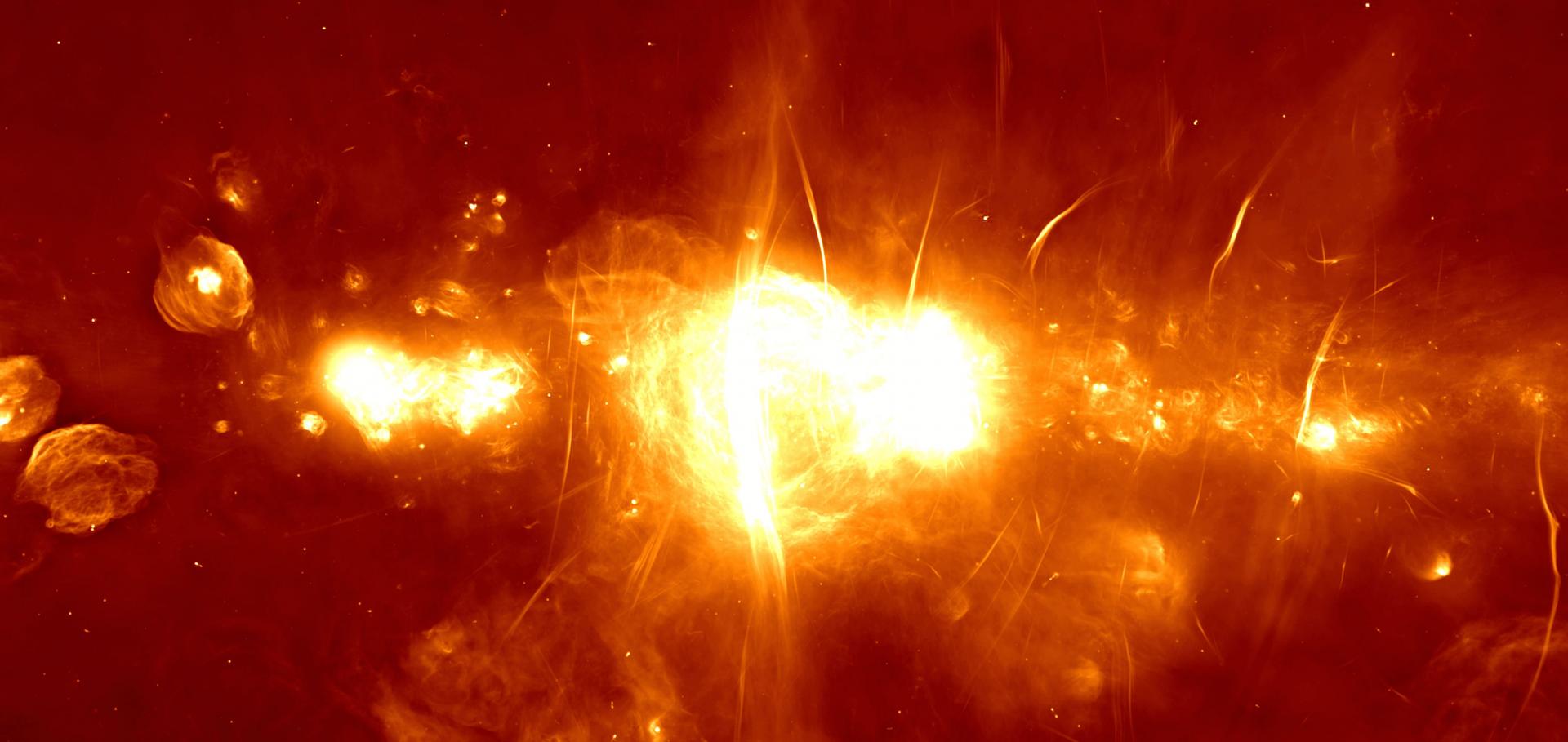
The Galactic center chimneys: the base of the multiphase outflow of the Milky Way
Astronomy and Astrophysics European Southern Observatory 646 (2021) A66
Abstract:
Context. Outflows and feedback are key ingredients of galaxy evolution. Evidence for an outflow arising from the Galactic center (GC) – the so-called GC chimneys – has recently been discovered at radio, infrared, and X-ray bands.Aims. We undertake a detailed examination of the spatial relationships between the emission in the different bands in order to place constraints on the nature and history of the chimneys and to better understand their impact on the GC environment and their relation with Galactic scale outflows.
Methods. We compare X-ray, radio, and infrared maps of the central few square degrees.
Results. The X-ray, radio, and infrared emissions are deeply interconnected, affecting one another and forming coherent features on scales of hundreds of parsecs, therefore indicating a common physical link associated with the GC outflow. We debate the location of the northern chimney and suggest that it might be located on the front side of the GC because of a significant tilt of the chimneys toward us. We report the presence of strong shocks at the interface between the chimneys and the interstellar medium, which are traced by radio and warm dust emission. We observe entrained molecular gas outflowing within the chimneys, revealing the multiphase nature of the outflow. In particular, the molecular outflow produces a long, strong, and structured shock along the northwestern wall of the chimney. Because of the different dynamical times of the various components of the outflow, the chimneys appear to be shaped by directed large-scale winds launched at different epochs. The data support the idea that the chimneys are embedded in an (often dominant) vertical magnetic field, which likely diverges with increasing latitude. We observe that the thermal pressure associated with the hot plasma appears to be smaller than the ram pressure of the molecular outflow and the magnetic pressure. This leaves open the possibility that either the main driver of the outflow is more powerful than the observed hot plasma, or the chimneys represent a “relic” of past and more powerful activity.
Conclusions. These multiwavelength observations corroborate the idea that the chimneys represent the channel connecting the quasi-continuous, but intermittent, activity at the GC with the base of the Fermi bubbles. In particular, the prominent edges and shocks observed in the radio and mid-infrared bands testify to the most powerful, more recent outflows from the central parsecs of the Milky Way.
The Fornax3D project: Assembly histories of lenticular galaxies from a combined dynamical and population orbital analysis
ArXiv 2102.02449 (2021)
MIGHTEE-HI: The H I emission project of the MeerKAT MIGHTEE survey
Astronomy and Astrophysics EDP Sciences 646:February 2021 (2021) A35
Abstract:
We present the H I emission project within the MIGHTEE survey, currently being carried out with the newly commissioned MeerKAT radio telescope. This is one of the first deep, blind, medium-wide interferometric surveys for neutral hydrogen (H I) ever undertaken, extending our knowledge of H I emission to z = 0.6. The science goals of this medium-deep, medium-wide survey are extensive, including the evolution of the neutral gas content of galaxies over the past 5 billion years. Simulations predict nearly 3000 galaxies over 0 < z < 0.4 will be detected directly in H I, with statistical detections extending to z = 0.6. The survey allows us to explore H I as a function of galaxy environment, with massive groups and galaxy clusters within the survey volume. Additionally, the area is large enough to contain as many as 50 local galaxies with H I mass < 108 M⊙, which allows us to study the low-mass galaxy population. The 20 deg2 main survey area is centred on fields with exceptional multi-wavelength ancillary data, with photometry ranging from optical through far-infrared wavelengths, supplemented with multiple spectroscopic campaigns. We describe here the survey design and the key science goals. We also show first results from the Early Science observations, including kinematic modelling of individual sources, along with the redshift, H I, and stellar mass ranges of the sample to date.Corrigendum: “Design and operation of the ATLAS Transient Science Server” (2020, PASP, 132, 085002)
Publications of the Astronomical Society of the Pacific IOP Publishing 133:1020 (2021) 029201