

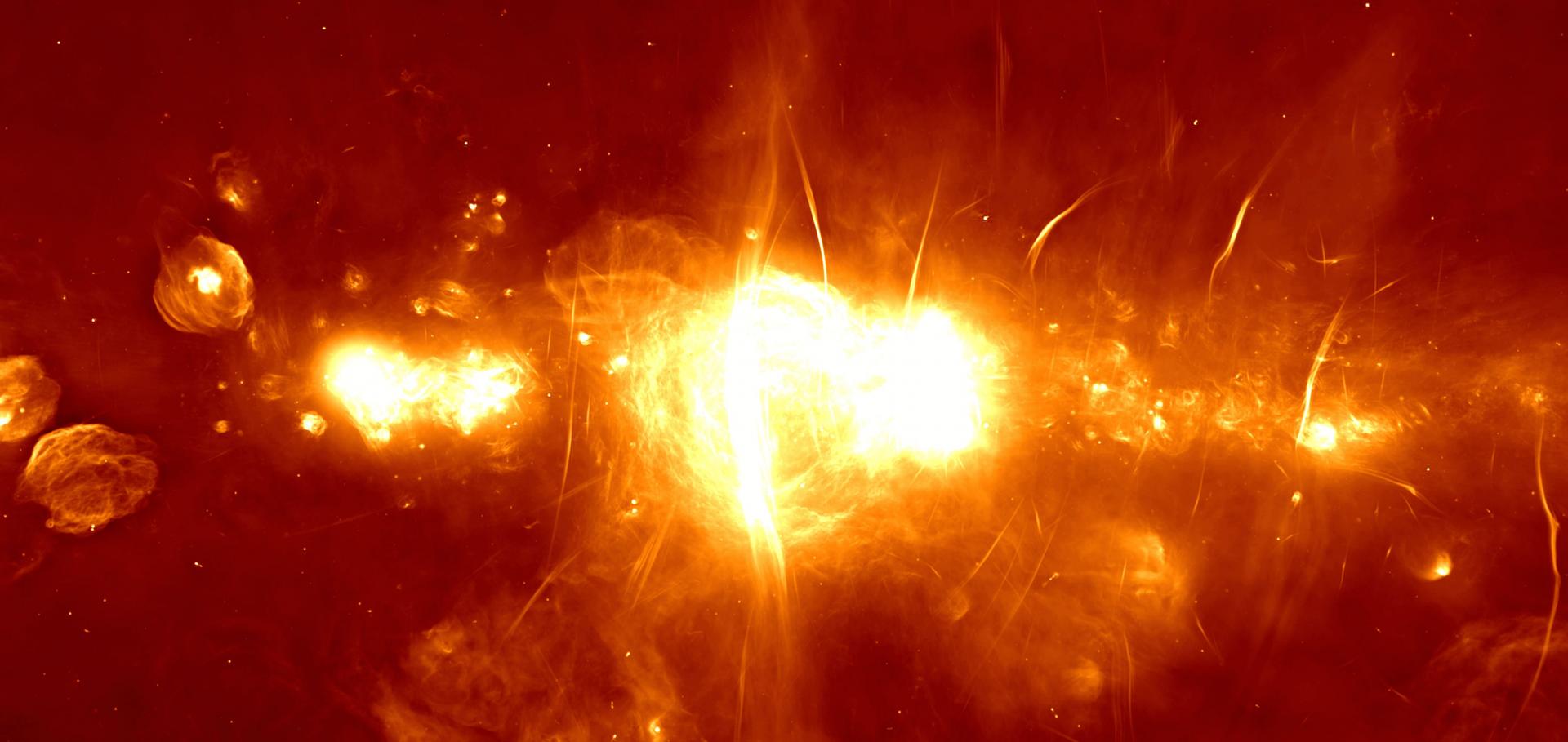
MeerKAT discovery of a MIGHTEE Odd Radio Circle
Monthly Notices of the Royal Astronomical Society: Letters Oxford University Press (OUP) 537:1 (2024) l42-l48
Constraints on compact objects from the Dark Energy Survey five-year supernova sample
Monthly Notices of the Royal Astronomical Society Oxford University Press (OUP) (2024) stae2614
The Extremely Metal-poor SN 2023ufx: A Local Analog to High-redshift Type II Supernovae
The Astrophysical Journal American Astronomical Society 976:2 (2024) 178
Abstract:
We present extensive observations of the Type II supernova (SN II) SN 2023ufx, which is likely the most metal-poor SN II observed to date. It exploded in the outskirts of a low-metallicity (Z host ∼ 0.1 Z ⊙) dwarf (M g = −13.39 ± 0.16 mag, r proj ∼ 1 kpc) galaxy. The explosion is luminous, peaking at M g ≈ −18.5 mag, and shows rapid evolution. The r-band (pseudobolometric) light curve has a shock-cooling phase lasting 20 (17) days followed by a 19 (23) day plateau. The entire optically thick phase lasts only ≈55 days following explosion, indicating that the red supergiant progenitor had a thinned H envelope prior to explosion. The early spectra obtained during the shock-cooling phase show no evidence for narrow emission features and limit the preexplosion mass-loss rate to Ṁ≲10−3 M ⊙ yr−1. The photospheric-phase spectra are devoid of prominent metal absorption features, indicating a progenitor metallicity of ≲0.1 Z ⊙. The seminebular (∼60–130 days) spectra reveal weak Fe ii, but other metal species typically observed at these phases (Ti ii, Sc ii, and Ba ii) are conspicuously absent. The late-phase optical and near-infrared spectra also reveal broad (≈104 km s−1) double-peaked Hα, Pβ, and Pγ emission profiles suggestive of a fast outflow launched during the explosion. Outflows are typically attributed to rapidly rotating progenitors, which also prefer metal-poor environments. This is only the second SN II with ≲0.1 Z ⊙ and both exhibit peculiar evolution, suggesting a sizable fraction of metal-poor SNe II have distinct properties compared to nearby metal-enriched SNe II. These observations lay the groundwork for modeling the metal-poor SNe II expected in the early Universe.A spatially-resolved spectral analysis of giant radio galaxies with MeerKAT
ArXiv 2411.06813 (2024)
MIGHTEE: the continuum survey Data Release 1
Monthly Notices of the Royal Astronomical Society Oxford University Press 536:3 (2024) 2187-2211