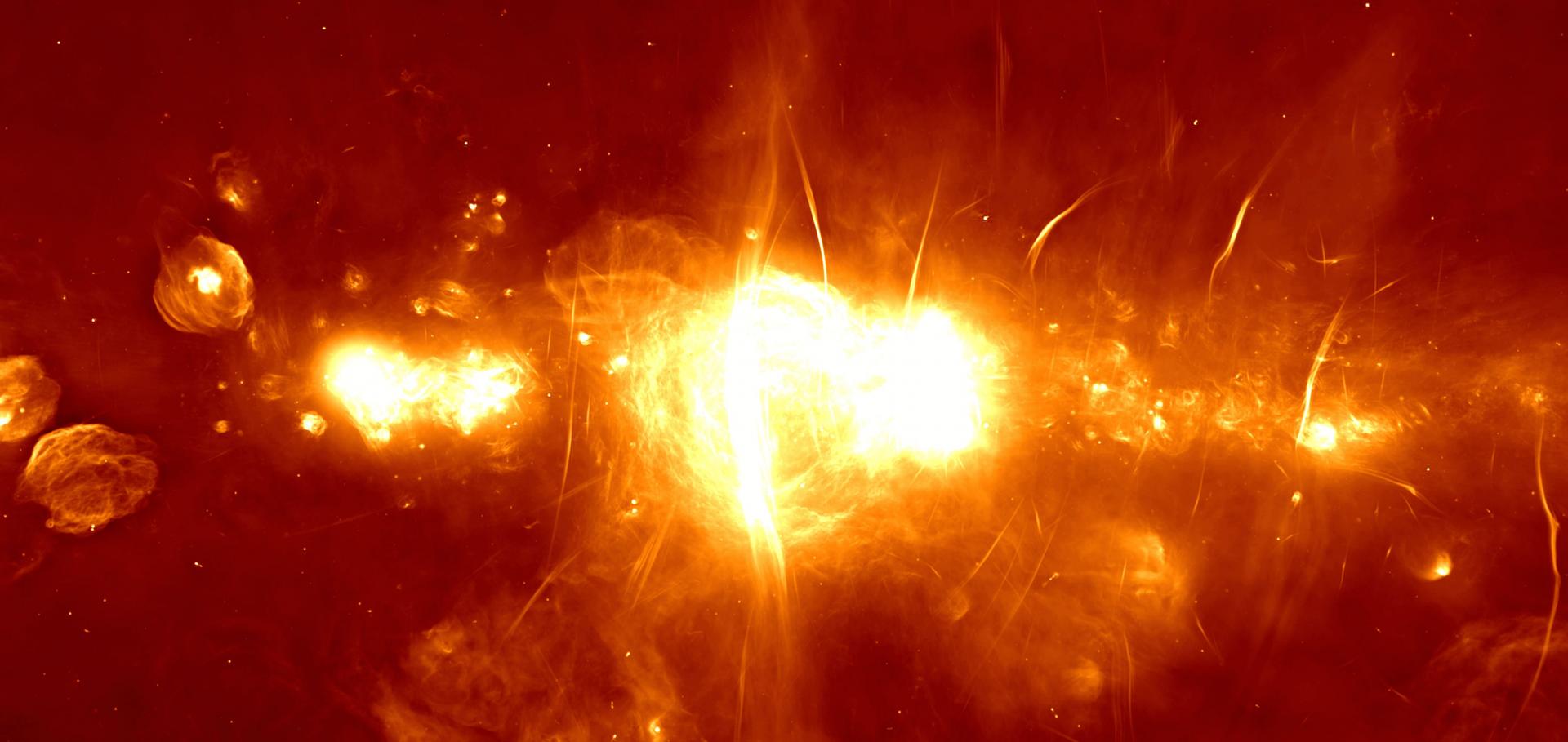
MIGHTEE - HI: The relation between the HI gas in galaxies and the cosmic web

Monthly Notices of the Royal Astronomical Society, Volume 513, Issue 2, pp.2168-2177

Authors:

Tudorache, Madalina N. ; Jarvis, M. J. ; Heywood, I. ; Ponomareva, A. A. ; Maddox, N. ; Frank, B. S. ; Adams, N. J. ; Bowler, R. A. A. ; Whittam, I. H. ; Baes, M. ; Pan, H. ; Rajohnson, S. H. A. ; Sinigaglia, F. ; Spekkens, K.

Abstract:

We study the 3D axis of rotation (3D spin) of 77 H I galaxies from the MIGHTEE-H I Early Science observations, and its relation to the filaments of the cosmic web. For this HI-selected sample, the alignment between the spin axis and the closest filament (|cos ψ|) is higher for galaxies closer to the filaments, with ⟨|cos ψ|⟩ = 0.66 ± 0.04 for galaxies <5 Mpc from their closest filament compared to ⟨|cos ψ|⟩ = 0.37 ± 0.08 for galaxies at 5 < d < 10 Mpc. We find that galaxies with a low HI-to-stellar mass ratio (log10(MHI/M⋆) < 0.11) are more aligned with their closest filaments, with ⟨|cos ψ|⟩ = 0.58 ± 0.04; whilst galaxies with (log10(MHI/M⋆) > 0.11) tend to be mis-aligned, with ⟨|cos ψ|⟩ = 0.44 ± 0.04. We find tentative evidence that the spin axis of HI-selected galaxies tend to be aligned with associated filaments (d < 10 Mpc), but this depends on the gas fractions. Galaxies that have accumulated more stellar mass compared to their gas mass tend towards stronger alignment. Our results suggest that those galaxies that have accrued high gas fraction with respect to their stellar mass may have had their spin axis alignment with the filament disrupted by a recent gas-rich merger, whereas the spin vector for those galaxies in which the neutral gas has not been strongly replenished through a recent merger tend to orientate towards alignment with the filament. We also investigate the spin transition between galaxies with a high HI content and a low HI content at a threshold of MHI≈10^9.5M⊙ found in simulations; however, we find no evidence for such a transition with the current data.

Neural Deprojection of Galaxy Stellar Mass Profiles

Machine Learning and the Physical Sciences Workshop, NeurIPS 2025

Authors:

MJ Yantovski-Barth, H Zhang, N Smyth, C Stone, Martin BUREAU, Y Hezaveh, L Perreault-Levasseur

SDSS-IV MaNGA: The Different Quenching Histories of Fast and Slow Rotators

MNRAS, 473, 2679

Authors:

Rebecca Smethurst, Karen Masters, Chris Lintott, Anne-Marie Weijmans, Michael Merrifield, Samantha Penny, Alfonso Aragon Salamanca, Joel Brownstein, Kevin Bundy, Niv Drory, David Law, Robert Nichol

Abstract:

The AGN fuelling/feedback cycle in nearby radio galaxies II. Kinematics of the molecular gas

Monthly Notices of the Royal Astronomical Society Oxford University Press (OUP)

Authors:

Ilaria Ruffa, Timothy A Davis, Isabella Prandoni, Robert A Laing, Rosita Paladino, Paola Parma, Hans de Ruiter, Viviana Casasola, Martin Bureau, Joshua Warren

Abstract:

This is the second paper of a series exploring the multi-component (stars, warm and cold gas and radio jets) properties of a sample of eleven nearby low excitation radio galaxies (LERGs), with the aim of better understanding the AGN fuelling/feedback cycle in these objects. Here we present a study of the molecular gas kinematics of six sample galaxies detected in $^{12}$CO(2-1) with ALMA. In all cases, our modelling suggests that the bulk of the gas in the observed (sub-)kpc CO discs is in ordered rotation. Nevertheless, low-level distortions are ubiquitous, indicating that the molecular gas is not fully relaxed into the host galaxy potential. The majority of the discs, however, are only marginally resolved, preventing us from drawing strong conclusions. NGC 3557 and NGC 3100 are special cases. The features observed in the CO velocity curve of NGC 3557 allow us to estimate a super-massive black hole (SMBH) mass of $(7.10\pm0.02)\times10^{8}$ M$_{\odot}$, in agreement with expectations from the M$_{\rm SMBH}- \sigma_{*}$ relation. The rotation pattern of NGC 3100 shows distortions that appear to be consistent with the presence of both a position angle and inclination warp. Non-negligible radial motions are also found in the plane of the CO disc, likely consistent with streaming motions associated with the spiral pattern found in the inner regions of the disc. The dominant radial motions are likely to be inflows, supporting a scenario in which the cold gas is contributing to the fuelling of the AGN.

The Birth of a Relativistic Jet Following the Disruption of a Star by a Cosmological Black Hole

Authors:

Dheeraj Pasham, Matteo Lucchini, Tanmoy Laskar, Benjamin Gompertz, Shubham Srivas, Matt Nicholl, Stephen Smartt, James Miller-Jones, Kate Alexander, Rob Fender, Graham Smith, Michael Fulton, Gulab Dewangan, Keith Gendreau, Lauren Rhodes, Assaf Horesh, Sjoert van Velzen, Itai Sfaradi, Muryel Guolo, N Castro Segura, Aysha Aamer, Joseph Anderson, Iair Arcavi, Seán Brennan, Kenneth Chambers, Panos Charalampopoulos, Ting-Wan Chen, Alejandro Clocchiatti, Thomas de Boer, Michel Dennefeld, Elizabeth Ferrara, Lluís Galbany, Hua Gao, James Gillanders, Adelle Goodwin, Mariusz Gromadzki, M Huber, Peter Jonker, Manasvita Joshi, Erin Kara, Thomas Killestein, Peter Kosec, Daniel Kocevski, Giorgos Leloudas, Chien-Cheng Lin, Raffaella Margutti, Seppo Mattila, Thomas Moore, Tom ’as M\”uller-Bravo, Chow-Choong Ngeow, Samantha Oates, Francesca Onori, Yen-Chen Pan, Miguel Perez Torres, Priyanka Rani, Ronald Remillard, E Ridley, Steve Schulze, Xinyue Sheng, Luke Shingles, Ken Smith, James Steiner, Richard Wainscoat, Thomas Wevers, Sheng Yang