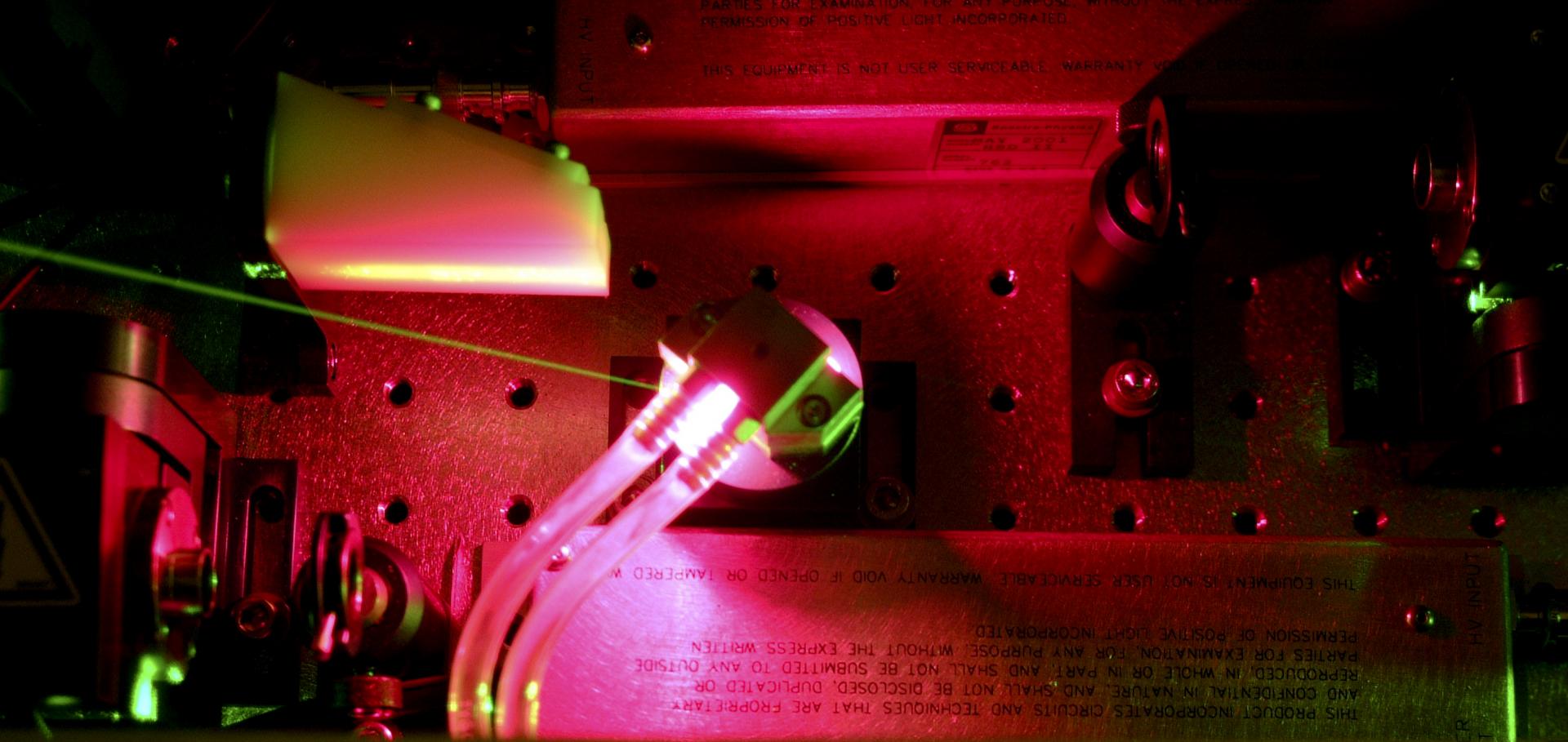
Progress in optic-field-ionization soft X-ray lasers at LOA

LASER PART BEAMS 23:3 (2005) 351-356

Authors:

T Mocek, S Sebban, I Bettaibi, P Zeitoun, G Faivre, B Cros, G Maynard, A Butler, CM McKenna, DJ Spence, A Gonsavles, SM Hooker, V Vorontsov, S Hallou, M Fajardo, S Kazamias, S Le Pape, P Mercere, AS Morlens, C Valentin, P Balcou

Abstract:

We give on overview of recent advances in collisionally pumped optical field-ionization soft X-ray lasers developed at LOA. Saturated amplification has been achieved on the 5d-5p transition in Xe8+ at 41.8 nm, and on the 4d-4p transition in Kr8+ at 32.8 nm. We demonstrate a significant increase of the energy output from the Xe8+ laser driven within two types of wave-guide. Finally, we present results of a pioneering work aimed to set up and characterize the first true soft X-ray laser chain.

An NLO QCD analysis of inclusive cross-section and jet-production data from the ZEUS experiment

European Physical Journal C 42:1 (2005) 1-16

Authors:

S Chekanov, M Derrick, S Magill, S Miglioranzi, B Musgrave, J Repond, R Yoshida, MCK Mattingly, N Pavel, AG Yagües Molina, P Antonioli, G Bari, M Basile, L Bellagamba, D Boscherini, A Bruni, G Bruni, G Cara Romeo, L Cifarelli, F Cindolo, A Contin, M Corradi, S de Pasquale, P Giusti, G Iacobucci, A Margotti, A Montanari, R Nania, F Palmonari, A Pesci, A Polini, L Rinaldi, G Sartorelli, A Zichichi, G Aghuzumtsyan, D Bartsch, I Brock, S Goers, H Hartmann, E Hilger, P Irrgang, HP Jakob, OM Kind, U Meyer, E Paul, J Rautenberg, R Renner, KC Voss, M Wang, M Wlasenko, DS Bailey, NH Brook, JE Cole, GP Heath, T Namsoo, S Robins, M Capua, S Fazio, A Mastroberardino, M Schioppa, G Susinno, E Tassi, JY Kim, KJ Ma, M Helbich, Y Ning, Z Ren, WB Schmidke, F Sciulli, J Chwastowski, A Eskreys, J Figiel, A Galas, K Olkiewicz, P Stopa, D Szuba, L Zawiejski, L Adamczyk, T Bold, I Grabowska-Bold, D Kisielewska, AM Kowal, J Łukasik, M Przybycień, L Suszycki, J Szuba, A Kotański, W Slomiński, V Adler, U Behrens, I Bloch, K Borras, G Drews, J Fourletova, A Geiser, D Gladkov, P Göttlicher, O Gutsche, T Haas, W Hain

Abstract:

The ZEUS inclusive differential cross-section data from HERA, for charged and neutral current processes taken with e + and e - beams, together with differential cross-section data on inclusive jet production in e + p scattering and dijet production in γp scattering, have been used in a new NLO QCD analysis to extract the parton distribution functions of the proton. The input of jet-production data constrains the gluon and allows an accurate extraction of alpha s(MZ) at NLO; alphas = 0.1183±0.0028(exp.)±0.0008(model). An additional uncertainty from the choice of scales is estimated as ±0.005. This is the first extraction of alphas(MZ) from HERA data alone. © Springer-Verlag/Società Italiana de Fisica 2005.

Collisional lasers at 41.8 nm in a guided regime

J PHYS IV 127 (2005) 33-37

Authors:

I Bettaibi, S Sebban, T Mocek, CM McKenna, B Cros, A Butler, DJ Spence, G Maynard, AJ Gonsavles, SM Hooker

Simulations of recombination lasing in Ar7+ driven by optical field ionization in a capillary discharge waveguide

Optics Communications 249:4-6 (2005) 501-513

Authors:

DJ Spence, SM Hooker

Abstract:

We present calculations of the small-signal gain coefficient, gain length, and output energy of a recombination laser in Ar7+ driven by optical field ionization. Simulations are presented for both 400 and 800 nm pump radiation, and for two targets containing mixtures of argon and hydrogen: a gas cell, and a gas-filled capillary discharge waveguide. Extremely high values for the small-signal gain coefficient are calculated for the 4s-3p transition at 23.2 nm using a pump wavelength of 400 nm for both the gas cell and waveguide. Operation in the waveguide is predicted to greatly increase the XUV laser output owing to a large increase of the gain length. The calculations also show that use of the waveguide allows significant single-pass gain to be achieved even with pump radiation of 800 nm wavelength. © 2005 Elsevier B.V. All rights reserved.

Study of deep inelastic inclusive and diffractive scattering with the ZEUS forward plug calorimeter

Nuclear Physics B 713:1-3 (2005) 3-80

Authors:

S Chekanov, M Derrick, S Magill, S Miglioranzi, B Musgrave, J Repond, R Yoshida, MCK Mattingly, N Pavel, AG Yagües Molina, P Antonioli, G Bari, M Basile, L Bellagamba, D Boscherini, A Bruni, G Bruni, G Cara Romeo, L Cifarelli, F Cindolo, A Contin, M Corradi, S De Pasquale, P Giusti, G Iacobucci, A Margotti, A Montanari, R Nania, F Palmonari, A Pesci, A Polini, L Rinaldi, G Sartorelli, A Zichici, G Aghuzumtsyan, D Bartsch, I Brock, S Goers, H Hartmann, E Hilger, P Irrgang, HP Jakob, O Kind, U Meyer, E Paul, J Rautenberg, R Renner, KC Voss, M Wang, M Wlasenko, DS Bailey, NH Brook, JE Cole, GP Heath, T Namsoo, S Robins, M Capua, A Mastroberardino, M Schioppa, G Susinno, E Tassi, JY Kim, KJ Ma, M Helbich, Y Ning, Z Ren, WB Schmidke, F Sciulli, J Chwastowski, A Eksreys, J Figiel, A Galas, K Olkiewicz, P Stopa, D Szuba, L Zawiejski, L Adamczyk, T Bołd, I Grabowska-Bołd, D Kisielewska, AM Kowal, J Łukasik, M Przybycień, L Suszycki, J Szuba, A Kotański, W Słomiński, V Adler, U Behrens, I Bloch, K Borras, DG Cassel, G Drews, J Fourletova, A Geiser, D Gladkov, F Goebel, P Göttlicher, R Graciani Diaz, O Gutsche

Abstract:

Deep inelastic scattering and its diffractive component, ep → e′ γ* p → e′ X N, have been studied at HERA with the ZEUS detector using an integrated luminosity of 4.2 pb-1. The measurement covers a wide range in the γ* p c.m. energy W (37-245 GeV), photon virtuality Q2 (2.2-80 GeV2) and mass MX (0.28-35 GeV). The diffractive cross section for MX > 2 GeV rises strongly with W; the rise is steeper with increasing Q2. The latter observation excludes the description of diffractive deep inelastic scattering in terms of the exchange of a single pomeron. The ratio of diffractive to total cross section is constant as a function of W, in contradiction to the expectation of Regge phenomenology combined with a naive extension of the optical theorem to γ* p scattering. Above MX of 8 GeV, the ratio is flat with Q2, indicating a leading-twist behaviour of the diffractive cross section. The data are also presented in terms of the diffractive structure function, F2D(3)(β, x, Q2), of the proton. For fixed β, the Q2 dependence of xF2 D(3) changes with x in violation of Regge factorisation. For fixed x, x F2D(3) rises as β → 0, the rise accelerating with increasing Q2. These positive scaling violations suggest substantial contributions of perturbative effects in the diffractive DIS cross section. © 2005 Elsevier B.V. All rights reserved.