

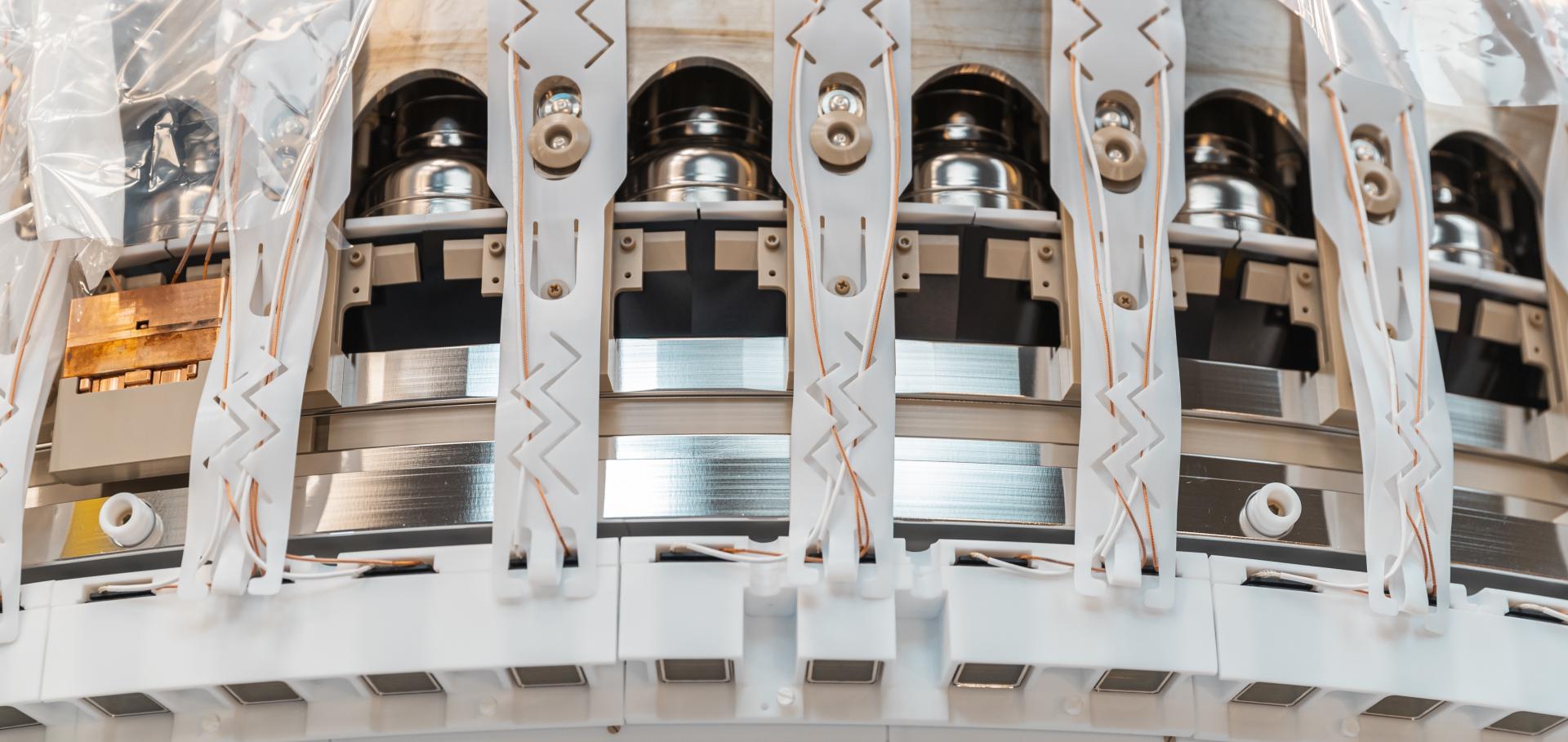
The CRESST dark matter search
(1998) 214-218
Abstract:
The CRESST (Cryogenic Rare Event Search with Superconducting Thermometers) experiment at the Gran Sasso Laboratory will search for dark matter WIMPs using cryogenic detectors. In the first stage we will use four 262 g sapphire crystals with thresholds of about 0.5 keV. This low threshold gives us sensitivity to WIMP masses below 10 GeV, making CRESST complementary to other dark matter searches. The main installation in Gran Sasso is now complete and we report on the first detector tests.Superconductive bolometers and calorimeters
Superconductor Science and Technology 9:10 (1996) 827-842
Abstract:
Superconducting bolometers and calorimeters are used in many applications, such as infrared astronomy, fast spectroscopy of condensed matter excitations or even in particle physics and plasma diagnostics. The development in this field has a long history and is very active and numerous successful applications can be counted. Many of the detectors discussed in this article make use of the steepness of the resistance-temperature characteristics at the transition between the normal and superconducting phase of superconductors. This overview includes low-TC calorimeters, mainly for applications to particle and astrophysics, and high-TC bolometers which could replace presently used detectors. In addition, related detection techniques will be addressed.X-ray response of STJ detectors using NbN absorbing layers
NUCL INSTRUM METH A 370:1 (1996) 95-97
Abstract:
We have designed and tested 5 x 5 mm(2) chips containing island type STJs with different geometries, fabricated on Si substrates in the configuration Nb/Al-AlOx/Nb and using a NbN overlayer acting both as wiring and radiation absorber. The aim is to investigate the advantages of the trapping effect due to the Nb layer trap. In fact, for the NbN/Nb bilayer the scattering time is much faster than the values calculated for other Nb based bilayers, leading to more efficient trapping processes. The junctions have been characterized by tunneling and Josephson current measurements down to 0.5 K. Experimental results concerning the response of the devices under X-ray irradiation down to 60 mK are presented and discussed.X-ray detectors with Ta/Al/AlxOy/Al hetero tunnel junctions
Nuclear Instruments and Methods in Physics Research Section A Accelerators Spectrometers Detectors and Associated Equipment Elsevier 370:1 (1996) 91-94
Measurement of the tunnel rate in SIS' tunnel junctions as function of bias voltage
Journal of Superconductivity 9:2 (1996) 245-252