

The JWST Emission Line Survey (JELS): an untargeted search for H α emission line galaxies at z greater than 6 and their physical properties
Monthly Notices of the Royal Astronomical Society Oxford University Press 541:2 (2025) 1348-1376
Abstract:
We present the first results of the JWST Emission Line Survey (JELS). Utilizing the first NIRCam narrow-band imaging at 4.7 m, over 63 arcmin in the PRIMER/COSMOS field, we have identified 609 emission line galaxy candidates. From these, we robustly selected 35 H star-forming galaxies at , with H star-formation rates () of . Combining our unique H sample with the exquisite panchromatic data in the field, we explored their physical properties and star-formation histories, and compared these to a broad-band selected sample at which has offered vital new insights into the nature of high-redshift galaxies. UV-continuum slopes () were considerably redder for our H sample () compared to the broad-band sample (). This was not due to dust attenuation as our H sample was relatively dust-poor (median ); instead, we argue that the reddened slopes could be due to nebular continuum. We compared and the UV-continuum-derived to SED-fitted measurements averaged over canonical time-scales of 10 and 100 Myr ( and ). We found an increase in recent SFR for our sample of H emitters, particularly at lower stellar masses (). We also found that strongly traces SFR averaged over 10 Myr time-scales, whereas the UV-continuum overpredicts SFR on 100 Myr time-scales at low stellar masses. These results point to our H sample undergoing ‘bursty’ star formation. Our F356W sample showed a larger scatter in across all stellar masses, which has highlighted how narrow-band photometric selections of H emitters are key to quantifying the burstiness of star-formation activity.A Novel Method of Modeling Extended Emission of Compact Jets: Application to Swift J1727.8−1613
The Astrophysical Journal Letters American Astronomical Society 986:2 (2025) l35
Abstract:
Flat radio spectra of compact jets launched by both supermassive and stellar-mass black holes (BHs) are explained by an interplay of self-absorbed synchrotron emission up to some distance along the jet and optically thin synchrotron at larger distances. Their spatial structure is usually studied using core shifts, in which the position of the peak (core) of the emission depends on the frequency. Here, we propose a novel and powerful method to fit the spatial dependence of the flux density at a given frequency of the jet and counterjet (when observed), using the theoretical spatial dependencies provided as simple analytical formulae. We apply our method to the spatial structure of the jets in the luminous hard spectral state of the BH X-ray binary Swift J1727.8−1613. It was the most resolved continuous jet from an X-ray binary ever observed. We find that the observed approaching jet is significantly intrinsically stronger than the receding one, which we attribute to an increase in the emission of both jets with time (observationally confirmed), together with the light travel effect, causing the receding jet to be observed at an earlier epoch than the approaching one. The jets are relatively slow, with a velocity of ∼(0.3–0.4)c. Our findings imply that the magnetic field strength increased with time. Additionally, the magnetic flux is significantly lower than in jets launched by “magnetically arrested disks.” Our method is general, and we propose that it be applied to jets launched by both stellar-mass and supermassive BHs.Are FRBs emitted from rotating magnetospheres? Searching for periodicity in polarized bursts
Monthly Notices of the Royal Astronomical Society: Letters Oxford University Press 542:1 (2025) L43-L47
Abstract:
One of the potential sources of repeating fast radio bursts (FRBs) is a rotating magnetosphere of a compact object, as suggested by the similarities in the polarization properties of FRBs and radio pulsars. Attempts to measure an underlying period in the times of arrival of repeating FRBs have nevertheless been unsuccessful. To explain this lack of observed periodicity, it is often suggested that the line of sight towards the source must be sampling active parts of the emitting magnetosphere throughout the rotation of the compact object, i.e. has a large duty cycle, as can be the case in a neutron star with near-aligned magnetic and rotation axes. This may lead to apparently aperiodic bursts; however, the polarization angle of the bursts should be tied to the rotational phase from which they occur. This is true for radio pulsars. We therefore propose a new test to identify a possible stable rotation period under the assumptions above, based on a periodogram of the measured polarization angle time series for repeating FRBs. We show that this test is highly sensitive when the duty cycle is large, where standard time-of-arrival periodicity searches fail. Therefore, we can directly test the hypothesis of repeating FRBs of magnetospheric origin with a stable rotation period. Both positive and negative results of the test applied to FRB data will provide important information.Thermal electrons in the radio afterglow of relativistic tidal disruption event ZTF22aaajecp/AT2022cmc
(2025)
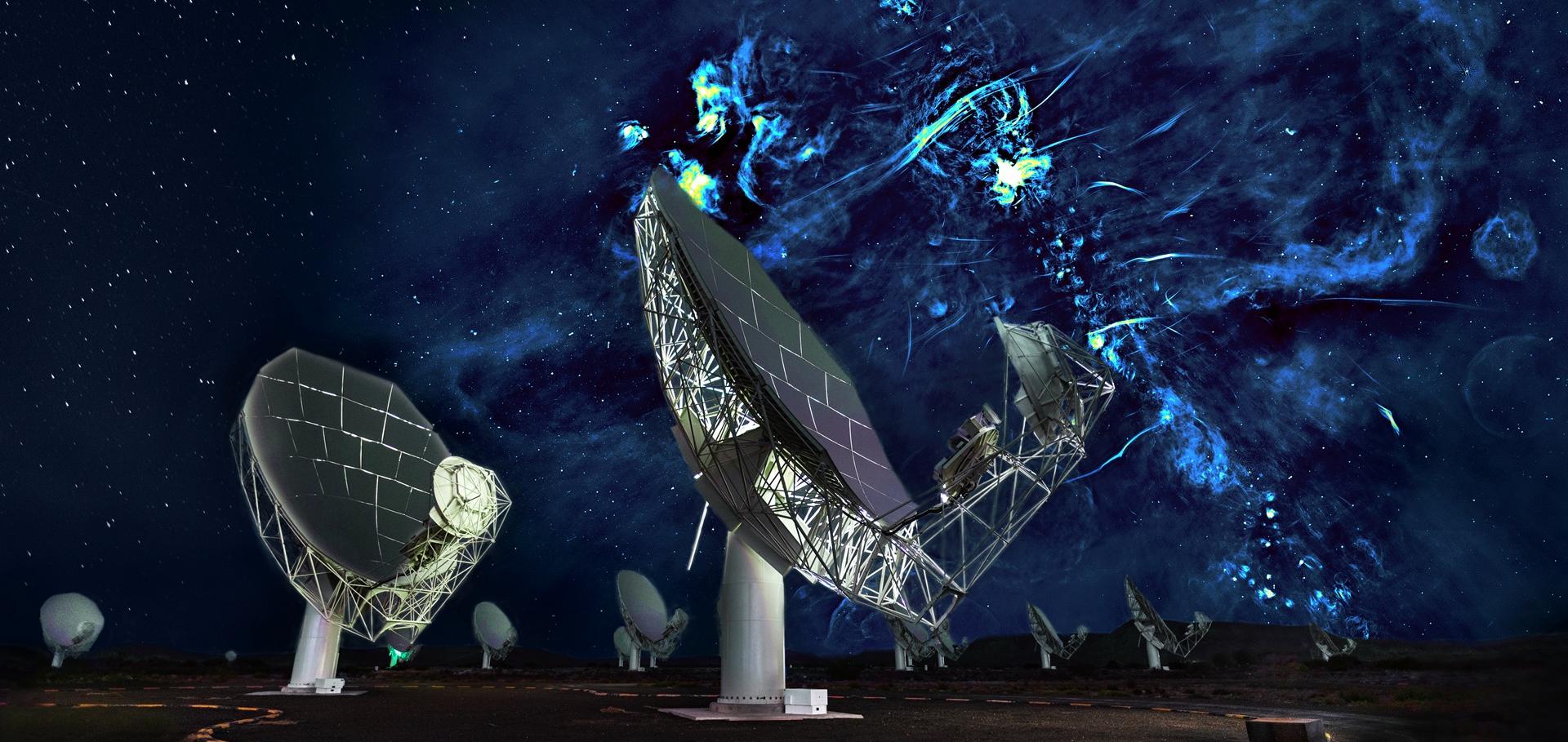
Hi intensity mapping with the MIGHTEE Survey: first results of the Hi power spectrum
Monthly Notices of the Royal Astronomical Society Oxford University Press 541:1 (2025) 476-493