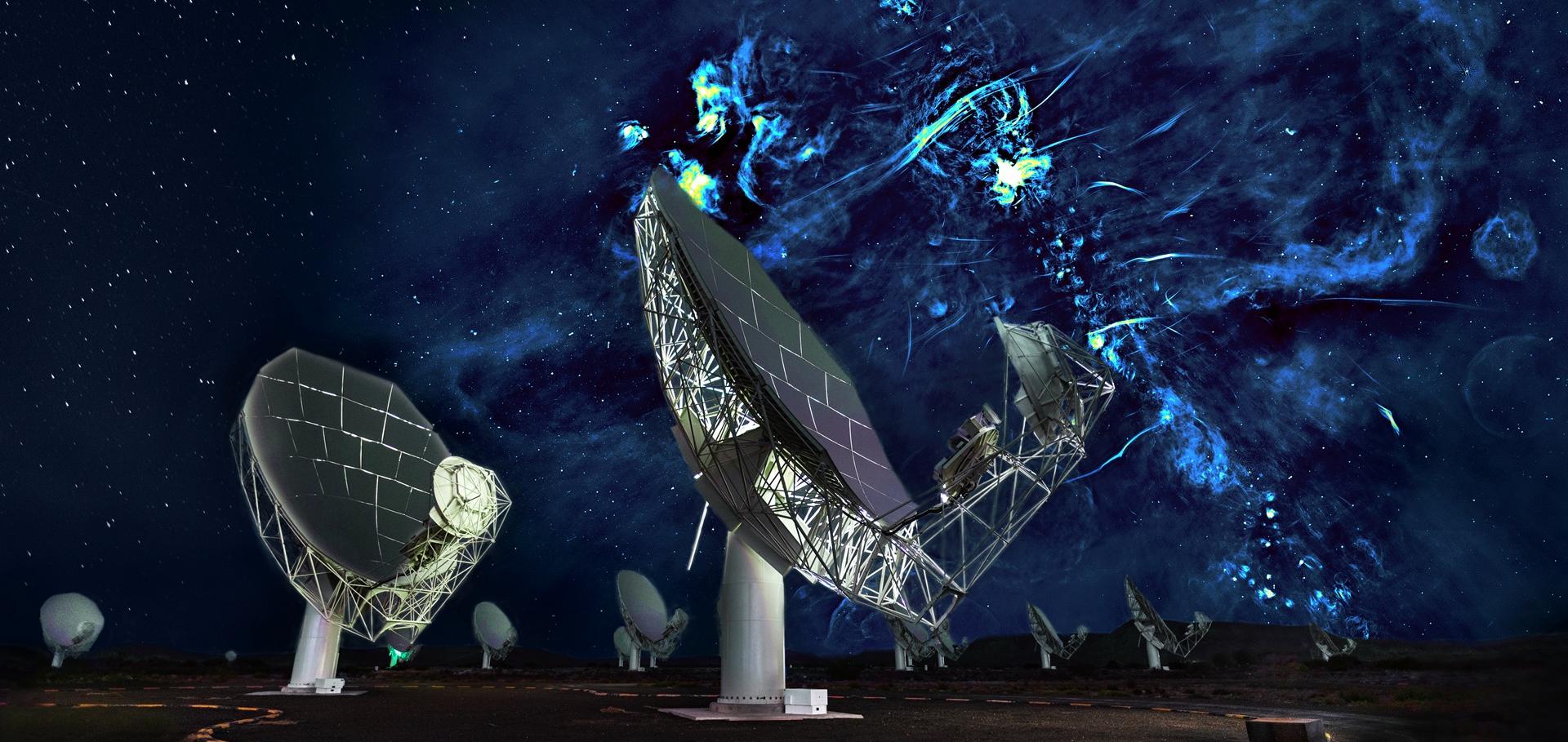
The MeerKAT Absorption Line Survey Data Release 2: Wideband continuum catalogues and a measurement of the cosmic radio dipole

Astronomy & Astrophysics, Volume 690, id.A163, 23 pp.

Authors:

J. D. Wagenveld, H-R. Klöckner, N. Gupta, S. Sekhar, P. Jagannathan, P. P. Deka, J. Jose, S. A. Balashev, D. Borgaonkar, A. Chatterjee, F. Combes, K. L. Emig, A. N. Gaunekar, M. Hilton, G. I. G. Józsa, D. Y. Klutse, K. Knowles, J.-K. Krogager, E. Momjian, S. Muller, S. P. Sikhosana

Abstract:

We present the second data release of the MeerKAT Absorption Line Survey (MALS), consisting of wideband continuum catalogues of 391 pointings observed at L band. The full wideband catalogue covers 4344 deg2 of sky, reaches a depth of 10 µJy beam−1, and contains 971 980 sources. With its balance between survey depth and sky coverage, MALS DR2 covers five orders of magnitude of flux density, presenting a robust view of the extragalactic radio source population down to 200 µJy. Using this catalogue, we perform a measurement of the cosmic radio dipole, an anisotropy in the number counts of radio sources with respect to the cosmic background, analogous to the dipole found in the cosmic microwave background (CMB). For this measurement, we present the characterisation of completeness and noise properties of the catalogue, and show that a declination-dependent systematic affects the number density of faint sources. In the dipole measurement on the MALS catalogue, we recover reasonable dipole measurements once we model the declination systematic with a linear fit between the size of the major axis of the restoring beam and the amount of sources of each pointing. The final results are consistent with the CMB dipole in terms of direction and amplitude, unlike many recent measurements of the cosmic radio dipole made with other centimetre wavelength catalogues, which generally show a significantly larger amplitude. This result demonstrates the value of dipole measurements with deeper and more sparse radio surveys, as the population of faint sources probed may have had a significant impact on the measured dipole.

The MeerKAT Absorption Line Survey: Homogeneous continuum catalogues towards a measurement of the cosmic radio dipole

Astronomy & Astrophysics, Volume 673, id.A113, 30 pp.

Authors:

J. D. Wagenveld, H.-R. Klöckner, N. Gupta, P. P. Deka, P. Jagannathan, S. Sekhar, S. A. Balashev, E. Boettcher, F. Combes, K. L. Emig, M. Hilton, G. I. G. Józsa, P. Kamphuis, D. Y. Klutse, K. Knowles, J.-K. Krogager, A. Mohapatra, E. Momjian, K. Moodley, S. Muller, P. Petitjean, P. Salas, S. Sikhosana, R. Srianand

Abstract:

The number counts of homogeneous samples of radio sources are a tried and true method of probing the large-scale structure of the Universe, as most radio sources outside the Galactic plane are at cosmological distances. As such, they are expected to trace the cosmic radio dipole, an anisotropy analogous to the dipole seen in the cosmic microwave background (CMB). Results have shown that although the cosmic radio dipole matches the direction of the CMB dipole, it has a significantly larger amplitude. This unexplained result challenges our assumption of the Universe being isotropic, which can have large repercussions for the current cosmological paradigm. Though significant measurements have been made, sensitivity to the radio dipole is generally hampered by systematic effects that can cause large biases in the measurement. Here we assess these systematics with data from the MeerKAT Absorption Line Survey (MALS), a blind search for absorption lines with pointings centred on bright radio sources. With the sensitivity and field of view of MeerKAT, thousands of sources are observed in each pointing, allowing for the possibility of measuring the cosmic radio dipole given enough pointings. We present the analysis of ten MALS pointings, focusing on systematic effects that could lead to an inhomogeneous catalogue. We describe the calibration and creation of full band continuum images and catalogues, producing a combined catalogue containing 16 307 sources and covering 37.5 square degrees of sky down to a sensitivity of 10 μJy beam‒1. We measure the completeness, purity, and flux recovery statistics for these catalogues using simulated data. We investigate different source populations in the catalogues by looking at flux densities and spectral indices and how they might influence source counts. Using the noise characteristics of the pointings, we find global measures that can be used to correct for the incompleteness of the catalogue, producing corrected number counts down to 100-200 μJy. We show that we can homogenise the catalogues and properly account for systematic effects. We determine that we can measure the dipole to 3σ significance with 100 MALS pointings.

A Spitzer survey of Deep Drilling Fields to be targeted by the Vera C. Rubin Observatory Legacy Survey of Space and Time

Authors:

M Lacy, Ja Surace, D Farrah, K Nyland, J Afonso, Wn Brandt, Dl Clements, Cdp Lagos, C Maraston, J Pforr, A Sajina, M Sako, M Vaccari, G Wilson, Dr Ballantyne, Wa Barkhouse, R Brunner, R Cane, Te Clarke, M Cooper, A Cooray, G Covone, C D'Andrea, Ae Evrard, Hc Ferguson, J Frieman, V Gonzalez-Perez, R Gupta, E Hatziminaoglou, J Huang, P Jagannathan, Mj Jarvis, Km Jones, A Kimball, C Lidman, L Lubin, L Marchetti, P Martini, Rg McMahon, S Mei, H Messias, Ej Murphy, Ja Newman, R Nichol, Rp Norris, S Oliver, I Perez-Fournon, Wm Peters, M Pierre, E Polisensky

Abstract:

The Vera C. Rubin Observatory Legacy Survey of Space and Time (LSST) will observe several Deep Drilling Fields (DDFs) to a greater depth and with a more rapid cadence than the main survey. In this paper, we describe the ``DeepDrill'' survey, which used the Spitzer Space Telescope Infrared Array Camera (IRAC) to observe three of the four currently defined DDFs in two bands, centered on 3.6 $\mu$m and 4.5 $\mu$m. These observations expand the area which was covered by an earlier set of observations in these three fields by the Spitzer Extragalactic Representative Volume Survey (SERVS). The combined DeepDrill and SERVS data cover the footprints of the LSST DDFs in the Extended Chandra Deep Field-South field (ECDFS), the ELAIS-S1 field (ES1), and the XMM Large-Scale Structure Survey field (XMM-LSS). The observations reach an approximate $5\sigma$ point-source depth of 2 $\mu$Jy (corresponding to an AB magnitude of 23.1; sufficient to detect a 10$^{11} M_{\odot}$ galaxy out to $z\approx 5$) in each of the two bands over a total area of $\approx 29\,$deg$^2$. The dual-band catalogues contain a total of 2.35 million sources. In this paper we describe the observations and data products from the survey, and an overview of the properties of galaxies in the survey. We compare the source counts to predictions from the SHARK semi-analytic model of galaxy formation. We also identify a population of sources with extremely red ([3.6]$-$[4.5] $>1.2$) colours which we show mostly consists of highly-obscured active galactic nuclei.

A persistent ultraviolet outflow from the accretion disc in a transient neutron star binary

Authors:

Noel Castro Segura, Christian Knigge, Knox Long, Diego Altamirano, Montserrat Armas Padilla, Charles Bailyn, David Buckley, Douglas Buisson, Jorge Casares, Phil Charles, Jorge Combi, Virginia A Cúneo, Nathalie Degenaar, Santiago del Palacio, Maria Diaz Trigo, Rob Fender, Poshak Gandhi, Claudia Gutíerrez, Juan Hernández Santisteban, Felipe Jiménez Ibarra, James Matthews, Mariano Mendez, Matthew Middleton, Teo Muñoz Darias, Mehtap Özbey Arabaci, Mayukh Pahari, Lauren Rhodes, Thomas Russell, Simone Scaringi, Jakob van den Eijden, Georgios Vasilopolulos, Federico Vincentelli, Phil Wiseman

Finding radio transients

Abstract:

Modern radio telescopes are data-intensive machines, producing many TB of data every night. Amongst this deluge of data are transient and variable phenomena, whose study can shed new light on processes as varied as stellar dynamos and the accretion discs in supermassive black holes. In this work I demonstrate the applicability of different methods to the discovery of these astrophysical transients and variables coming from telescopes such as MeerKAT.

I first consider a standard approach to discovering transients by characterising their variability. By making use of even modest sampling with the high sensitivity and wide field of view of MeerKAT, I demonstrate how we are now able to uncover new transients almost by accident - if we exclude the vast amount of time spent planning, building and operating excellent telescopes, efficient pipelines and well- crafted observing proposals. In this work I found a stellar flare from a nearby M dwarf, which was then followed up and complemented by optical and X-ray photometry and spectroscopy, providing new insights on the system.

Next I built a citizen science platform in order to perform such transient searches at scale, making use of a wide range of data available in the MeerKAT archive. I detail the process of review and beta-testing that resulted in the final design of the Bursts from Space: MeerKAT project. Over 1000 volunteers took part, demonstrating a healthy appetite for further Zooniverse data releases. Volunteers discovered or recovered a wide range of phenomena, from flare stars and pulsars to scintillating AGN and transient OH maser emission. I was also able to use the known transients in our fields to understand some reasons why interesting sources may be missed and will fold this learning through to future iterations of the project. This is the first demonstration of volunteers finding radio transients in images.

Finally, I show how anomaly detection, an unsupervised machine learning approach, is a suitable tool for finding these variable phenomena at scale, as is required for modern astronomical surveys. I use three feature sets as applied to two anomaly detection techniques in the Astronomaly package and analyse anomaly detection performance by comparison with citizen science labels. By using transients found by citizen scientists as a ground truth I demonstrate that anomaly detection techniques can recall over half of the radio transients within 10% of the sample dataset. I find that the choice of feature set is crucial, especially when considering available resources for human inspection and follow-up. I find that active learning on ∼2% of the data improves recall by up to 10%, depending on the feature-model pair. The best performing feature-model pairs result in a factor of 5 times fewer sources requiring vetting by humans. This is the first effort to apply anomaly detection techniques to finding radio transients and shows great promise for application to other datasets, a real-time transient detection system and upcoming large surveys.