

The 2018 outburst of BHXB H1743−322 as seen with MeerKAT
Monthly Notices of the Royal Astronomical Society Oxford University Press 491:1 (2019) L28-L33
Abstract:
In recent years, the black hole candidate X-ray binary system H1743-322 has undergone outbursts and it has been observed with X-ray and radio telescopes. We present 1.3 GHz MeerKAT radio data from the ThunderKAT Large Survey Project on radio transients for the 2018 outburst of H1743-322. We obtain seven detections from a weekly monitoring programme and use publicly available Swift X-ray Telescope and MAXI data to investigate the radio/X-ray correlation of H1743-322 for this outburst. We compare the 2018 outburst with those reported in the literature for this system and find that the X-ray outburst reported is similar to previously reported 'hard-only' outbursts. As in previous outbursts, H1743-322 follows the 'radio-quiet' correlation in the radio/X-ray plane for black hole X-ray binaries, and the radio spectral index throughout the outburst is consistent with the 'radio-quiet' population.The Lense–Thirring timing-accretion plane for ULXs
Monthly Notices of the Royal Astronomical Society Oxford University Press (OUP) 489:1 (2019) 282-296
Understanding the radio beam of PSR J1136+1551 through its single pulses
Monthly Notices of the Royal Astronomical Society Oxford University Press (OUP) 489:1 (2019) 310-324
Abstract:
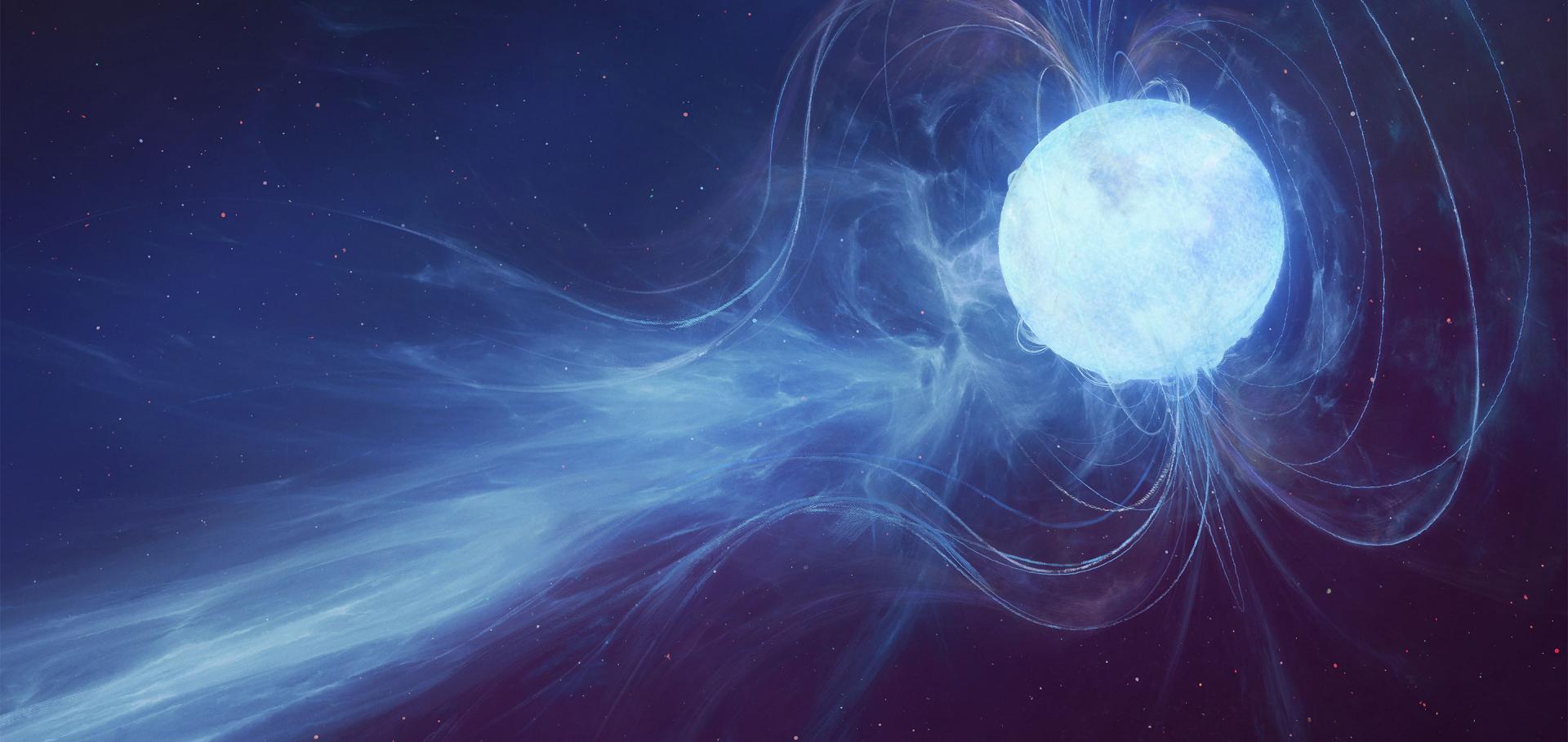
Stellar mergers as the origin of magnetic massive stars
Nature Springer Nature 574 (2019) 211-214
Abstract:
About ten per cent of 'massive' stars (those of more than 1.5 solar masses) have strong, large-scale surface magnetic fields1-3. It has been suggested that merging of main-sequence and pre-main-sequence stars could produce such strong fields4,5, and the predicted fraction of merged massive stars is also about ten per cent6,7. The merger hypothesis is further supported by a lack of magnetic stars in close binaries8,9, which is as expected if mergers produce magnetic stars. Here we report three-dimensional magnetohydrodynamical simulations of the coalescence of two massive stars and follow the evolution of the merged product. Strong magnetic fields are produced in the simulations, and the merged star rejuvenates such that it appears younger and bluer than other coeval stars. This can explain the properties of the magnetic 'blue straggler' star τ Sco in the Upper Scorpius association that has an observationally inferred, apparent age of less than five million years, which is less than half the age of its birth association10. Such massive blue straggler stars seem likely to be progenitors of magnetars, perhaps giving rise to some of the enigmatic fast radio bursts observed11, and their supernovae may be affected by their strong magnetic fields12.Disk-Jet Coupling in the 2017/2018 Outburst of the Galactic Black Hole Candidate X-Ray Binary MAXI J1535-571
Astrophysical Journal American Astronomical Society 883:2 (2019) 198