

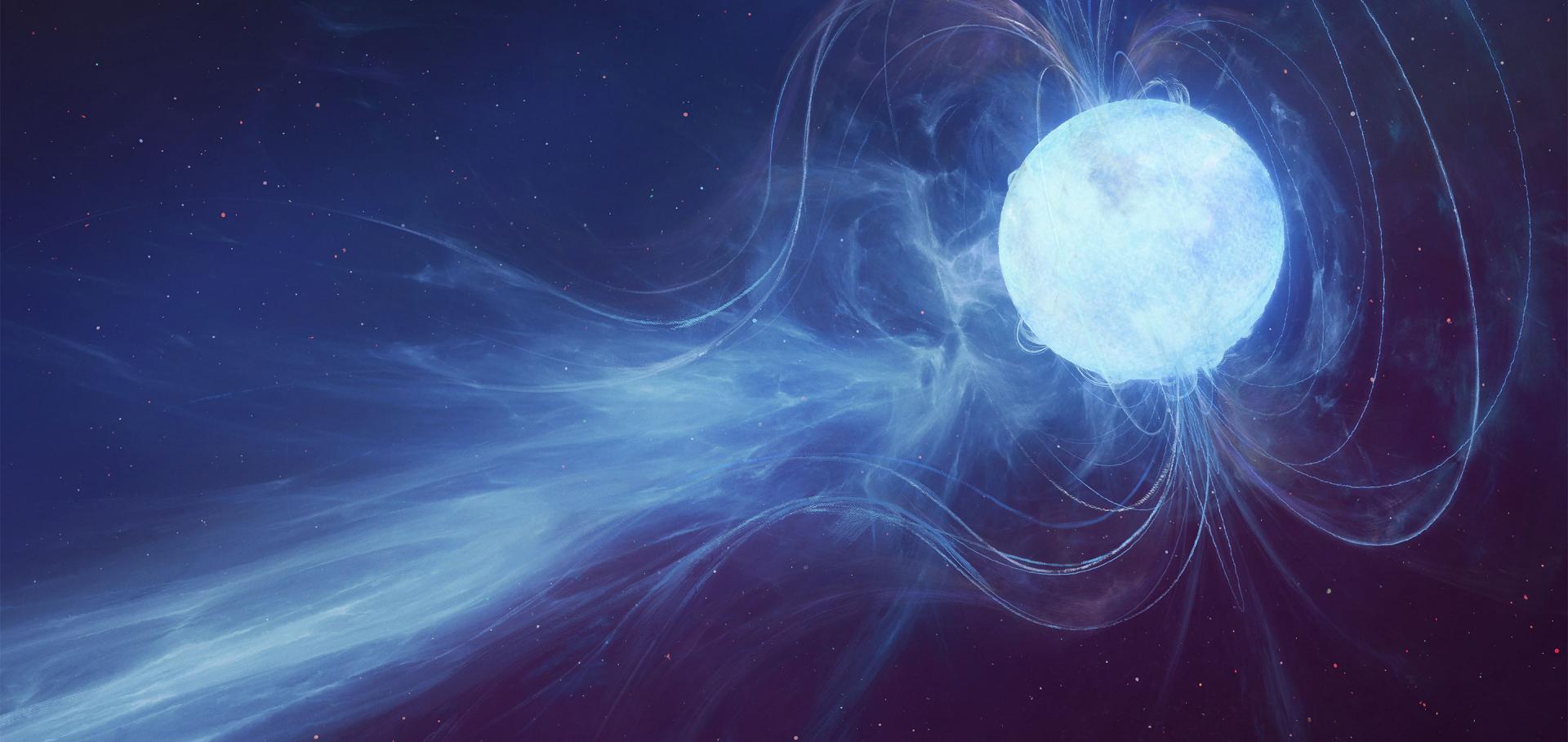
Evidence for an Instability-induced Binary Merger in the Double-peaked, Helium-rich Type IIn Supernova 2023zkd
The Astrophysical Journal American Astronomical Society 989:2 (2025) 182
Abstract:
We present ultraviolet to infrared observations of the extraordinary Type IIn supernova 2023zkd (SN 2023zkd). Photometrically, it exhibits persistent and luminous precursor emission spanning ∼4 yr preceding discovery (Mr ≈ −15 mag, 1500 days in the observer frame), followed by a secondary stage of gradual brightening in its final year. Post-discovery, it exhibits two photometric peaks of comparable brightness (Mr ≲ −18.7 mag and Mr ≈ −18.4 mag, respectively) separated by 240 days. Spectroscopically, SN 2023zkd exhibits highly asymmetric and multicomponent Balmer and He I profiles that we attribute to ejecta interaction with fast-moving (1000–2000 km s−1) He-rich polar material and slow-moving (∼400 km s−1) equatorially distributed H-rich material. He II features also appear during the second light curve peak and evolve rapidly. Shock-driven models fit to the multiband photometry suggest that the event is powered by interaction with ∼5–6 M⊙ of CSM, with 2–3 M⊙ associated with each light curve peak, expelled during mass-loss episodes ∼3–4 yr and ∼1–2 yr prior to explosion. The observed precursor emission, combined with the extreme mass-loss rates required to power each light curve peak, favors either super-Eddington accretion onto a black hole or multiple long-lived eruptions from a massive star to luminosities that have not been previously observed. We consider multiple progenitor scenarios for SN 2023zkd, and find that the brightening optical precursor and inferred explosion properties are most consistent with a massive (MZAMS ≥ 30 M⊙) and partially stripped He star undergoing an instability-induced merger with a black hole companion.New Metrics for Identifying Variables and Transients in Large Astronomical Surveys
(2025)
Evidence for an intrinsic luminosity–decay correlation in GRB radio afterglows
Monthly Notices of the Royal Astronomical Society Oxford University Press 542:3 (2025) 2421-2430
Abstract:
We present the discovery of a correlation, in a sample of 16 gamma-ray burst 8.5 GHz radio afterglows, between the intrinsic luminosity measured at 10 d in the rest frame, , and the average rate of decay past this time, . The correlation has a Spearman’s rank coefficient of at a significance of and a linear regression fit of . This finding suggests that more luminous radio afterglows have higher average rates of decay than less luminous ones. We use a Monte Carlo simulation to show the correlation is not produced by chance or selection effects at a confidence level of . Previous studies found this relation in optical/UV, X-ray, and GeV afterglow light curves, and we have now extended it to radio light curves. The Spearman’s rank coefficients and the linear regression slopes for the correlation in each waveband are all consistent within . We discuss how these new results in the radio band support the effects of observer viewing geometry, and time-varying microphysical parameters, as possible causes of the correlation as suggested in previous works.Evidence for an intrinsic luminosity-decay correlation in GRB radio afterglows
ArXiv 2508.07276 (2025)
3D adiabatic simulations of binary black hole formation in AGN discs
Monthly Notices of the Royal Astronomical Society Oxford University Press 542:2 (2025) 1033-1055