

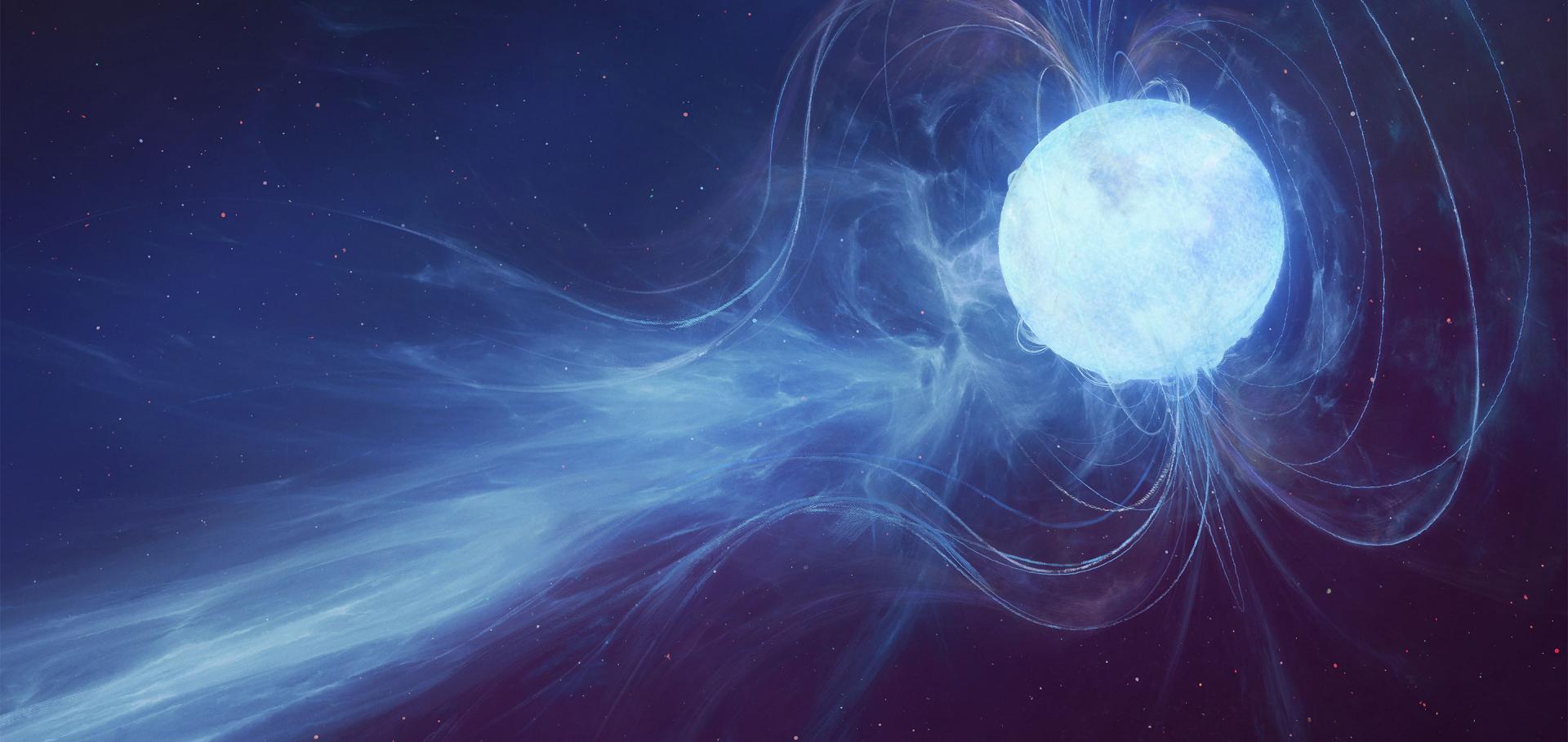
An emission-state-switching radio transient with a 54-minute period
Nature Astronomy Nature Research 8:9 (2024) 1159-1168
Abstract:
Long-period radio transients are an emerging class of extreme astrophysical events of which only three are known. These objects emit highly polarized, coherent pulses of typically a few tens of seconds duration, and minutes to approximately hour-long periods. Although magnetic white dwarfs and magnetars, either isolated or in binary systems, have been invoked to explain these objects, a consensus has not emerged. Here we report on the discovery of ASKAP J193505.1+214841.0 (henceforth ASKAP J1935+2148) with a period of 53.8 minutes showing 3 distinct emission states—a bright pulse state with highly linearly polarized pulses with widths of 10–50 seconds; a weak pulse state that is about 26 times fainter than the bright state with highly circularly polarized pulses of widths of approximately 370 milliseconds; and a quiescent or quenched state with no pulses. The first two states have been observed to progressively evolve over the course of 8 months with the quenched state interspersed between them suggesting physical changes in the region producing the emission. A constraint on the radius of the source for the observed period rules out an isolated magnetic white-dwarf origin. Unlike other long-period sources, ASKAP 1935+2148 shows marked variations in emission modes reminiscent of neutron stars. However, its radio properties challenge our current understanding of neutron-star emission and evolution.Determining the difference between local acceleration and local gravity: applications of the equivalence principle to relativistic trajectories
American Journal of Physics American Association of Physics Teachers 92:6 (2024) 444-449
Abstract:
We show by direct calculation that the common equivalence principle explanation for why gravity must deflect light is quantitatively incorrect by a factor of three in Schwarzschild geometry. It is, therefore, possible, at least as a matter of principle, to tell the difference between local acceleration and a true gravitational field by measuring the local deflection of light. We calculate as well the deflection of test particles of arbitrary energy and construct a leading-order coordinate transformation from Schwarzschild to local inertial coordinates, which shows explicitly how the effects of spatial curvature manifest locally for relativistic trajectories of both finite and vanishing rest mass particles.SN 2020pvb: A Type IIn-P supernova with a precursor outburst
Astronomy & Astrophysics EDP Sciences 686 (2024) a13
Spectrum and extension of the inverse-Compton emission of the Crab Nebula from a combined Fermi-LAT and H.E.S.S. analysis
Astronomy & Astrophysics EDP Sciences 686 (2024) a308
The dense and non-homogeneous circumstellar medium revealed in radio wavelengths around the Type Ib SN 2019oys★
Astronomy & Astrophysics EDP Sciences 686 (2024) a129