

A search for dark matter produced in association with a dark Higgs boson decaying into a Higgs boson pair in 3 b or 4 b final states using pp collisions at s = 13 TeV with the ATLAS detector
Journal of High Energy Physics Springer 2025:9 (2025) 67
Abstract:
A search is performed for dark matter particles produced in association with a resonant pair of Higgs bosons using 140 fb−1 of proton-proton collisions at a centre-of-mass energy of 13 TeV recorded by the ATLAS detector at the Large Hadron Collider. This signature is expected in some extensions of the Standard Model predicting the production of dark matter particles, and is interpreted in terms of a dark Higgs model containing a Z′ mediator in which the dark Higgs boson s decays into a pair of Higgs bosons. The dark Higgs boson is reconstructed through final states with at least three b-tagged jets, produced by the pair of Higgs boson decays, in events with significant missing transverse momentum consistent with the presence of dark matter. The observed data are found to be in good agreement with Standard Model predictions, constraining scenarios with dark Higgs boson masses within the range of 250 to 400 GeV and Z′ mediators up to 2.3 TeV.Evidence for inverse Compton scattering in high-redshift Lyman-break galaxies
(2025)
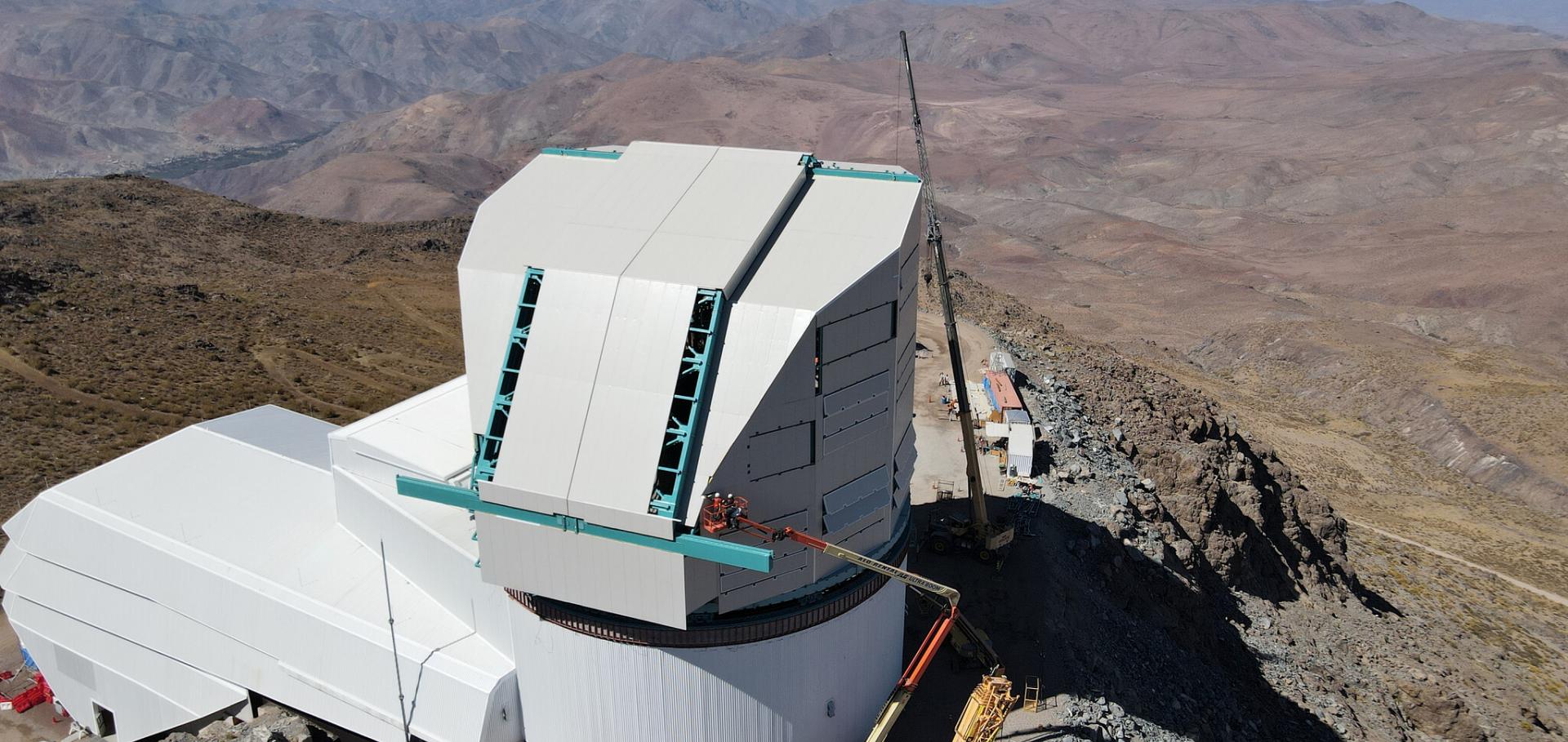
The Visibility of the Ōtautahi–Oxford Interstellar Object Population Model in LSST
The Planetary Science Journal IOP Publishing 6:9 (2025) 214
Abstract:
With a new probabilistic technique for sampling interstellar object (ISO) orbits with high efficiency, we assess the observability of ISOs under a realistic cadence for the upcoming Vera C. Rubin Observatory’s Legacy Survey of Space and Time (LSST). Using the Ōtautahi–Oxford population model, we show that there will be complex on-sky structure in the pattern of direction and velocity revealed by the detected ISO population, with the expected enhanced northern flux complicating efforts to derive population parameters from the LSST’s predominately southern footprint. For reasonable luminosity functions with slopes of 2.5 ≤ qs ≤ 4.0, the most discoverable ISOs have Hr ≃ 14.6−20.7. The slope of the luminosity function of ISOs will be relatively quickly constrained by the characteristics of the LSST detected population, such as the distributions of perihelia, velocity at infinity, and discovery circumstances. Discoveries are evenly split around their perihelion passage and are biased to lower velocities. After their discovery by LSST, it will be rare for ISOs to be visible for less than a month; most will have mr ≤ 23 for months, and the window for spectroscopic characterization could be as long as 2 yr. While these probabilistic assessments are robust against model or spatial density refinements that change the absolute numbers of ISO discoveries, our simulations predict a yield of 6–51 asteroidal ISOs, which is similar to previous works and demonstrates the validity of our new methods.Spatial and temporal evaluations of the liquid argon purity in ProtoDUNE-SP
Journal of Instrumentation IOP Publishing 20:09 (2025) P09008
Abstract:
Liquid argon time projection chambers (LArTPCs) rely on highly pure argon to ensure that ionization electrons produced by charged particles reach readout arrays. ProtoDUNE Single-Phase (ProtoDUNE-SP) was an approximately 700-ton liquid argon detector intended to prototype the Deep Underground Neutrino Experiment (DUNE) Far Detector Horizontal Drift module. It contains two drift volumes bisected by the cathode plane assembly, which is biased to create an almost uniform electric field in both volumes. The DUNE Far Detector modules must have robust cryogenic systems capable of filtering argon and supplying the TPC with clean liquid. This paper will explore comparisons of the argon purity measured by the purity monitors with those measured using muons in the TPC from October 2018 to November 2018. A new method is introduced to measure the liquid argon purity in the TPC using muons crossing both drift volumes of ProtoDUNE-SP. For extended periods on the timescale of weeks, the drift electron lifetime was measured to be above 30 ms using both systems. A particular focus will be placed on the measured purity of argon as a function of position in the detector.A precise measurement of the jet energy scale derived from single-particle measurements and in situ techniques in proton–proton collisions at $$\sqrt{s}=$$ 13 TeV with the ATLAS detector
The European Physical Journal C SpringerOpen 85:9 (2025) 927