

Particle Physics Summer Internships for 2026 - Applications now closed
Oxford Particle Physics is running a summer internship programme for undergraduate physics students from UK Universities. Priority will be given to students in their second year and above. Students will work with a supervisor in the department, usually a postdoctoral researcher or lecturer, on a self-contained project. Students are encouraged to take part in department life, joining researchers for coffee, discussions and seminars.
The projects run for typically 8 weeks, nominally 1 July through to the end of August. Students will be paid as employees of the University, receiving a payment of at the Oxford living wage (subject to tax and National Insurance deductions). Students are normally expected to work full time on their project, but hours can be discussed with your supervisor.
Eligibility
Unfortunately, due to UK visa regulations, we are only able to accept applications from candidates who do not require a visa to work in the UK. EU students currently in the UK who have been granted Pre-Settled Status are also welcome to apply along with current students in the UK on a Tier 4 visa that allows vacation employment. If you have queries about your personal circumstances, please get in touch with Kim Proudfoot at ppadmin@physics.ox.ac.uk. Please be aware that unfortunately there are no exceptions to these criteria.
How to apply
To apply, submit a 1-page CV and a 1-page cover letter (in a single PDF file).
Please use this form to apply.
For any administrative issues and referees please contact ppgradadmin@ox.ac.uk
The 1-page cover letter should briefly mention the following, bearing in mind the one page limit:
On your 1-page application, you should tell us why you are interested in the programme and which project(s) most interest you. Also include your contact details, your year and course, and contact details (including email) of your academic referee. Please also mention any computer programming experience and any previous research experience that you have had. You are welcome to informally contact the supervisor(s) to find out more details about the projects that interest you.
The deadline for applications and references is TBC.
Projects
The CERN Linear Electron Accelerator for R&D
Supervisor: Professor Philip Burrows (philip.burrows@physics.ox.ac.uk)
The CERN Linear Electron Accelerator for R&D – has been commissioned and experiments are taking place on the beamline. The intern will have the opportunity to work on simulation studies for operating and upgrading the 220 MeV electron beamline. There are also opportunities for working on simulations of novel beam position monitors and high-gradient radio-frequency accelerating cavities.
SNO+
Supervisors: Professor Steven Biller (steve.biller@physics.ox.ac.uk)
Professor Jeff Tseng (jeff.tseng@physics.ox.ac.uk)
Professor Armin Reichold (armin.reichold@physics.ox.ac.uk)
SNO+ is a large-scale liquid scintillation detector current operating in Sudbury, Canada. It has a diverse programme of physics, including measuring oscillations of reactor ant-neutrinos, studying geo-antineutrinos, solar neutrinos and supernova neutrinos. With the addition of Tellurium to the detector in 2025, it will also perform a sensitive search for neutrinoless double beta decay. The summer project student will help study event reconstruction and the identification of backgrounds to varisou physics analyses. Some knowledge of programming in C++ and python would be beneficial.
PaMIr+: 2026 Summer Placements
Supervisor: Professor Armin Reichold (armin.reichold@physics.ox.ac.uk)
PaMIr is short for Phase Modulation Interferometry. The PaMIr group is developing and testing a novel method to interferometrically measure rapid displacements with high accuracy and time resolution as well as low latency on a large number of interferometers simultaneously. PaMIr can measure high speed (1 m/s) displacement up to 20m with nm accuracy, which has many applications in science and industry. We are currently characterising a real-time, commercial prototype of our interferometer together with our industrial partner Etalon as well as making precision studies of the ultimate performance of the technique. PaMIr+ summer students will help to improve the performance of the interferometer, using ML techniques:
PaMIr is designed to become a plug-compatible extension to our Frequency Scanning Interferometry technology which measure absolute optical path differences and it is now used in its commercial form (Absolute Multiline™) in many scientific projects in accelerator science, particle physics, astrophysics and many industrial settings. Our technology already has applications in many large-scale science experiments. Among them are the alignment of the crab cavities in the upgrade HL-LHC, control of undulators at LCLS-II (Linac Coherent Light Source at SLAC), relative positioning of the primary and secondary mirrors of several next generation telescopes (GMT, EELT, KECK), as well as future measurements of deployable space antennae on satellites.
In our next step this summer we aim to combine PaMIr with its nm accuracy for high speed (1 m/s) displacement sensing with our FSI technology. We are now in the brain storming period of this project and are looking for a motivated summer student to simulate and test various methods for combination. We have enjoyed input from seven summer students and two MPhys students to date who have been great contributors to our research.
Work in the PaMIr group requires understanding of second year wave optics, in particular lasers and interferometry. Some familiarity with Python or Matlab and Simulink as well as second year mathematics is required for this project. Knowledge of C++ and GPU programming can be beneficial. Familiarity with version control using Git would also be a useful skill. For the lab work, skills in setting up optics and opto-mechanics will be beneficial. Interested applicants can discuss project options Prof Armin Reichold (armin.reichold@physics.ox.ac.uk).
Modelling proton-proton collisions
Supervisor: Professor Chris Hays (chris.hays@physics.ox.ac.uk)
The Large-Hadron Collider accelerates protons to more than 7000 times their rest mass, and collides them head-on with other protons with the same energy. This results in a mess of hadrons produced through quantum-chromodynamical processes that cannot be calculated, but instead are empirically modelled using Monte Carlo generators. This project will investigate the latest generators and their model parameters, in order to determine how well they describe measurements of hadron production and whether they can be improved. The models are crucial for a wide range of measurements at the LHC, including those of Higgs bosons, top quarks, and W bosons, and in particular for the precision measurement of the W boson mass.
Instrumentation development to search for dark matter with the DarkSide-20k Experiment
Supervisor: Professor Jocelyn Monroe (jocelyn.monroe@physics.ox.ac.uk)
This project will involve performance qualification of silicon photon sensors employed in the DarkSide-20k experiment. DarkSide-20k searches for dark matter particles, gravitationally bound to our galaxy, interacting in an ultra-sensitive terrestrial detector.
The signature of dark matter interactions in DarkSide-20k is light produced by the argon target. This light signal is detected by novel silicon photon detectors, composed of arrays of silicon photomultipliers (SiPMs), assembled into photon detection modules.
You will learn to measure the photon detection performance of these cutting-edge silicon detectors, employ calibration techniques and develop data analysis skills.
The project aims are for you to learn new skills in research at the low background frontier of particle physics, to contribute to the delivery of the silicon detector readout system that instruments part of the international DarkSide-20k experiment, currently under construction at the LNGS laboratory in Italy; and to gain experience with working as part of a research team.
Entry requirements
You should have, or be studying, a degree in physics, engineering or computer science; you should have laboratory experience; and, a working knowledge of python would be helpful.
Simulating detector designs for the ePIC and future experiments
Supervisor: Dr Sam Henry (samuel.henry@physics.ox.ac.uk)
Prof Todd Huffman (todd.huffman@physics.ox.ac.uk)
Simulating the transport and interaction of particles within the complex environment of a collider experiment is a central component of particle physics analysis. The development of simulation software must proceed alongside the design and construction of a new detector.
This project focusses on developing simulation software for the silicon vertex detector of the ePIC (electron Proton / Ion Collider) experiment, which will study collision of electrons with protons and heavy ions at the Brookhaven National Laboratory in New York. The science goal of ePIC is to explore the inner structure of the proton and the interactions of quarks and gluons. Achieving this will require an innovative detector design to track the trajectories of particles to high precision, while keeping the material budget in the inner volume low.
The student will part an active role, enhancing prototype software to better model the detector geometry, and then running simulations to evaluate the detector performance. There is scope to simulate future detector concepts and investigate what might be possible with next-generation technology. This may involve using AI techniques to convert CAD files to simulation-ready geometries, and developing benchmark studies to assess the expected performance of physics studies from different designs.
AI techniques for liquid argon neutrino detector measurements
Supervisor: Prof Morgan Wascko (morgan.wascko@physics.ox.ac.uk)
Why is the universe made of matter and not antimatter? Neutrino oscillations and interactions with matter give hints to this and more big questions in Particle Physics.
The main objective of this project is application of AI techniques to measurements of hadron-argon interaction cross sections using existing data from the ProtoDUNE liquid argon neutrino detectors at CERN. These are prototype detectors for the gigantic liquid argon detectors that will be built in the USA for the DUNE project. The Oxford neutrino group plays an important role in DUNE and ProtoDUNE, and you will be able to work within this research group and make a new measurement of hadron-argon scattering. Most of the work will be done using python or C++, but expertise in those languages is not required.
Summer intern placement on the ATLAS experiment, July and August.
Supervisor: Dr Umberto Molinatti (umberto.molinatti@physics.ox.ac.uk)
The Oxford Physics Microstructure Detector (OPMD) group develops state-of-the-art silicon detectors for Particle Physics and Astrophysics experiments. To support this work, we operate a cutting-edge 160m² cleanroom facility.
These advanced sensors are at the heart of modern Particle Physics detectors, such as those at the Large Hadron Collider (LHC) at CERN, as well as key components in telescopes, atom interferometers, and other high-precision instrumentation. As such, they play a critical role in some of the most active and pioneering fields of research today.
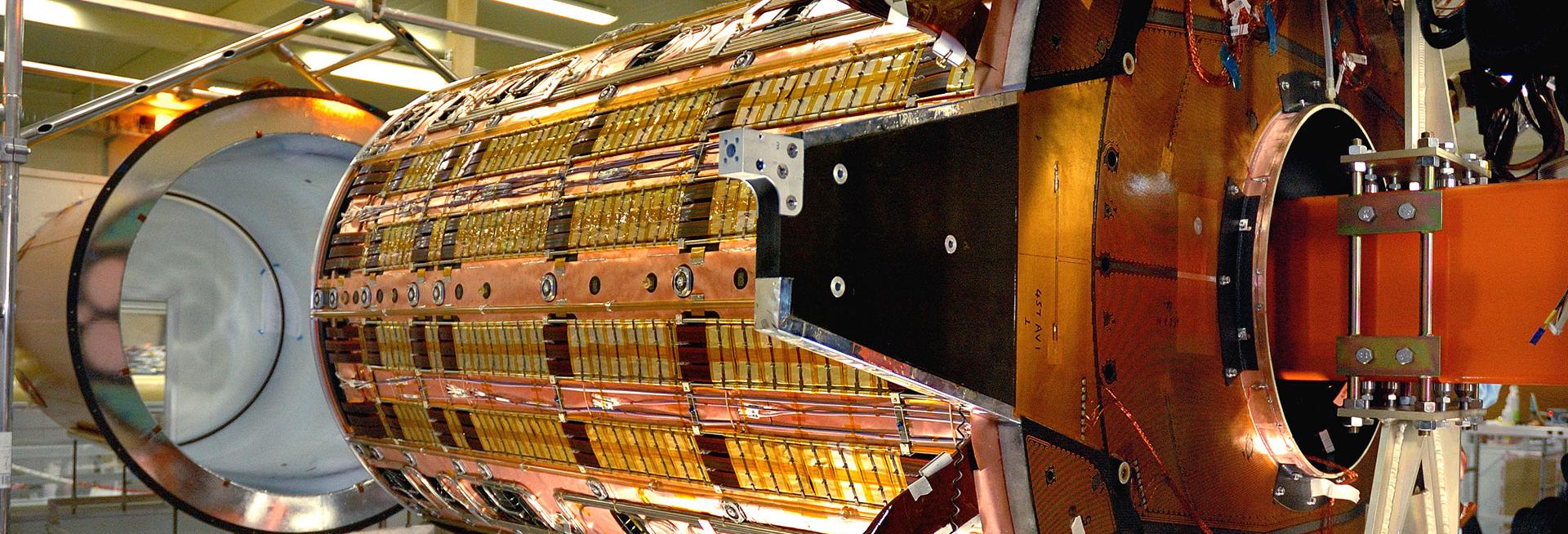
OPMD is a major contributor to the ATLAS experiment, one of the four flagship experiments at the LHC, designed to probe the depths of the Standard Model and explore physics beyond it. Oxford is responsible for constructing the Inner Tracker Outer Barrel Endcap, in collaboration with other UK institutions. This component will enable precise tracking of particles emerging from high-angle interactions, forming a crucial part of the next-generation detector that will replace the current system at the LHC. As construction progresses, we are seeking a highly motivated summer student to contribute to this effort.
This is a hands-on opportunity to work closely with applied physicists and technicians in our state-of-the-art ISO7 (Class 10k) cleanroom facility in central Oxford. The role will involve key aspects of module quality control, streamlining electrical testing procedures, and programming an automated testing setup to significantly enhance efficiency and accuracy.
You will be setting up and performing quality control measurements, testing pixel detectors for the ATLAS Inner Tracker, investigating methods to improve module performance, and helping to develop our production routines. This will provide a unique experience with direct contact with cutting-edge detector technologies and silicon handling and testing techniques. The ATLAS Inner Tracker is scheduled to be installed and operational in 2028 so this is a rare opportunity to take part in the construction of an upcoming large-scale Particle Physics experiment. The experience gained will provide a strong technical foundation for future research and could open pathways to further academic opportunities.
Energy Absorption Interferometry for Probing the Dynamical Behaviour of Many Body Quantum Systems
Supervisor: Professor Stafford Withington (stafford.withington@physics.ox.ac.uk)
Energy Absorption Interferometry (EAI) is a technique for measuring the responsivities and complex-valued spatial polarimetric forms of the individual degrees of freedom through which a many-body system can absorb energy. It was originally formulated, (Withington, Phys. Rev. A 96, 022131, 2017) using the language of quantum correlation functions, making it applicable to different kinds of excitation (electromagnetic, elastic and acoustic fields). Since that time, it has been developed and used experimentally at various wavelengths (1-3 mm, 360-110 um, and 1500nm). EAI can also be used as a powerful numerical tool to study the properties of complex structures, such as plasmonic materials and structured emitters and absorbers, spin waves in magnetic materials, acoustic absorption in non-homogenous bodies, and applications in characterising detectors being developed for particle physics. It has found a major application in characterising the behaviour of near-quantum-noise limited detector arrays being developed for the next FIR space telescope (PRIMA).
A review was published recently (Withington arXiv.2602.00745), which extends the analysis and provides a noise model. During the course of the project the student will develop a package of software for modelling the behaviour of a generic EAI system, including calculations of how experimental noise propagates through to error bars on modal spectra and spatial plots.
LZ data analysis and XLZD R&D
Supervisor: Professor Kimberly Palladino (kimberly.palladino@physics.ox.ac.uk)
In this role a student will perform analysis on LZ’s large dataset, primarily working in Python. We are seeking to improve our low energy threshold event reconstruction and background rejection. Both cuts and reconstruction benefit from the use of machine Learning and our group is using a variety of algorithms on both event waveforms and reconstructed variables. In addition, students may be involved with testing in laboratory of new hardware concepts for a future XLZD detector, including a composite field cage design.