

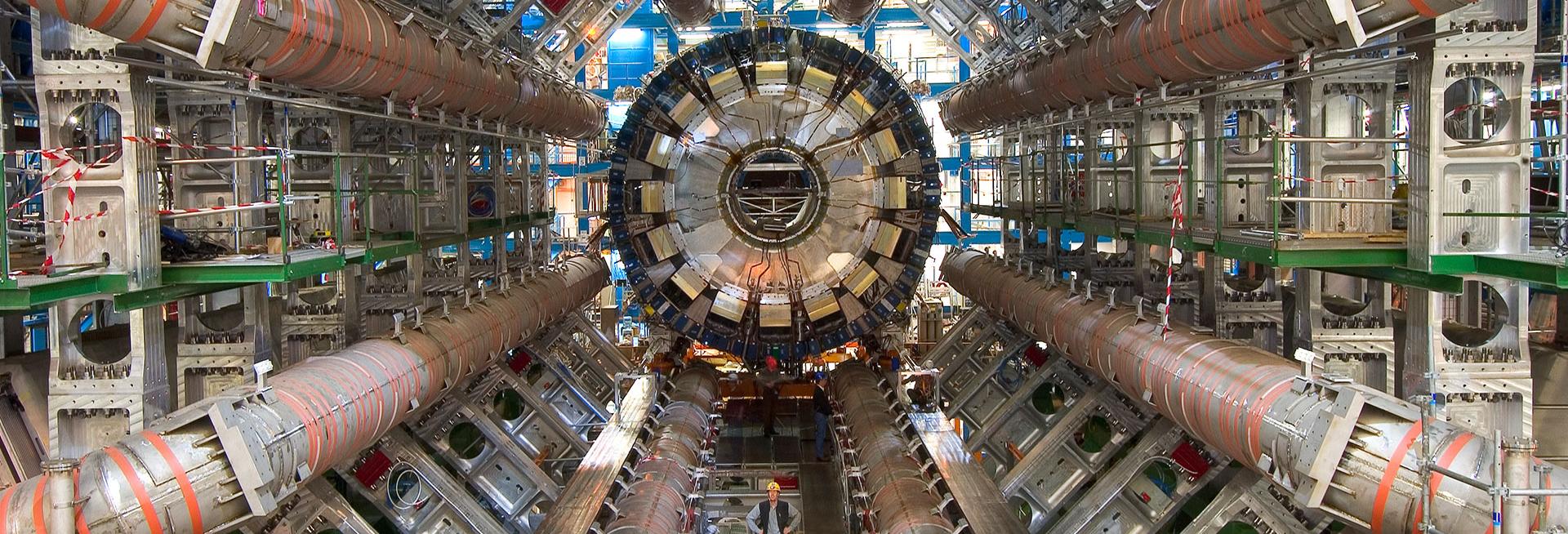
A DPhil (PhD) in Particle Physics may be pursued across a wide range of topics from the study of new particles produced at the energy frontier, to neutrinos, dark matter, and dark energy and development of the accelerators and detector technologies vital to this science.
Oxford’s particle physics subdepartment is one of the largest such groups in the world; it includes 25 academics and almost 50 research and technical staff and we support more than 50 postgraduate research students. Our doctoral students have the opportunity to conduct world-class physics research: our portfolio includes membership of ATLAS and LHCb collaborations at the Large Hadron Collider, CERN; the DUNE long-baseline neutrino experiment, MicroBooNE and the LZ dark matter direct detection experiment in the USA; T2K, Super-K and Hyper-K in Japan; the Mu3e experiments at PSI; BES-III experiment in China; the Rubin-LSST programme in Chile, the AION experiment in Oxford, SNO+ in Canada and other experiments by bespoke arrangement. We play a leading role in exploiting existing facilities, and the design and development of future experiments with a state of the art clean room, workshops and a huge experimental assembly area. We host the John Adams Institute for accelerator science (JAI), which offers students the opportunity to pursue accelerator physics DPhil projects at CERN (HL-LHC, CLIC, FCC, AWAKE), the Diamond Light Source, the ISIS neutron/muon source, and the Central Laser Facility at the Harwell campus, as well as at other laboratories including DESY, Hamburg (FLASHForward, HALHF) and KEK, Japan (ILC, ATF2).
Eligibility
Successful applicants will typically have a master's level degree with honours in physics. A bachelor's degree in physics with a minimum four years standard duration may be acceptable if particle physics options have been chosen. Candidates graduating in other subjects but wishing to pursue particle physics should discuss with specific academics before applying to ensure a suitable project could be offered.
On-course obligations
Once a place is offered and funding confirmed, graduate students join us in week 0 of the following Michaelmas Term; deferred entry is not possible. In the first year, the sub-department provides a course of short modules on topics of general relevance to a particle or accelerator physicist. Assessment is conducted by coursework or viva voce and participation in the course is mandatory to transfer into the second year. Thesis submission is expected to be within four years and must document a significant contribution to a specialist field.
Online "open day"
To find out more, please attend the online Particle Physics Graduate Open Day. A presentation of opportunities will be given, plus a closed Q&A session with our current students (only). Everyone is welcome. The next one will be;
Monday 7 December 2026, 11:00 GMT.
To register, complete this online form and a link will be provided close to the date. Privacy notice: The information you provide will only be used for this event. For additional information about our privacy practices, please see here.
Funding
Read comprehensive information on fees and funding for graduate students. Please note that to be considered for research council funding and most scholarships, applications must be submitted before the earlier deadline (i.e. January, not March).
How to apply
All applications must be made through the central University of Oxford graduate admissions website where you will find information about applying to any of the six DPhil courses on offer at the Department of Physics.
It is important to note that you are not required to select a final project or supervisor at the point of application; while it is useful for us to know the broad areas you are interested in, we do not expect you to have made a final decision on your preferred projects and there will be opportunities to discuss your interests before offers are made.
Important Notice - Applicants are required to submit an application for each Physics DPhil Course they are interested in, noting that you are allowed to apply to a maximum of 3 PGR courses total. If you wish to apply for more than 3 courses, please write to the relevant administrator for advice.